
 Deutsch
 English
 Français
 Español
 Italiano
 Nederlands
 Português
 Slovenčina
 Hrvatski
 Slovenščina
 Lietuvių
 Eesti
Eesti Български

CC 382 2020
Coincard
BU
Coincard
Lithuania · Aukschtaitien (Series: Lithuanian Ethnographic Regions)
Mintage5,000
Issue price€9.00
Issue date16 Sept 2020
PackagingCoincard
Edge letteringLAISVĖ ★ VIENYBĖ ★ GEROVĖ ★
Market price€69.00
Issue occasion
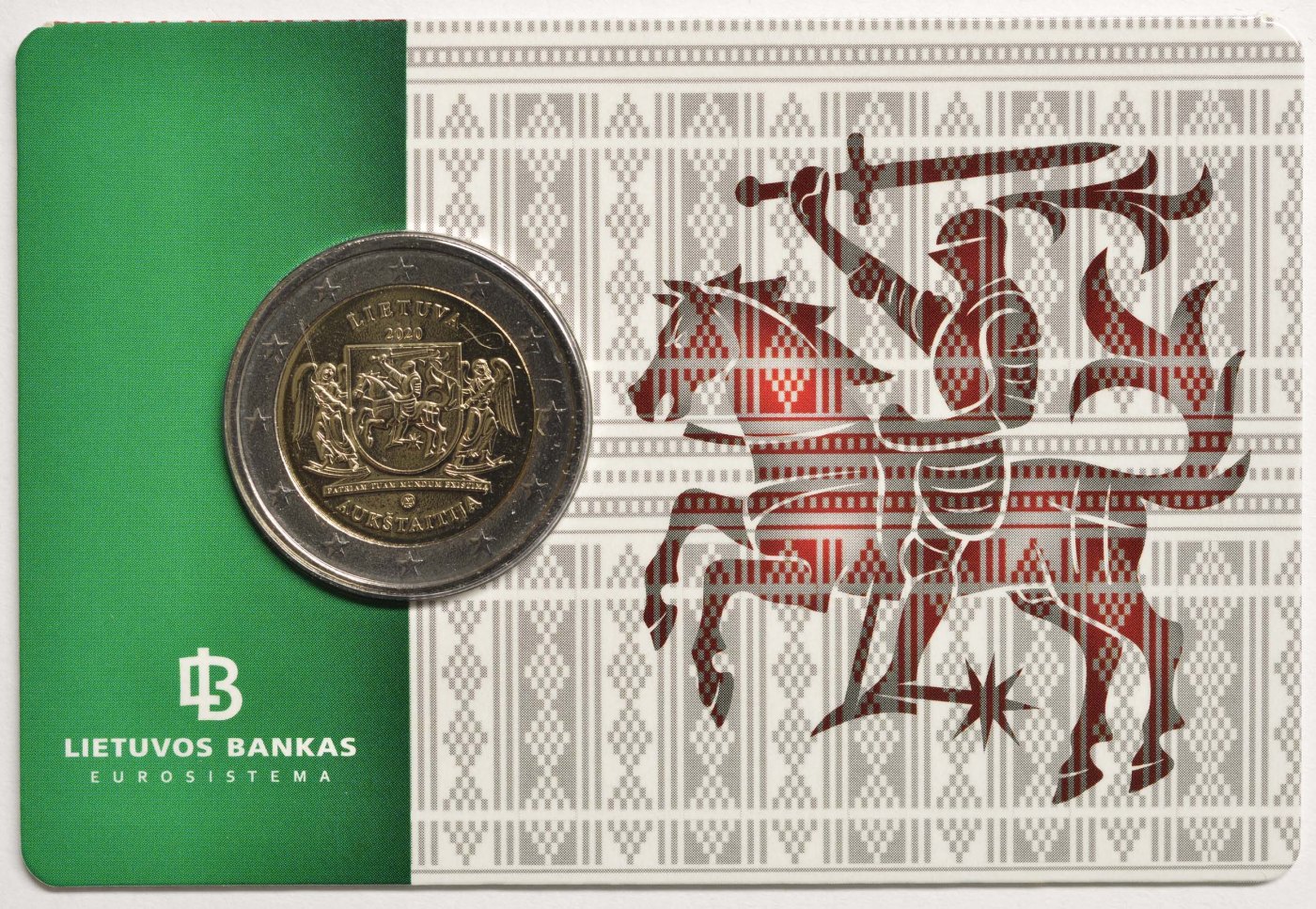
The coin is dedicated to Aukštaitija (Upper Lithuania), one of Lithuania’s most important ethnographic regions and the cradle of its statehood. The design shows a coat of arms held by two angels, featuring a knight in armor carrying a sword in his right hand. Beneath the coat of arms is the Latin inscription “PATRIAM TUAM MUNDUM EXISTIMA” (“Consider your homeland the whole world”); the design is complemented by the inscriptions “LIETUVA” and “AUKŠTAITIJA”.
The design
The coin design features a coat of arms depicting a knight in armour holding a sword in his right hand. The coat of arms is held by two angels who praise and protect Aukštaitija – one of Lithuania’s most significant regions and the cradle of its statehood.
Below the coat of arms is the Latin inscription PATRIAM TUAM MUNDUM EXISTIMA (CONSIDER YOUR HOMELAND THE WHOLE WORLD).
The coat of arms is framed by two inscriptions: “LIETUVA” (Lithuania), “AUKŠTAITIJA”, the year of issue “2020” and the mark of the Lithuanian Mint.
The twelve stars of the European flag are depicted on the outer ring of the coin.
Below the coat of arms is the Latin inscription PATRIAM TUAM MUNDUM EXISTIMA (CONSIDER YOUR HOMELAND THE WHOLE WORLD).
The coat of arms is framed by two inscriptions: “LIETUVA” (Lithuania), “AUKŠTAITIJA”, the year of issue “2020” and the mark of the Lithuanian Mint.
The twelve stars of the European flag are depicted on the outer ring of the coin.
Background on the topic
Aukštaitija is not an administrative unit with defined political boundaries, but a historically and ethnographically defined cultural region in eastern and northeastern Lithuania. Its name means roughly “highland” and contrasts with Žemaitija, the “lowland” in the west. Depending on whether linguistic, historical or folkloric characteristics are taken into account, its geographical boundaries may vary.
Early centres of rule in medieval Lithuania were located in this area. These included Kernavė, which emerged as a political and economic centre in the 13th century. The area around Vilnius is also considered part of the Aukštaitian cultural region. From these eastern core lands, the Grand Duchy of Lithuania (Großfürstentum Litauen) developed, later encompassing large parts of Eastern Europe. The name Aukštaitija is already known from medieval sources and served to distinguish the region from Žemaitija.
Language is also important to the region’s cultural distinctiveness. Aukštaitian, alongside Žemaitian, forms one of the two major dialect groups of Lithuanian. The modern Lithuanian standard language is based primarily on western Aukštaitian dialects. Nevertheless, significant linguistic and folkloric differences exist within the region. Traditional architectural forms, songs, textiles and customs are therefore not preserved in the same way everywhere.
The knight on the regional coat of arms refers to Lithuanian heraldry and the medieval military and ruling tradition. However, it is not to be equated with the Lithuanian state coat of arms, “Vytis”, which depicts a mounted knight. The coat of arms of Aukštaitija is a modern heraldic representation of regional identity; the angels serve as shield supporters, as known from European heraldic art.
The issue forms part of Lithuania’s engagement with its ethnographic regions. Although these have no separate state or administrative status, they serve as points of reference for dialects, traditions and regional self-identification. The coin series transfers this cultural structure to a means of payment circulating throughout the country and the euro area.
Early centres of rule in medieval Lithuania were located in this area. These included Kernavė, which emerged as a political and economic centre in the 13th century. The area around Vilnius is also considered part of the Aukštaitian cultural region. From these eastern core lands, the Grand Duchy of Lithuania (Großfürstentum Litauen) developed, later encompassing large parts of Eastern Europe. The name Aukštaitija is already known from medieval sources and served to distinguish the region from Žemaitija.
Language is also important to the region’s cultural distinctiveness. Aukštaitian, alongside Žemaitian, forms one of the two major dialect groups of Lithuanian. The modern Lithuanian standard language is based primarily on western Aukštaitian dialects. Nevertheless, significant linguistic and folkloric differences exist within the region. Traditional architectural forms, songs, textiles and customs are therefore not preserved in the same way everywhere.
The knight on the regional coat of arms refers to Lithuanian heraldry and the medieval military and ruling tradition. However, it is not to be equated with the Lithuanian state coat of arms, “Vytis”, which depicts a mounted knight. The coat of arms of Aukštaitija is a modern heraldic representation of regional identity; the angels serve as shield supporters, as known from European heraldic art.
The issue forms part of Lithuania’s engagement with its ethnographic regions. Although these have no separate state or administrative status, they serve as points of reference for dialects, traditions and regional self-identification. The coin series transfers this cultural structure to a means of payment circulating throughout the country and the euro area.