
 Deutsch
 English
 Français
 Español
 Italiano
 Nederlands
 Português
 Slovenčina
 Hrvatski
 Slovenščina
 Lietuvių
 Eesti
Eesti Български


CC 276 2017
2 euro coin
Proof
2 Euro Proof
Italy · 2000th anniversary of the death of Titus Livius
Mintage7,000
Issue price€22.00
Issue date23 Jun 2017
Packagingin case
Edge lettering2 ★ × 6, alternately upright/inverted
Market price€179.00
Issue occasion
The coin commemorates the two-thousandth anniversary of the death of the Roman historian Titus Livius. The design shows his bust based on a work by Lorenzo Larese Moretti, surrounded by a circle of dots and the inscription “TITO • LIVIO”. Also depicted are the emblem of the Italian Republic “RI”, the initials of the engraver Claudia Momoni “C.M.”, the years “17” and “2017”, and the mint mark “R” of the Mint of Rome.
The design
Bust of the Roman historian Titus Livius based on a work by Lorenzo Larese Moretti; on the left are the emblem of the Italian Republic “RI” and the initials of the engraver Claudia Momoni “C.M.”; on the right are the numbers “17” and “2017”, i.e. the year of Livius’s death and the year the coin was issued, respectively, as well as the mintmark of the Rome Mint “R”; surrounding them are a circle of dots and the inscription “TITO • LIVIO”.
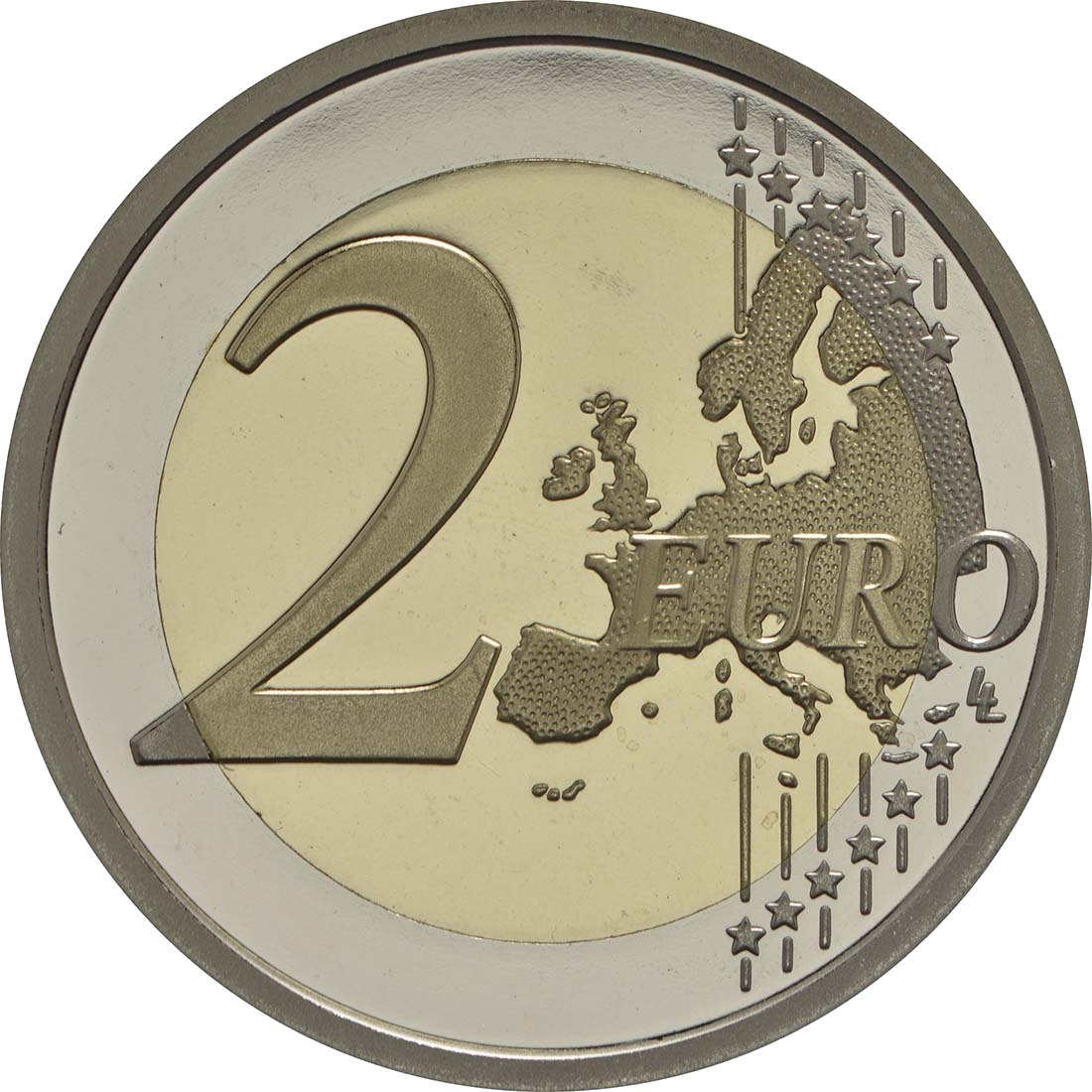
The twelve stars of the European flag are depicted on the coin’s outer ring.
The twelve stars of the European flag are depicted on the coin’s outer ring.
Background on the topic
Titus Livius was born in 59 BC in Patavium, present-day Padua. He lived in a time of profound political change: the Roman Republic disintegrated as a result of civil wars, while a monarchically shaped system of government emerged under Augustus. Unlike many Roman historians, Livius, as far as is known, held neither a senatorial office nor a military command. He devoted most of his activity to presenting Rome’s past.
His principal work bears the title “Ab urbe condita”, meaning “From the Founding of the City”. It comprised 142 books and recounted the history of Rome from its mythical beginnings to the time of Augustus. Only 35 books have survived in full; summaries and individual fragments are known from further sections. The surviving sections include accounts of the early Republic as well as the Second Punic War (Zweiter Punischer Krieg) against Carthage and Hannibal.
Livius drew on earlier Roman historical works and arranged the material predominantly by year. His account was not intended merely to record events. Through its portrayal of individuals and conflicts, it presented forms of behaviour such as the fulfilment of duty, ambition, loyalty and abuse of power. Speeches by historical actors were given literary form and served to explain political decisions and moral conflicts. Modern scholarship therefore distinguishes between the source value of his information and the narrative form of his work.
Livius has been read intensively since the Renaissance. Niccolò Machiavelli took the first ten books as the starting point for his “Discorsi” on republican order, political institutions and the preservation of state freedom. In this way, Livius influenced European political thought far beyond ancient historiography.
For Italy, the remembrance of him connects Roman heritage with a specific regional origin in Padua. The round anniversary therefore provided a comprehensible occasion to honour an ancient author whose portrayal permanently helped shape the later image of Roman history.
His principal work bears the title “Ab urbe condita”, meaning “From the Founding of the City”. It comprised 142 books and recounted the history of Rome from its mythical beginnings to the time of Augustus. Only 35 books have survived in full; summaries and individual fragments are known from further sections. The surviving sections include accounts of the early Republic as well as the Second Punic War (Zweiter Punischer Krieg) against Carthage and Hannibal.
Livius drew on earlier Roman historical works and arranged the material predominantly by year. His account was not intended merely to record events. Through its portrayal of individuals and conflicts, it presented forms of behaviour such as the fulfilment of duty, ambition, loyalty and abuse of power. Speeches by historical actors were given literary form and served to explain political decisions and moral conflicts. Modern scholarship therefore distinguishes between the source value of his information and the narrative form of his work.
Livius has been read intensively since the Renaissance. Niccolò Machiavelli took the first ten books as the starting point for his “Discorsi” on republican order, political institutions and the preservation of state freedom. In this way, Livius influenced European political thought far beyond ancient historiography.
For Italy, the remembrance of him connects Roman heritage with a specific regional origin in Padua. The round anniversary therefore provided a comprehensible occasion to honour an ancient author whose portrayal permanently helped shape the later image of Roman history.
eBay price analysis
For this issue, there is a price history based on actual eBay sales – with median, range and number of sales
View price analysis