
 Deutsch
 English
 Français
 Español
 Italiano
 Nederlands
 Português
 Slovenčina
 Hrvatski
 Slovenščina
 Lietuvių
 Eesti
Eesti Български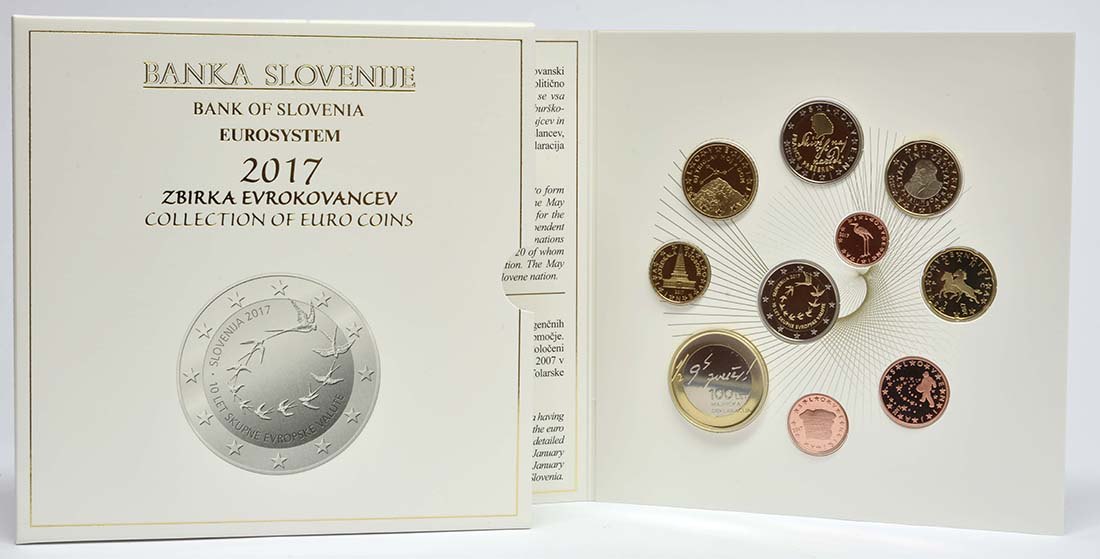
CC 266 2017
Coin set
Proof
Coin set proof
Slovenia · 10th anniversary of the introduction of the euro in Slovenia
Mintage1,000
Issue price€60.00
Issue date2 Feb 2017
PackagingCoin set
Edge letteringSLOVENIJA •
Market price€67.00
Issue occasion
The commemorative coin marks the 10th anniversary of the introduction of the euro in Slovenia. The design shows ten flying swallows forming a circle. The semicircular inscription “10 LET SKUPNE EVROPSKE VALUTE” and “SLOVENIJA 2017” also appear, separated by a dot.
The design
The coin design shows ten flying swallows forming a circle. In the lower half, the semicircular inscription “10 YEARS OF THE COMMON EUROPEAN CURRENCY” can be seen. In the upper half, “SLOVENIJA 2017” is displayed. A dot is engraved between the two inscriptions.
The twelve stars of the European flag are depicted on the coin’s outer ring.
The twelve stars of the European flag are depicted on the coin’s outer ring.
Background on the topic
Following the state independence of Yugoslavia, Slovenia introduced the Tolar as its own currency in 1991. It replaced the Yugoslav Dinar and thus also became an expression of its newly acquired monetary-policy independence. With accession to the European Union on 1 May 2004, the final phase of the transition to the European common currency began.
To participate in the euro, Slovenia had to fulfil the convergence criteria laid down in the Maastricht Treaty. These included requirements concerning price stability, the level of the government deficit and debt, long-term interest rates, and exchange-rate stability. The Tolar was included in the European Exchange Rate Mechanism in 2004. This was intended to demonstrate that its exchange rate against the euro could be maintained without major fluctuations. Following a positive assessment by the European institutions, the conversion rate was irrevocably set at 239,640 Tolar for one euro.
With the currency changeover on 1 January 2007, Slovenia became the first of the countries that had joined the EU in 2004 to belong to the euro area. For a short transitional period, the Tolar and the euro could be used in parallel as means of payment. Thereafter, only the euro remained legal tender. Prices were shown in both currencies before and for some time after the changeover in order to facilitate comparisons and make unjustified price increases apparent.
The introduction of the euro linked Slovenia’s monetary policy to the Eurosystem, consisting of the European Central Bank and the national central banks. Decisions on key interest rates and the money supply were henceforth taken jointly for the euro area. At the same time, exchange-rate risks and the need for direct currency exchange disappeared in trade and travel with other euro-area countries.
The anniversary was particularly suitable as the subject of a commemorative coin because it directly concerns the currency itself. The Slovenian wording on the coin describes the euro as the “common European currency” and thus highlights not only the technical changeover but also participation in a common European monetary area.
To participate in the euro, Slovenia had to fulfil the convergence criteria laid down in the Maastricht Treaty. These included requirements concerning price stability, the level of the government deficit and debt, long-term interest rates, and exchange-rate stability. The Tolar was included in the European Exchange Rate Mechanism in 2004. This was intended to demonstrate that its exchange rate against the euro could be maintained without major fluctuations. Following a positive assessment by the European institutions, the conversion rate was irrevocably set at 239,640 Tolar for one euro.
With the currency changeover on 1 January 2007, Slovenia became the first of the countries that had joined the EU in 2004 to belong to the euro area. For a short transitional period, the Tolar and the euro could be used in parallel as means of payment. Thereafter, only the euro remained legal tender. Prices were shown in both currencies before and for some time after the changeover in order to facilitate comparisons and make unjustified price increases apparent.
The introduction of the euro linked Slovenia’s monetary policy to the Eurosystem, consisting of the European Central Bank and the national central banks. Decisions on key interest rates and the money supply were henceforth taken jointly for the euro area. At the same time, exchange-rate risks and the need for direct currency exchange disappeared in trade and travel with other euro-area countries.
The anniversary was particularly suitable as the subject of a commemorative coin because it directly concerns the currency itself. The Slovenian wording on the coin describes the euro as the “common European currency” and thus highlights not only the technical changeover but also participation in a common European monetary area.
Interesting Facts
This coin set contains all eight circulation coins from 1 cent to 2 euros, this 2-euro commemorative coin, and a 3-euro collector coin (face value: 8.88 euros).