
 Deutsch
 English
 Français
 Español
 Italiano
 Nederlands
 Português
 Slovenčina
 Hrvatski
 Slovenščina
 Lietuvių
 Eesti
Eesti Български
Reverse

Obverse

Spain · UNESCO World Heritage series, 1st issue, Centro Histórico de Córdoba
Issue date3 Mar 2010
Total mintage4,000,000
EU maximum8,000,000
Editions8
Edge lettering2 ★ ★ × 6, alternating upright/inverted
InscriptionESPAÑA 2010
DesignerAlfonso Morales Muñoz
mintFábrica Nacional de Moneda y Timbre / · Real Casa de la Moneda, Madrid
Issue occasion
The coin commemorates the historic centre of Córdoba, which is a UNESCO World Heritage Site. The design shows an interior view of the Mosque–Cathedral of Córdoba, as well as the mint mark and the inscription “ESPAÑA 2010”.
The design
The inner part of the coin depicts an interior view of the Great Mosque-Cathedral of Córdoba. The mintmark is embossed on the left. At the bottom is the issuing country with the year “ESPAÑA 2010”.
The twelve stars of the European flag are depicted on the outer ring of the coin.
The twelve stars of the European flag are depicted on the outer ring of the coin.
Background on the topic
Córdoba was already an important urban centre in Roman times. Following the Islamic conquest of the Iberian Peninsula, the city became the capital of the independent Emirate of Córdoba in 756 and of the Caliphate that emerged from it in 929. Especially in the 10th century, it was a political, economic and intellectual centre of the western Mediterranean. After the dissolution of the Caliphate, Córdoba changed rulers several times until the city was conquered in 1236 by King Ferdinand III of Castile.
Construction of the Great Mosque began in the late 8th century under Emir Abd ar-Rahman I. Several rulers had it expanded over the following centuries. Its distinctive features include horseshoe and semicircular arches arranged one above the other, with alternating light and reddish voussoirs. Many of the columns and capitals came from older Roman and Visigothic buildings or were made after ancient models. The complex also includes richly decorated prayer areas dating from the period of the Caliphate.
After the Christian conquest, the mosque was consecrated as a church. Over the centuries, chapels and other Christian additions were built. In the 16th century, a new cathedral choir with a transept was erected in the centre of the former prayer hall. The former minaret was also later enclosed by a Christian bell tower. As a result, the building visibly combines different phases of the city’s history.
UNESCO initially inscribed the Mosque–Cathedral on the World Heritage List. The protected area was later extended to large parts of the old town. These include the former Jewish quarter, the area around the Roman bridge and streets whose basic structure dates back to various historical periods.
The issue inaugurated a Spanish coin series dedicated to the country’s UNESCO World Heritage sites. The choice of Córdoba therefore commemorated not only a single anniversary, but also marked the beginning of a longer-term series in which a Spanish World Heritage site was presented each year.
Construction of the Great Mosque began in the late 8th century under Emir Abd ar-Rahman I. Several rulers had it expanded over the following centuries. Its distinctive features include horseshoe and semicircular arches arranged one above the other, with alternating light and reddish voussoirs. Many of the columns and capitals came from older Roman and Visigothic buildings or were made after ancient models. The complex also includes richly decorated prayer areas dating from the period of the Caliphate.
After the Christian conquest, the mosque was consecrated as a church. Over the centuries, chapels and other Christian additions were built. In the 16th century, a new cathedral choir with a transept was erected in the centre of the former prayer hall. The former minaret was also later enclosed by a Christian bell tower. As a result, the building visibly combines different phases of the city’s history.
UNESCO initially inscribed the Mosque–Cathedral on the World Heritage List. The protected area was later extended to large parts of the old town. These include the former Jewish quarter, the area around the Roman bridge and streets whose basic structure dates back to various historical periods.
The issue inaugurated a Spanish coin series dedicated to the country’s UNESCO World Heritage sites. The choice of Córdoba therefore commemorated not only a single anniversary, but also marked the beginning of a longer-term series in which a Spanish World Heritage site was presented each year.
eBay price analysis
For this issue, there is a price history based on actual eBay sales – with median, range and number of sales
View price analysis2 Euro BU – Single page
- Mintage
- 3,915,000
- Market price
- €5.30
- Edge lettering
- 2 ★ ★ × 6, alternating upright/inverted
Mintage by issue type
BU
3,915,000
Blister pack
10,000
Coin set
70,000
5 Editions
Numismatic cover
5,000
More editions
7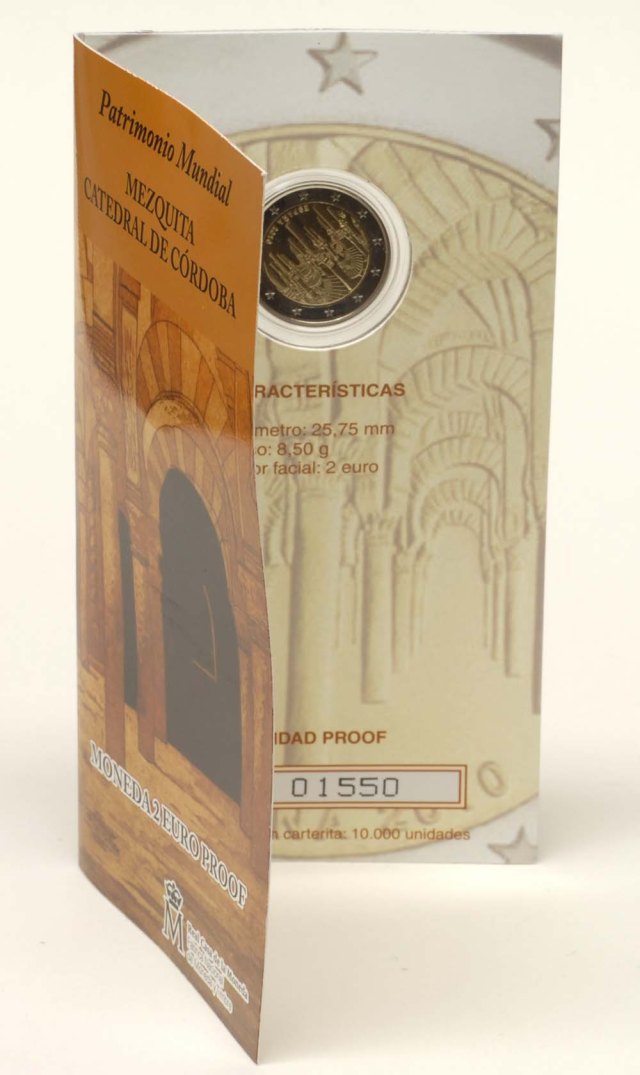


Series
UNESCO World Heritage Series
Mintages
Spanien
4,000,000Circulation: 3,915,000
Proof blister: 10,000
BU Mint Set: 25,000
BU Mint Set: 20,000
BU Mint Set: 20,000
BU Mint Set: 2,000
Coin set proof: 3,000
Numismatic cover: 5,000
Official issue prices
2010 · Proof blister: €19.49
2010 · BU Mint Set: 25,00
32,00
35,00
2010 · Coin set proof: €58.00
2010 · Numismatic cover: €20.00
Additional information
Bei den KMS BU wird die Serie mit den autonomen Regionen fortgesetzt (Casilla y León, Castilla - La Mancha je max 20.000, je 32,- €). Blister KMS 2010 BU mit 25.000 Ex., 25,- €. Zusätzl. KMS BU bereits zur World Money Fair (2.000 Ex. / 35,- €). Alle KMS enthalten zusätzlich die 2CC Altstadt von Córdoba. Der Numisbrief ist eine offizielle Gemeinschaftsausgabe der spanischen Post und der spanischen Münze FNMT.