
 Deutsch
 English
 Français
 Español
 Italiano
 Nederlands
 Português
 Slovenčina
 Hrvatski
 Slovenščina
 Lietuvių
 Eesti
Eesti Български

CC 573 2025
Blister pack
Proof
Proof blister
Germany · 35 years of Deutsche Einheit (series: Einigkeit und Recht und Freiheit, 1st issue)
Mintage19,000
Issue price€46.95
Issue date25 Sept 2025
PackagingBlister pack
Edge letteringEINIGKEIT UND RECHT UND FREIHEIT + Federal Eagle
Market price€55.50
Varieties
1Germany, A · A · Mint mark A · Proof · Blister pack · Mintage 19,000
Issue occasion
The coin commemorates 35 years of German unity. The design shows the inscriptions “Wir sind ein Volk” and “35 Jahre Deutsche Einheit” as offset blocks of text connected by an enlarged “D”. The arrangement symbolizes the former division of Germany and the reunification of the East and West German populations; the interrupted lines also evoke the fall of the Wall.
The design
The national side features a typographic composition: along a longitudinal axis slightly shifted to the left, the words of the inscription “We are one people” are arranged right-aligned one below the other on the left, while the words of the inscription “35 years Deutsche Einheit” are arranged left-aligned one below the other on the right. Both blocks of text are slightly offset from one another along the longitudinal axis and are each bordered by a horizontal line at the top and bottom. The two inscriptions are connected by a slightly enlarged “D” in the centre.
The offset blocks of text symbolise the fact that Germany was divided, while the connecting “D”, which forms part of the inscription in both blocks, represents the fact that the populations of East and West Germany have been reunited for 35 years. Despite the apparently simple composition of the design, it evokes a wide range of associations and, for example, the interrupted lines may suggest the fall of the Wall.
In the upper half of the inner coin ring are also the initials of the artist Thomas Serres (“TS”) from Hattingen, with the mint mark of the respective mint (“A”, “D”, “F”, “G” or “J”) below. In the lower half of the inner coin ring are the year of issue “2025” and, above it, the country code “D” for the issuing country Germany.
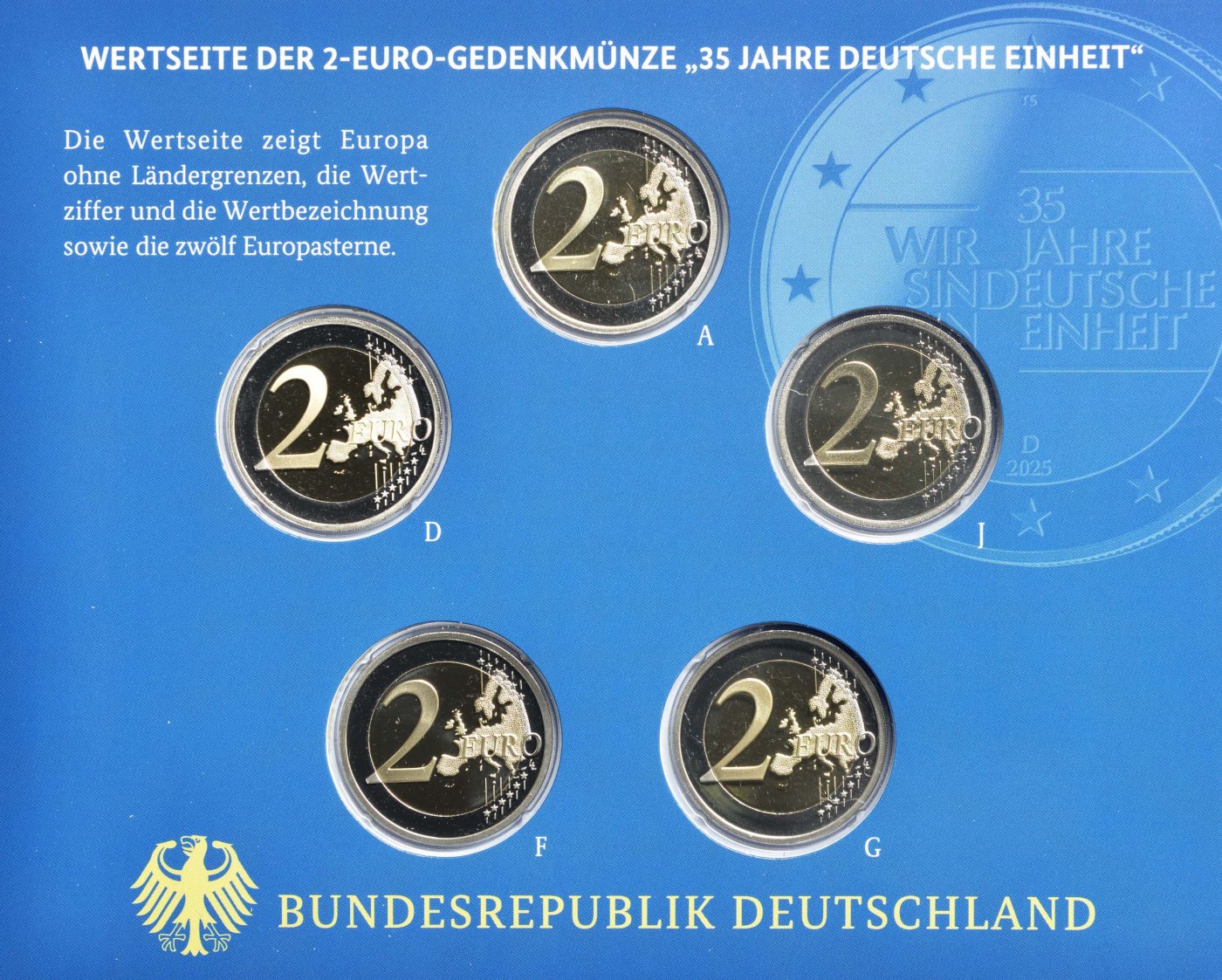
The twelve stars of the European flag are depicted on the outer coin ring.
The offset blocks of text symbolise the fact that Germany was divided, while the connecting “D”, which forms part of the inscription in both blocks, represents the fact that the populations of East and West Germany have been reunited for 35 years. Despite the apparently simple composition of the design, it evokes a wide range of associations and, for example, the interrupted lines may suggest the fall of the Wall.
In the upper half of the inner coin ring are also the initials of the artist Thomas Serres (“TS”) from Hattingen, with the mint mark of the respective mint (“A”, “D”, “F”, “G” or “J”) below. In the lower half of the inner coin ring are the year of issue “2025” and, above it, the country code “D” for the issuing country Germany.
The twelve stars of the European flag are depicted on the outer coin ring.
Background on the topic
The division of Germany resulted from the consequences of the Second World War and the emerging East–West conflict. In 1949, the Federal Republic of Germany (Bundesrepublik Deutschland) was established in the West and the German Democratic Republic (Deutsche Demokratische Republik) in the East. The two states belonged to different political, economic and military alliance systems. The Berlin Wall, which had existed since 1961, and the inner-German border severely restricted freedom of movement between East and West.
In autumn 1989, the leadership of the German Democratic Republic came under pressure as a result of movements seeking to leave the country and growing protests. At the Monday demonstrations and other rallies, citizens demanded political participation, free elections, and freedom of travel and expression. The slogan “Wir sind das Volk” (“We are the people”) expressed the demonstrators’ understanding of themselves as the holders of state sovereignty and their rejection of the ruling Socialist Unity Party of Germany’s claim to sole representation. The protests remained largely peaceful and are therefore referred to as the Peaceful Revolution (Friedliche Revolution).
Following the opening of the Berlin Wall on 9 November 1989, German reunification became a more prominent issue. In this context, the modified slogan “Wir sind ein Volk” (“We are one people”) spread. It no longer stood solely for democratic rights within the German Democratic Republic, but for the desire of many people for a common German state. At the same time, however, differing views existed regarding the pace and form of the reunification process.
The first free People's Chamber (Volkskammer) election in the German Democratic Republic in March 1990 created the parliamentary basis for the subsequent negotiations. This was followed by the Economic, Monetary and Social Union, the Treaty of Unification (Einigungsvertrag) between the two German states, and the Treaty on the Final Settlement with Respect to Germany (Zwei-plus-Vier-Vertrag) with the four former occupying powers. On 3 October 1990, the German Democratic Republic acceded to the scope of application of the Basic Law (Grundgesetz); its Länder became part of the Federal Republic.
The selection of this commemorative occasion thus refers both to a state anniversary and to the political language of the protest movement. The slogan used points to the transition from demands for democratic self-determination to German reunification.
In autumn 1989, the leadership of the German Democratic Republic came under pressure as a result of movements seeking to leave the country and growing protests. At the Monday demonstrations and other rallies, citizens demanded political participation, free elections, and freedom of travel and expression. The slogan “Wir sind das Volk” (“We are the people”) expressed the demonstrators’ understanding of themselves as the holders of state sovereignty and their rejection of the ruling Socialist Unity Party of Germany’s claim to sole representation. The protests remained largely peaceful and are therefore referred to as the Peaceful Revolution (Friedliche Revolution).
Following the opening of the Berlin Wall on 9 November 1989, German reunification became a more prominent issue. In this context, the modified slogan “Wir sind ein Volk” (“We are one people”) spread. It no longer stood solely for democratic rights within the German Democratic Republic, but for the desire of many people for a common German state. At the same time, however, differing views existed regarding the pace and form of the reunification process.
The first free People's Chamber (Volkskammer) election in the German Democratic Republic in March 1990 created the parliamentary basis for the subsequent negotiations. This was followed by the Economic, Monetary and Social Union, the Treaty of Unification (Einigungsvertrag) between the two German states, and the Treaty on the Final Settlement with Respect to Germany (Zwei-plus-Vier-Vertrag) with the four former occupying powers. On 3 October 1990, the German Democratic Republic acceded to the scope of application of the Basic Law (Grundgesetz); its Länder became part of the Federal Republic.
The selection of this commemorative occasion thus refers both to a state anniversary and to the political language of the protest movement. The slogan used points to the transition from demands for democratic self-determination to German reunification.