
 Deutsch
 English
 Français
 Español
 Italiano
 Nederlands
 Português
 Slovenčina
 Hrvatski
 Slovenščina
 Lietuvių
 Eesti
Eesti Български

CC 537 2024
Coin set
BU
BU Mint Set
Malta · Iċ-Ċittadella Gozo, Series: Maltese Walled Cities
Mintage10,000
Issue price€30.00
Issue date26 Aug 2024
PackagingCoin set
Edge lettering2 ✠✠ × 6, alternately upright/inverted
Market price€48.82
Issue occasion
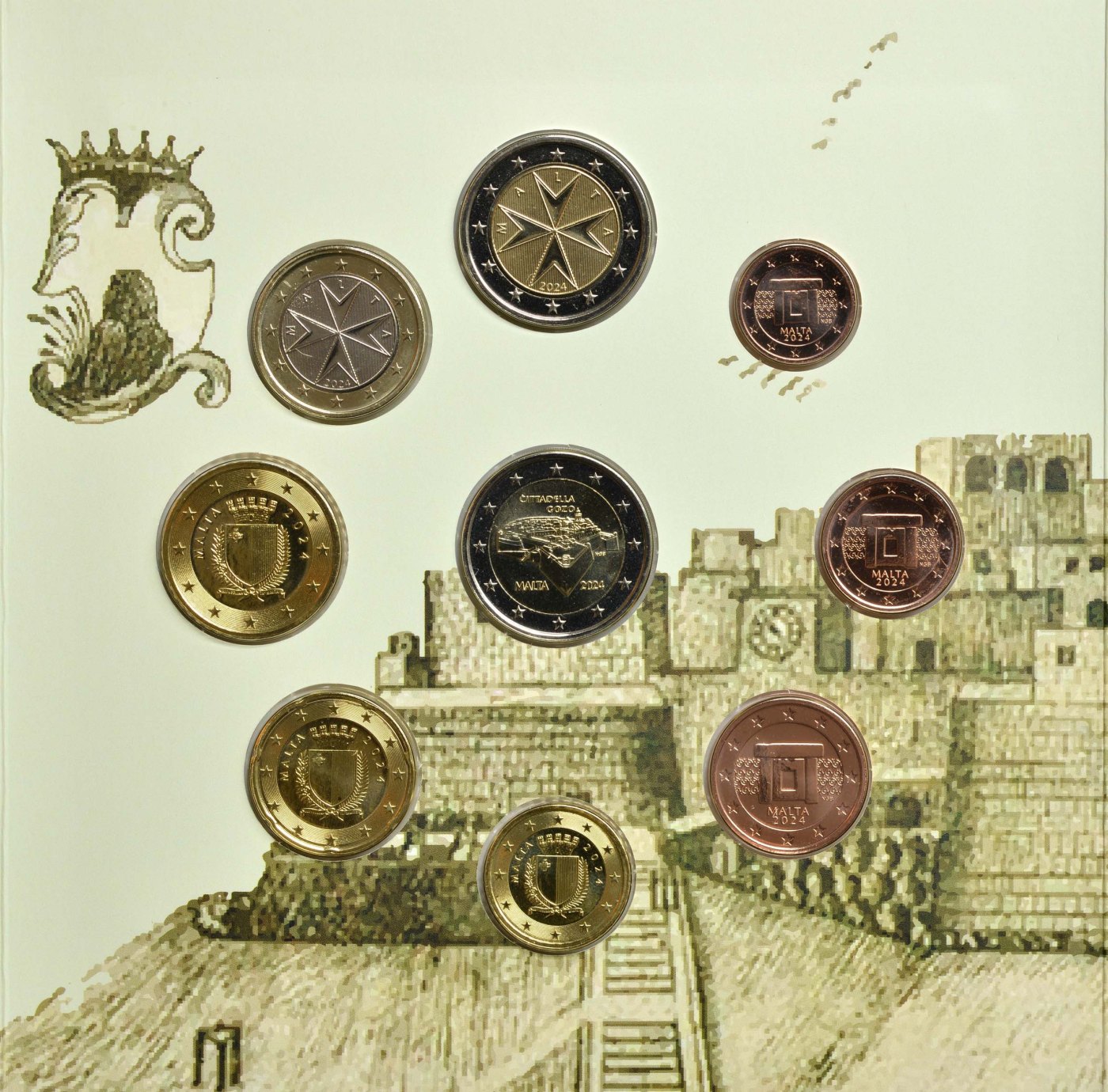
The commemorative coin is dedicated to Iċ-Ċittadella on Gozo and is part of a series about Maltese fortified cities as components of Maltese and European cultural heritage. The design by Noel Galea Bason shows the walled city with its fortifications, which were built and reconstructed in their present form by the Order of St John, as well as the inscriptions “ĊITTADELLA” and “GOZO”.
The design
The design was created by Noel Galea Bason and depicts the walled city of “Iċ-Ċittadella” (the Citadel) on Gozo, the second-largest island of the Maltese archipelago. In their present form, the fortification walls around the “Ċittadella” were built and reconstructed by the Johanniterorden.
The design shows the city with its fortification walls. The issuing country “MALTA” is shown at the bottom left and the year of issue “2024” at the bottom right. The inscription “ĊITTADELLA” appears at the top, with the inscription “GOZO” below it.
This coin is intended to form part of a series dedicated to Maltese fortified cities such as Mdina and Valletta. They are essential components of Malta’s and Europe’s cultural heritage.
The outer ring of the coin depicts the twelve stars of the European flag.
The design shows the city with its fortification walls. The issuing country “MALTA” is shown at the bottom left and the year of issue “2024” at the bottom right. The inscription “ĊITTADELLA” appears at the top, with the inscription “GOZO” below it.
This coin is intended to form part of a series dedicated to Maltese fortified cities such as Mdina and Valletta. They are essential components of Malta’s and Europe’s cultural heritage.
The outer ring of the coin depicts the twelve stars of the European flag.
Background on the topic
The citadel is situated on a hill above Victoria, the main town of Gozo. The site was already settled in prehistoric times and was later used, among others, by the Phoenicians and Romans. Its elevated position allowed control over large parts of the island and offered protection against attacks. In the Middle Ages, a fortified settlement developed here that was known as “Gran Castello”. Within its walls were residential buildings as well as facilities of the secular and ecclesiastical administrations.
Its function as a place of refuge was connected with the repeated attacks on Gozo. Particularly devastating was an Ottoman attack in 1551. The fortifications at the time were unable to withstand it; a large part of the island’s population was captured and enslaved. After this event and the Siege of Malta in 1565, the complex was reinforced. The southern side, facing the more easily accessible terrain, was equipped with bastions according to the principles of early modern fortification construction. The steeper northern slopes, by contrast, retained more of their medieval character. Until 1637, the inhabitants of Gozo had to spend the night inside the citadel for their protection.
The buildings include the Cathedral of the Assumption (Kathedrale Mariä Himmelfahrt), which was constructed around the turn of the 18th century according to plans by the Maltese architect Lorenzo Gafà. Although the church has no dome, a perspectivally painted ceiling inside creates the impression of one. The fortified city also contained administrative buildings, courts and a prison. As the military threat declined, settlement increasingly shifted to the area below the walls.
The citadel is suitable as a coin-issuing theme because several periods of Gozo’s history can be read from it: early settlement, medieval rule, the danger of raids from the Mediterranean, early modern fortification construction, and its role as an administrative and ecclesiastical centre. It thus represents both the defensive character of the Maltese islands and Gozo’s historical distinctiveness within Malta.
Its function as a place of refuge was connected with the repeated attacks on Gozo. Particularly devastating was an Ottoman attack in 1551. The fortifications at the time were unable to withstand it; a large part of the island’s population was captured and enslaved. After this event and the Siege of Malta in 1565, the complex was reinforced. The southern side, facing the more easily accessible terrain, was equipped with bastions according to the principles of early modern fortification construction. The steeper northern slopes, by contrast, retained more of their medieval character. Until 1637, the inhabitants of Gozo had to spend the night inside the citadel for their protection.
The buildings include the Cathedral of the Assumption (Kathedrale Mariä Himmelfahrt), which was constructed around the turn of the 18th century according to plans by the Maltese architect Lorenzo Gafà. Although the church has no dome, a perspectivally painted ceiling inside creates the impression of one. The fortified city also contained administrative buildings, courts and a prison. As the military threat declined, settlement increasingly shifted to the area below the walls.
The citadel is suitable as a coin-issuing theme because several periods of Gozo’s history can be read from it: early settlement, medieval rule, the danger of raids from the Mediterranean, early modern fortification construction, and its role as an administrative and ecclesiastical centre. It thus represents both the defensive character of the Maltese islands and Gozo’s historical distinctiveness within Malta.
Interesting Facts
This coin set contains all eight circulating coins from 1 cent to 2 euros as well as the €2 commemorative coin (face value: €5.88).