
 Deutsch
 English
 Français
 Español
 Italiano
 Nederlands
 Português
 Slovenčina
 Hrvatski
 Slovenščina
 Lietuvių
 Eesti
Eesti Български
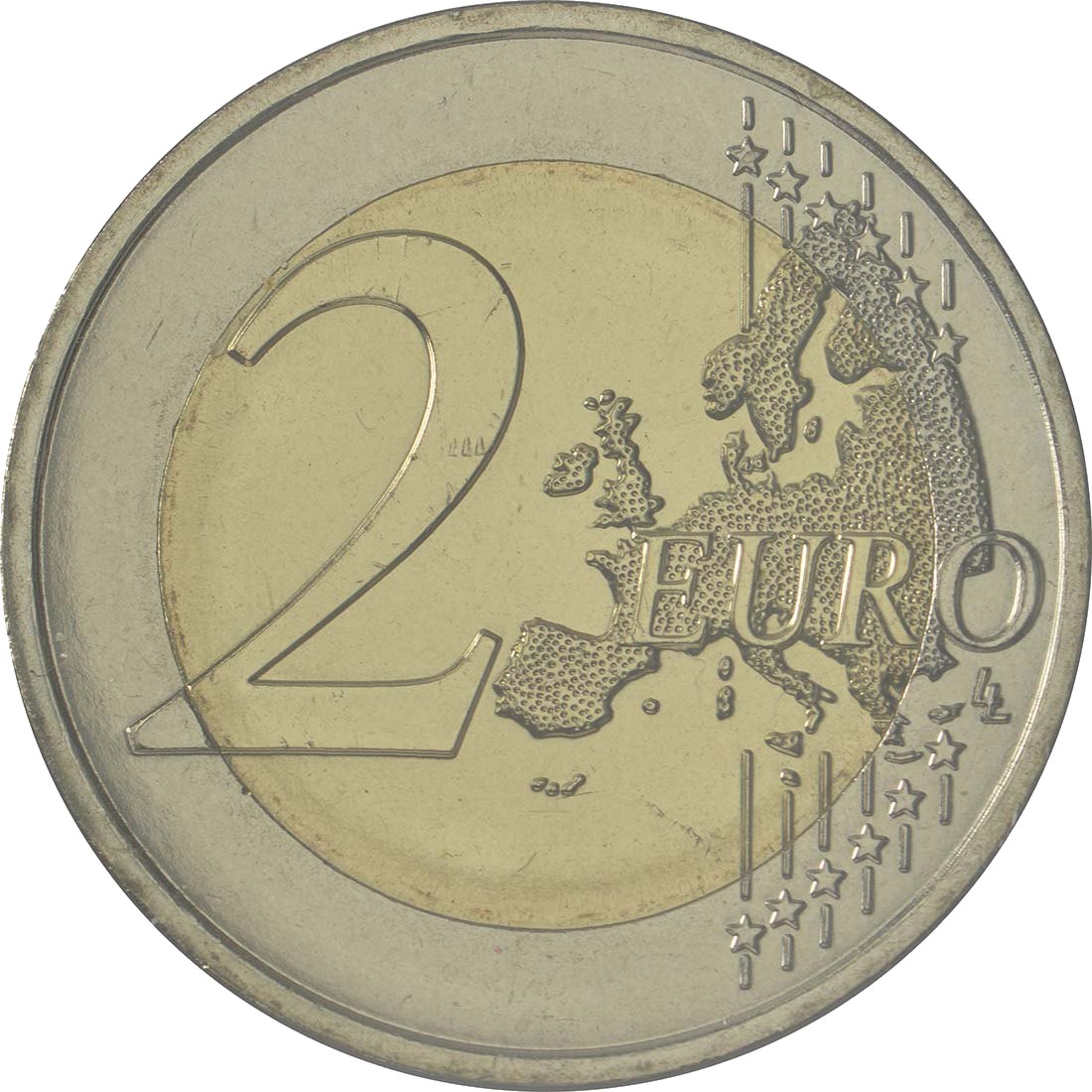
Reverse
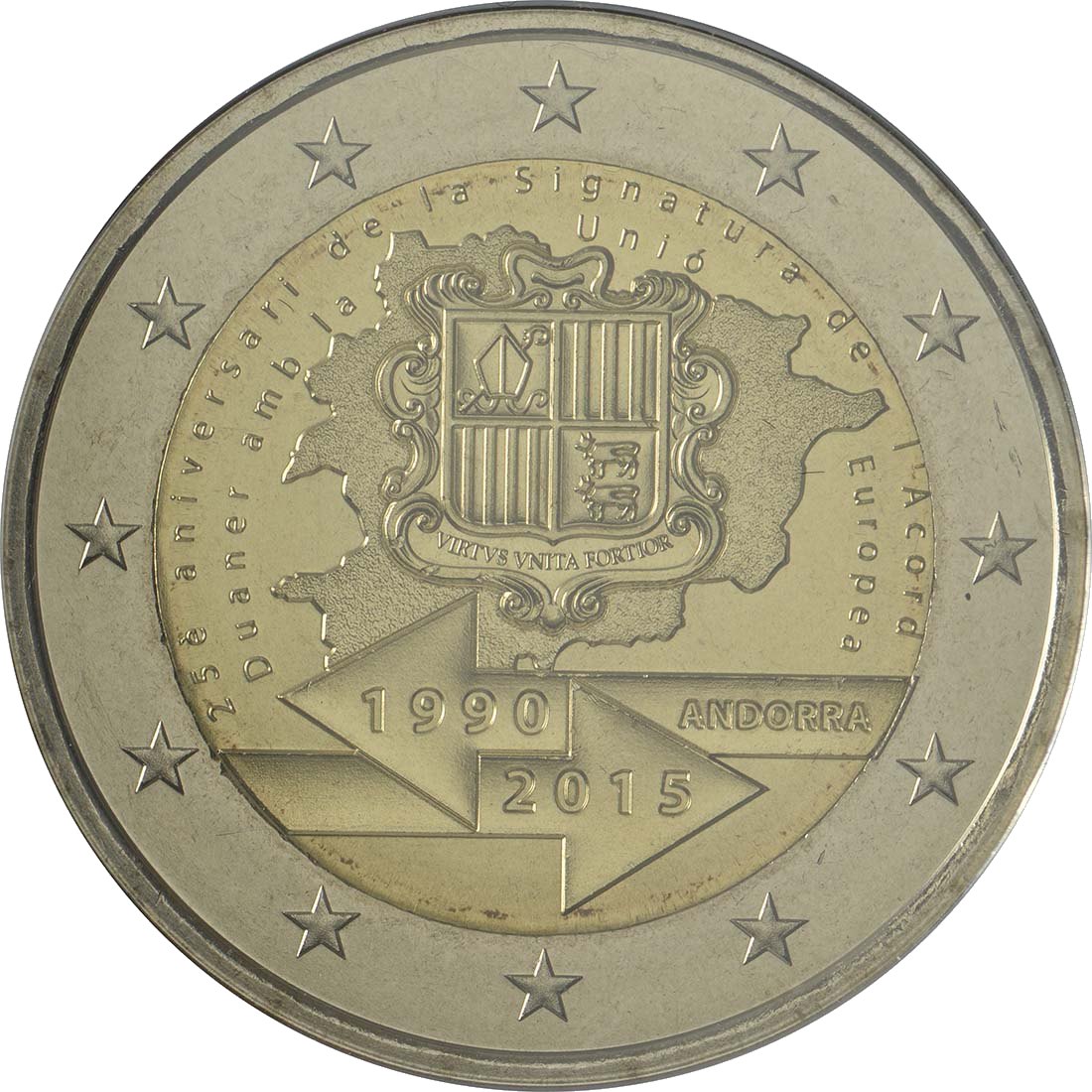
Obverse
More images of the main coin
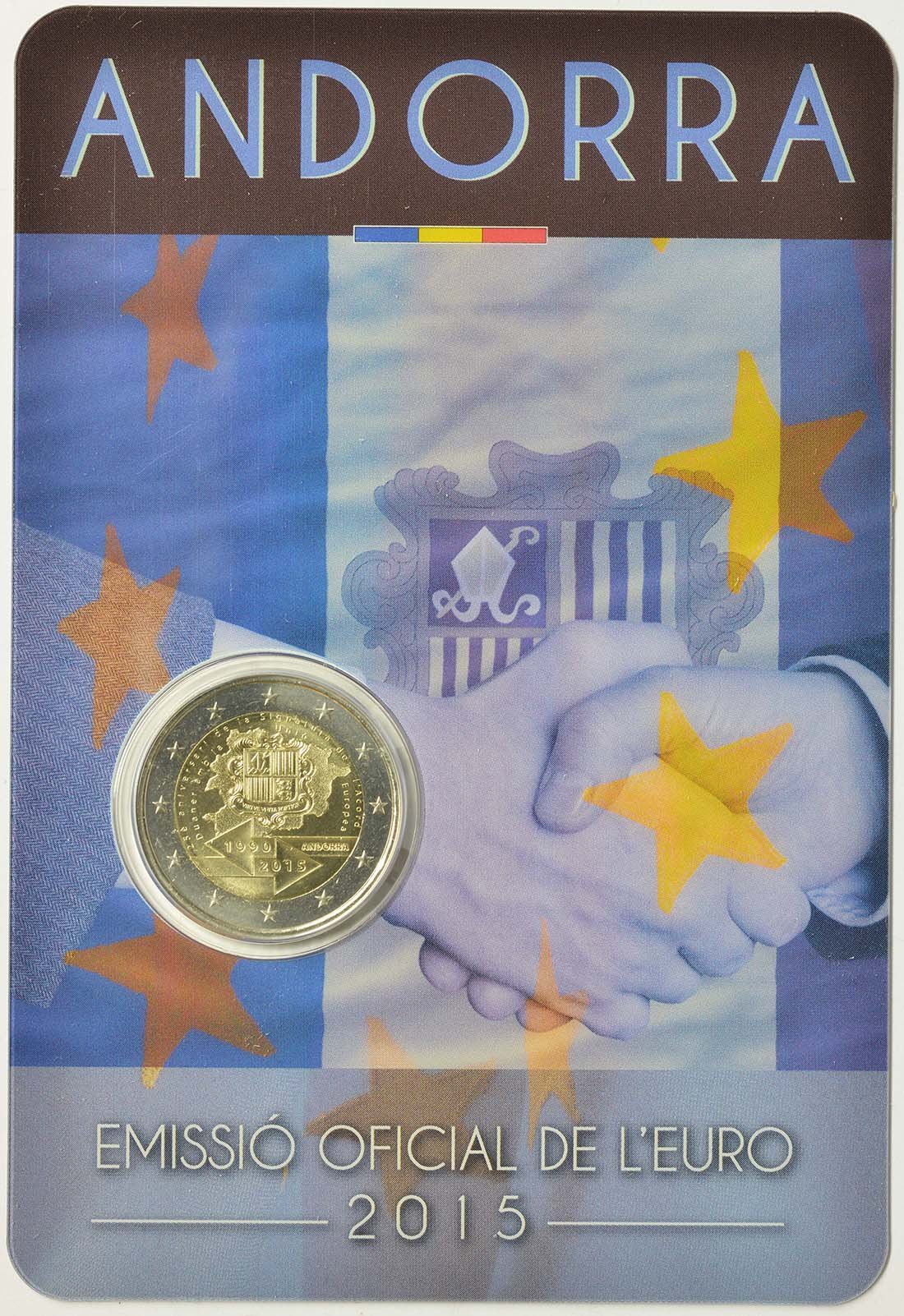
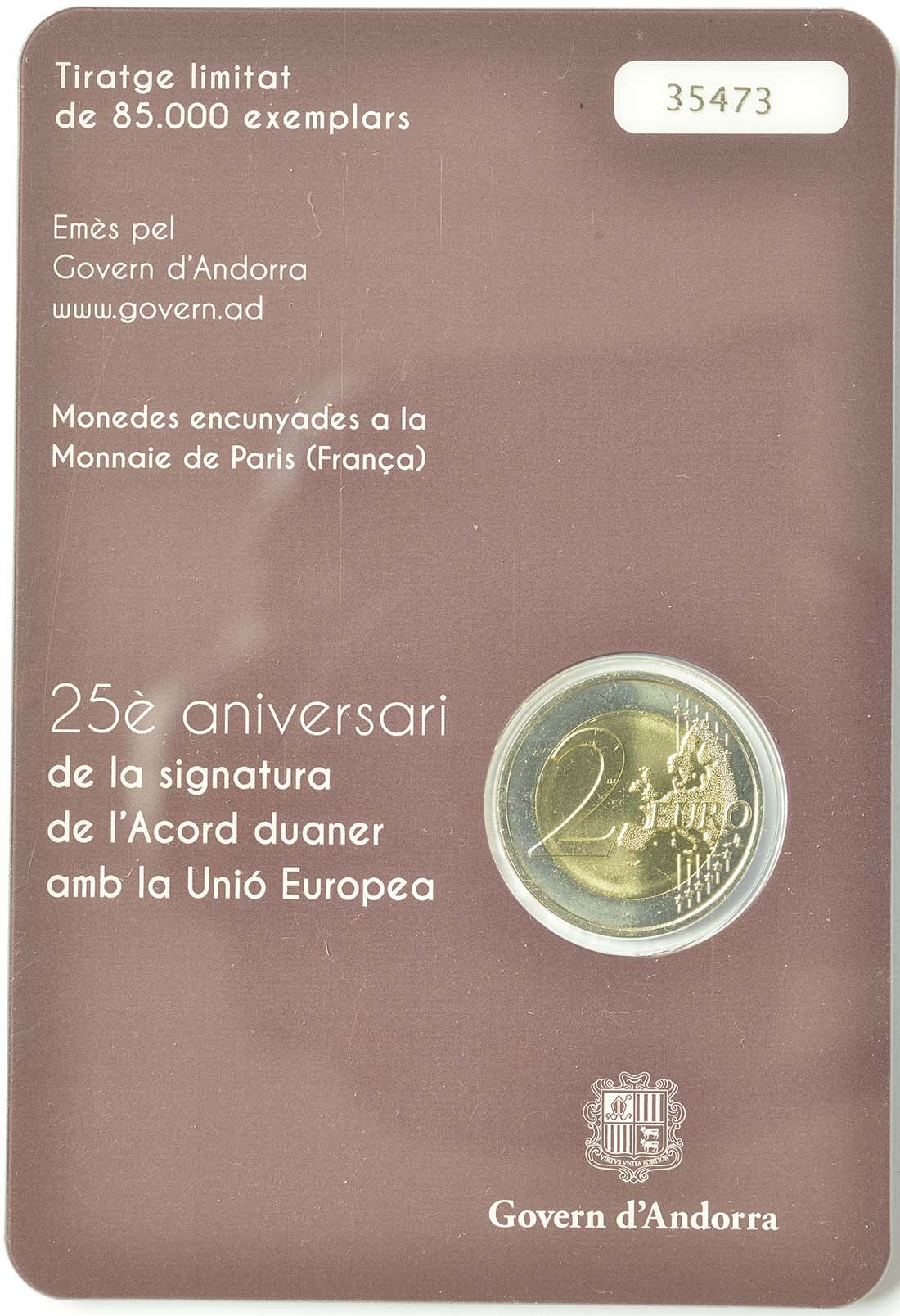
Andorra · 25 years of customs union with the EU
Issue date18 Jul 2016
Total mintage85,000
EU maximum85,000
Editions1
Edge lettering2 ★ ★ × 6, alternating upright/inverted
Inscription1990 / 2015 / ANDORRA / 25è aniversari de la Signatura de l’Acord Duaner amb la Unió Europea
DesignerAteliers de Gravure
mintMonnaie de Paris, Pessac
Issue occasion
The coin commemorates the 25th anniversary of the signing of the customs agreement between Andorra and the European Union. The design shows a map of Andorra with the highlighted coat of arms of the Principality, as well as two opposing arrows symbolizing the agreement. It also includes the years “1990” and “2015”, the name “ANDORRA” and the Catalan inscription “25è aniversari de la Signatura de l’Acord Duaner amb la Unió Europea”.
The design
The coin design shows the map of Andorra at the top, with the coat of arms of the Principality highlighted within it. At the bottom edge of the coin design, there are two opposing arrows representing the Customs Agreement between Andorra and the EU and commemorating the years “1990” and “2015” (2015 is also the year of issue). “ANDORRA” is also given as the issuing country. Around the map of Andorra is the inscription “25th anniversary of the signing of the Customs Agreement with the European Union”.
The twelve stars of the European flag are depicted on the outer ring of the coin.
The twelve stars of the European flag are depicted on the outer ring of the coin.
Background on the topic
Andorra is not a member of the European Union. Due to its location between France and Spain, however, the principality is economically closely linked to the European single market. When the agreement was concluded, the present-day EU did not yet exist; the contracting party was the European Economic Community (EEC). The European Union was created only with the Treaty of Maastricht. The rights and obligations arising from the agreement were later transferred to it.
The agreement created a customs union for industrial goods. Customs duties and charges having equivalent effect were eliminated in mutual trade. With regard to goods from third countries, Andorra in principle adopted the common customs tariff and parts of the Community’s customs provisions. Agricultural products were not included to the same extent. A Joint Committee was established to oversee implementation and deal with disputes.
For the small state, this arrangement was particularly relevant because a large proportion of its trade in goods is conducted through its two neighbouring countries. Andorra’s economy is strongly oriented towards trade, tourism and services. A regulated customs connection facilitated trade with the European economic area without Andorra joining the Community or the EU. At the same time, the country had to apply European provisions in the treatment of imported goods.
The Customs Agreement must be distinguished from the later Monetary Agreement. Andorra previously used the French franc and the Spanish peseta and subsequently adopted the euro, initially without the right to issue its own coins. Only a separate monetary agreement allowed the principality to mint its own euro coins. The commemorative coin thus combines two levels of Andorra’s relations with the EU: the older integration in trade policy and the more recent right to participate in the euro system with nationally designed coins.
The anniversary was a suitable occasion for issuing a coin because the agreement is one of the enduring contractual foundations of relations between Andorra and the EU. It represents institutionalised economic cooperation, even though the principality has remained outside the Union.
The agreement created a customs union for industrial goods. Customs duties and charges having equivalent effect were eliminated in mutual trade. With regard to goods from third countries, Andorra in principle adopted the common customs tariff and parts of the Community’s customs provisions. Agricultural products were not included to the same extent. A Joint Committee was established to oversee implementation and deal with disputes.
For the small state, this arrangement was particularly relevant because a large proportion of its trade in goods is conducted through its two neighbouring countries. Andorra’s economy is strongly oriented towards trade, tourism and services. A regulated customs connection facilitated trade with the European economic area without Andorra joining the Community or the EU. At the same time, the country had to apply European provisions in the treatment of imported goods.
The Customs Agreement must be distinguished from the later Monetary Agreement. Andorra previously used the French franc and the Spanish peseta and subsequently adopted the euro, initially without the right to issue its own coins. Only a separate monetary agreement allowed the principality to mint its own euro coins. The commemorative coin thus combines two levels of Andorra’s relations with the EU: the older integration in trade policy and the more recent right to participate in the euro system with nationally designed coins.
The anniversary was a suitable occasion for issuing a coin because the agreement is one of the enduring contractual foundations of relations between Andorra and the EU. It represents institutionalised economic cooperation, even though the principality has remained outside the Union.
eBay price analysis
For this issue, there is a price history based on actual eBay sales – with median, range and number of sales
View price analysisCoincard
- Packaging
- Coincard
- Mintage
- 85,000
- Market price
- €35.90
- Edge lettering
- 2 ★ ★ × 6, alternating upright/inverted
Mintage by issue type
Coincard
85,000
Official issue prices
2015 · Coincard: €12.50
Additional information
In den Umlaufmünzensätzen Andorras ist diese Gedenkmünze nicht enthalten.