
 Deutsch
 English
 Français
 Español
 Italiano
 Nederlands
 Português
 Slovenčina
 Hrvatski
 Slovenščina
 Lietuvių
 Eesti
Eesti Български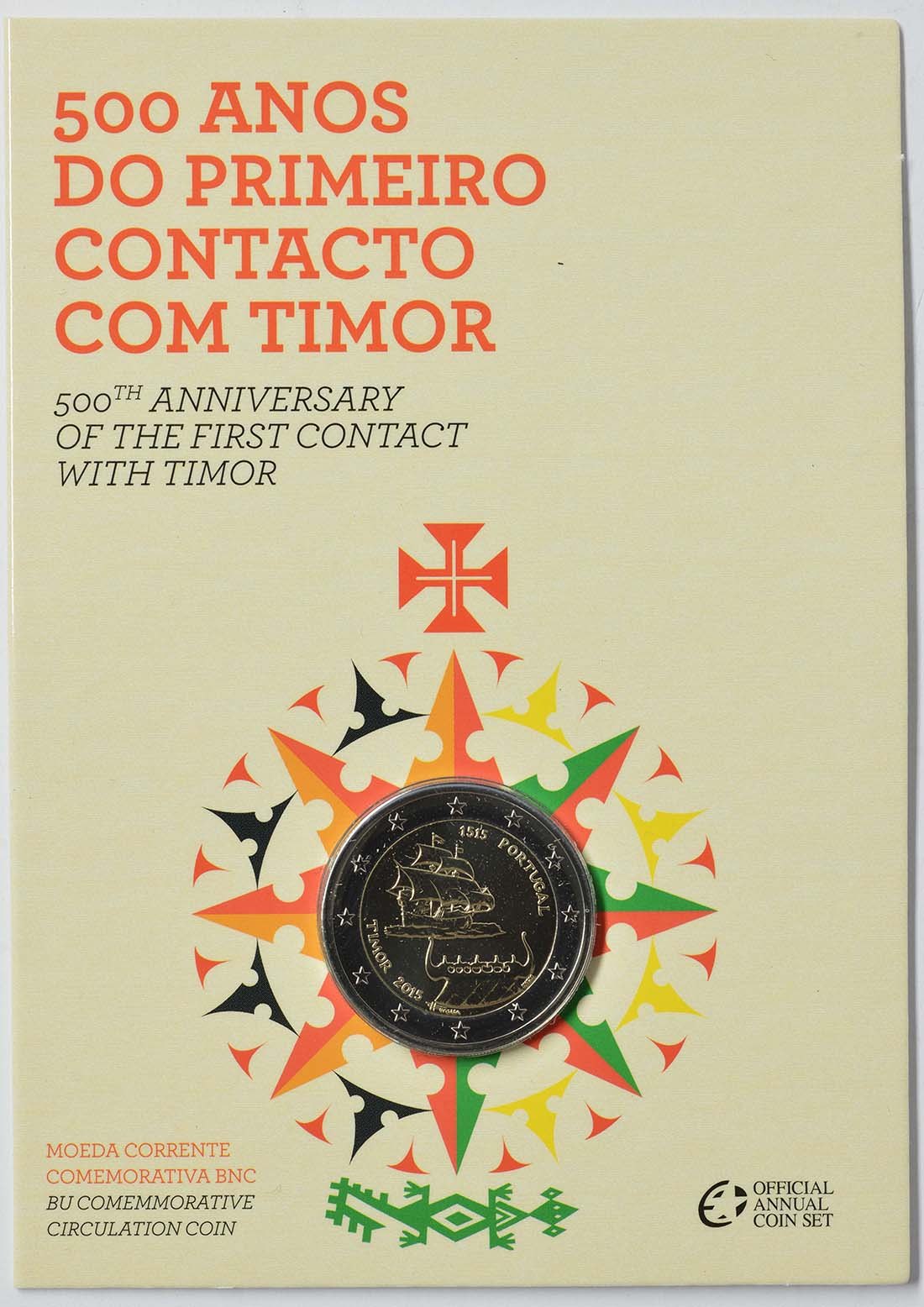


CC 198 2015
Blister pack
BU
Blister pack BU
Portugal · 500th anniversary of the first Portuguese contact with Timor
Mintage3,976
Issue date15 Jul 2015
PackagingBlister pack
Edge lettering5 Wappenschilde + 7 castles, evenly distributed
Market price€29.00
Issue occasion
The coin commemorates the first contacts between Portuguese seafarers and Timor 500 years ago. The design depicts a 16th-century ship as well as a traditional house roof with typical wooden figures referring to myths and legends, the origins of the first inhabitants from other parts of Asia, and the importance of horses as a means of transport. The design is completed by the inscriptions “1515”, “PORTUGAL”, “TIMOR” and “2015”.
The design
The design depicts a 16th-century ship illustrating the arrival of Portuguese seafarers on the island, and a traditional covered house roof with typical wooden figures evoking myths and legends. The roof depicted on the coin represents the history of the first inhabitants, who arrived by boat from other parts of Asia, and the importance of horses as a means of transport in view of the steep mountains that cover almost the entire island. In the upper right are the year “1515” and the name of the issuing country, “PORTUGAL”. In the lower left are the name of the island, “TIMOR”, and the year “2015”. At the very bottom is the signature of the artist Fernando Fonseca.
The outer ring of the coin features the twelve stars of the European flag.
The outer ring of the coin features the twelve stars of the European flag.
Background on the topic
The Portuguese presence on Timor emerged in the context of European expansion into the Indian Ocean. Portuguese traders were primarily seeking sandalwood there, which was in demand in China and other Asian markets. Initially, there were no comprehensive colonial structures. Traders and, later, Dominican missionaries established relations with local rulers, through which trade, political alliances and the spread of Catholicism were organised.
Portugal competed with the Netherlands in the region. The respective spheres of influence developed into the division of the island: the western part now belongs to Indonesia, while the eastern part and the exclave of Oe-Cusse became the territory of Timor-Leste. The Portuguese administrative seat was initially located in Lifau and was moved to Dili in the 18th century. For a long time, actual colonial control remained limited beyond individual coastal settlements and regional alliances.
Following the Carnation Revolution (Nelkenrevolution) of 1974, Portugal initiated the decolonisation of its overseas territories. In Timor, the withdrawal led to conflicts between political groups. Shortly after a declaration of independence in 1975, Indonesia occupied the territory. The subsequent occupation was characterised by armed resistance, repression and numerous civilian casualties. In a referendum organised by the United Nations, the population voted in 1999 against autonomy within Indonesia. Following a transitional administration by the United Nations, Timor-Leste became sovereign in 2002.
The memory of the early contact therefore refers not only to seafaring and trade, but also to a conflict-ridden relationship spanning around five centuries. Portuguese influences are particularly evident in Catholicism, family names, law and language. Portuguese is an official language alongside Tetum; Timor-Leste is also a member of the Community of Portuguese Language Countries (Gemeinschaft der Portugiesischsprachigen Länder). The anniversary thus gave Portugal an occasion to address the historical connection with a now-independent state.
Portugal competed with the Netherlands in the region. The respective spheres of influence developed into the division of the island: the western part now belongs to Indonesia, while the eastern part and the exclave of Oe-Cusse became the territory of Timor-Leste. The Portuguese administrative seat was initially located in Lifau and was moved to Dili in the 18th century. For a long time, actual colonial control remained limited beyond individual coastal settlements and regional alliances.
Following the Carnation Revolution (Nelkenrevolution) of 1974, Portugal initiated the decolonisation of its overseas territories. In Timor, the withdrawal led to conflicts between political groups. Shortly after a declaration of independence in 1975, Indonesia occupied the territory. The subsequent occupation was characterised by armed resistance, repression and numerous civilian casualties. In a referendum organised by the United Nations, the population voted in 1999 against autonomy within Indonesia. Following a transitional administration by the United Nations, Timor-Leste became sovereign in 2002.
The memory of the early contact therefore refers not only to seafaring and trade, but also to a conflict-ridden relationship spanning around five centuries. Portuguese influences are particularly evident in Catholicism, family names, law and language. Portuguese is an official language alongside Tetum; Timor-Leste is also a member of the Community of Portuguese Language Countries (Gemeinschaft der Portugiesischsprachigen Länder). The anniversary thus gave Portugal an occasion to address the historical connection with a now-independent state.