
 Deutsch
 English
 Français
 Español
 Italiano
 Nederlands
 Português
 Slovenčina
 Hrvatski
 Slovenščina
 Lietuvių
 Eesti
Eesti Български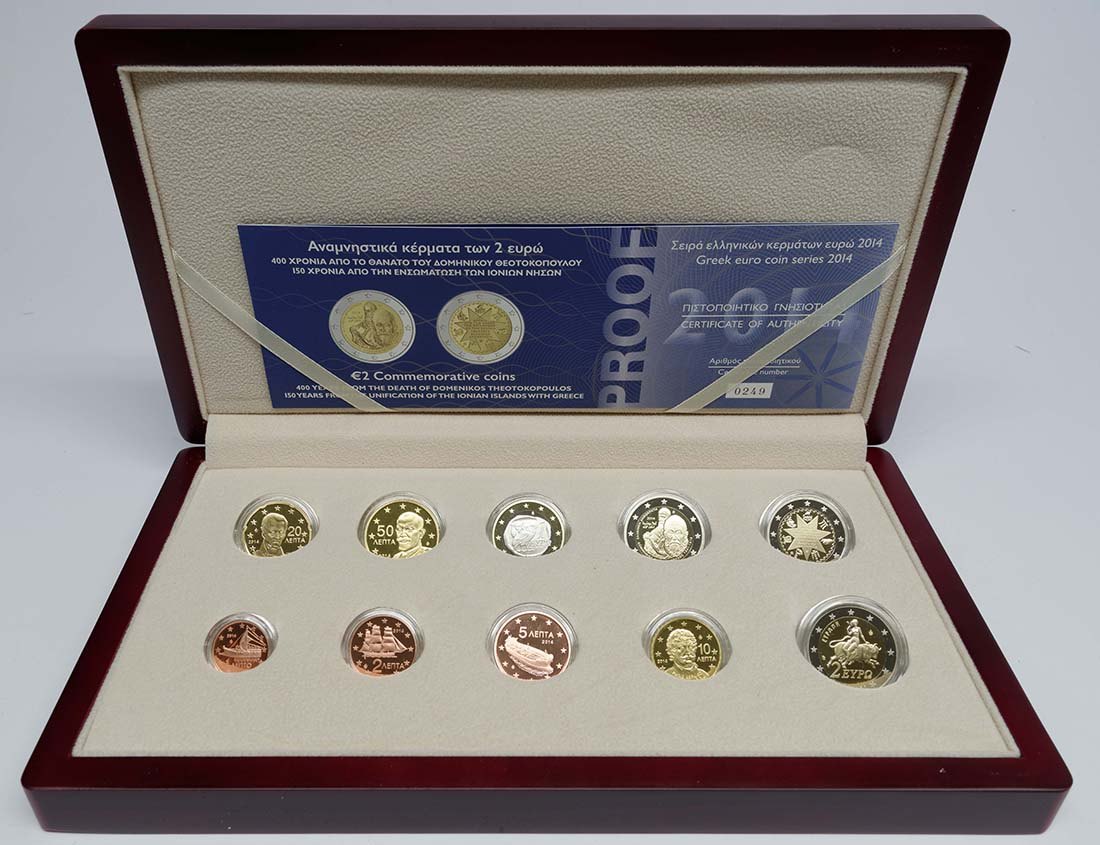

CC 175 2014
Coin set
Proof
2 Euro Proof
Greece · 150 years of union with the Ionian Islands
Mintage2,500
Issue date24 Sept 2014
Edge letteringΕΛΛΗΝΙΚΗ ΔΗΜΟΚΡΑΤΙΑ + ★
Price of the set (2 coins)€139.00
Issue occasion
The commemorative coin marks the 150th anniversary of the union of the Ionian Islands with Greece in 1864. The design features a seven-pointed star with a Greek commemorative inscription, the name “HELLENIC REPUBLIC” and the mark of the Greek State Mint. The landmarks of the Ionian Islands are arranged between the points; a stylized wave frames the overall design.
The design
The coin’s inner part shows a seven-pointed star, into which the text “150 YEARS UNION OF THE IONIAN ISLANDS (EPTA’NISA) WITH GREECE 1864-2014” in Greek, the name of the issuing state — “HELLENIC REPUBLIC” — and the mintmark of the Greek State Mint are engraved. The landmarks of the Ionian Islands are arranged between the individual points of the star. The overall design is framed by a decorative stylized depiction of a wave.
The outer ring of the coin features the twelve stars of the European flag.
The outer ring of the coin features the twelve stars of the European flag.
Background on the topic
The Ionian Islands (Ionische Inseln) lie off the west coast of Greece. The traditional group known as the “Eptanisa”, the seven islands, comprises Corfu (Korfu), Paxos, Lefkada, Ithaca (Ithaka), Kefalonia, Zakynthos and Kythira; the archipelago also includes numerous smaller islands. Kythira, however, lies south of the Peloponnese (Peloponnes) and thus outside the actual Ionian Sea (Ionisches Meer). The term “Eptanisa” therefore refers to a historical-political and cultural community.
Unlike large parts of mainland Greece, the islands were under Venetian rule for centuries and did not permanently belong to the Ottoman Empire (Osmanisches Reich). After the end of the Republic of Venice (Republik Venedig) in 1797, control changed hands several times. France and a Russo-Ottoman alliance were involved at different times. In 1800, the Septinsular Republic (Republik der Sieben Vereinigten Inseln) was established, a polity formally subordinate to the Ottoman Empire but with its own administration.
After the Napoleonic Wars, the islands were placed under British protection in 1815 as the “United States of the Ionian Islands” (Vereinigter Staat der Ionischen Inseln). They had their own political institutions but were under the supervision of a British high commissioner. During the 19th century, the Enosis movement gained influence; it called for union with the already independent Greek state. The so-called Radicals in particular advocated this goal in the Ionian Parliament.
The transfer took place in connection with a political change in Greece. After King Otto (König Otto) was deposed in 1862, George I (Georg I.) born in Denmark, ascended the Greek throne. Britain subsequently agreed to cede its protectorate. The union expanded the Greek state’s territory at the time and fulfilled a long-standing demand of a large part of the island population.
The symbols between the points of the stars draw on traditions and symbols of the individual islands, including Odysseus for Ithaca, Aphrodite for Kythira, a lyre for Lefkada and a trident for Paxos. The round anniversary gave Greece an opportunity to commemorate both the political union and the shared identity of the seven islands.
Unlike large parts of mainland Greece, the islands were under Venetian rule for centuries and did not permanently belong to the Ottoman Empire (Osmanisches Reich). After the end of the Republic of Venice (Republik Venedig) in 1797, control changed hands several times. France and a Russo-Ottoman alliance were involved at different times. In 1800, the Septinsular Republic (Republik der Sieben Vereinigten Inseln) was established, a polity formally subordinate to the Ottoman Empire but with its own administration.
After the Napoleonic Wars, the islands were placed under British protection in 1815 as the “United States of the Ionian Islands” (Vereinigter Staat der Ionischen Inseln). They had their own political institutions but were under the supervision of a British high commissioner. During the 19th century, the Enosis movement gained influence; it called for union with the already independent Greek state. The so-called Radicals in particular advocated this goal in the Ionian Parliament.
The transfer took place in connection with a political change in Greece. After King Otto (König Otto) was deposed in 1862, George I (Georg I.) born in Denmark, ascended the Greek throne. Britain subsequently agreed to cede its protectorate. The union expanded the Greek state’s territory at the time and fulfilled a long-standing demand of a large part of the island population.
The symbols between the points of the stars draw on traditions and symbols of the individual islands, including Odysseus for Ithaca, Aphrodite for Kythira, a lyre for Lefkada and a trident for Paxos. The round anniversary gave Greece an opportunity to commemorate both the political union and the shared identity of the seven islands.
Interesting Facts
2014 proof set, containing all eight denominations from 1 cent to 2 euros as well as the two €2 commemorative coins “400th anniversary of the death of Domenikos Theotokopoulos (El Greco)” (CC174) and “150th anniversary of union with the Ionian Islands” (CC175), face value: 7,88 €