
 Deutsch
 English
 Français
 Español
 Italiano
 Nederlands
 Português
 Slovenčina
 Hrvatski
 Slovenščina
 Lietuvių
 Eesti
Eesti Български


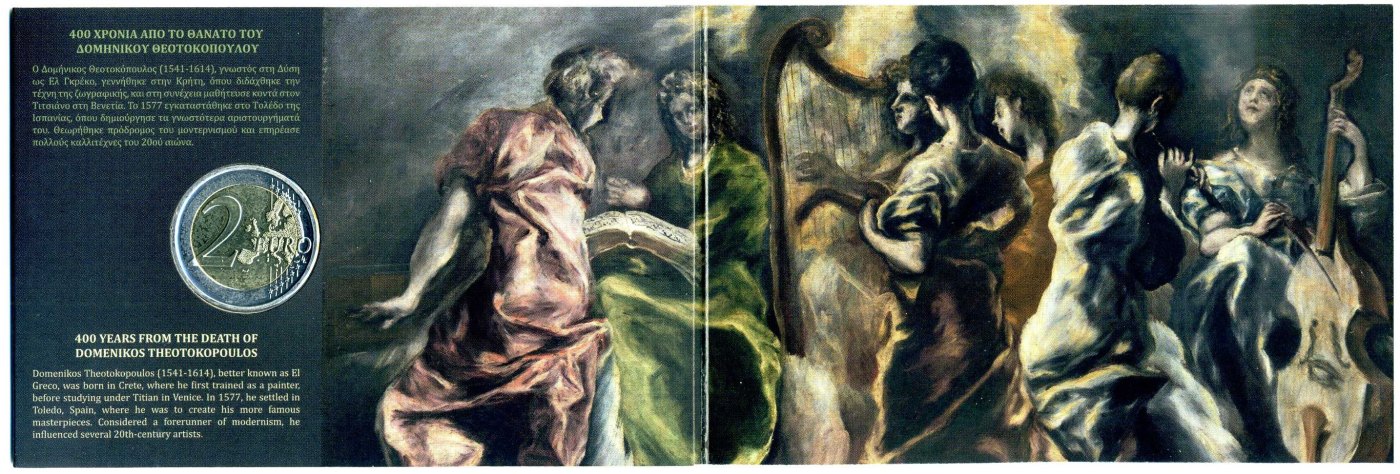
CC 174 2014
Coincard
BU
Coincard
Greece · 400th anniversary of the death of Domenikos Theotokopoulos (El Greco)
Mintage7,500
Issue price€5.00
Issue date24 Sept 2014
PackagingCoincard
Edge letteringΕΛΛΗΝΙΚΗ ΔΗΜΟΚΡΑΤΙΑ + ★
Issue occasion
The coin commemorates the 400th anniversary of the death of Dominikos Theotokopoulos (1541–1614). The design features a portrait of the painter and, in the background, a human figure typical of his painting technique from his work. The design is complemented by his signature “Dominikos Theotokopoulos Epoiei”, the year 2014 and a circular Greek inscription bearing his name and dates of life.
The design
The inner disc of the coin depicts Dominikos Theotokopoulos in portrait. In the background, a portrait typical of the painter’s technique from his oeuvre can be seen. On the left, the year 2014 and the artist’s signature (“Dominikos Theotokopoulos Epoiei”) are engraved; on the right is the mintmark of the Greek State Mint. Arranged in a circle around the design, in Greek, are the text “DOMINIKOS THEOTOKOPOULOS 1541–1614” and the name of the issuing country—“HELLENIC REPUBLIC”.
The twelve stars of the European flag are depicted on the coin’s outer ring.
The twelve stars of the European flag are depicted on the coin’s outer ring.
Background on the topic
Dominikos Theotokopoulos is best known by his Spanish nickname El Greco, “the Greek”. He came from Crete, which at the time belonged to the Republic of Venice. There he was trained as a painter in the Cretan icon tradition. This combined Byzantine-influenced religious forms of representation with influences from the Italian Renaissance. His origins remained evident in his self-image: even after moving to Western Europe, he continued to use his Greek name.
From Crete, Theotokopoulos first went to Venice. The artistic environment there, particularly the painting of Titian and Tintoretto, taught him how to work with colour, light, space and figures in motion. He subsequently stayed in Rome, where he came into contact with Mannerism. This artistic movement departed from the balanced proportions of the High Renaissance and favoured complex compositions, unusual perspectives and highly stylised bodily forms.
Later, El Greco settled in the Spanish city of Toledo. The city was an ecclesiastical centre and offered him numerous commissions for altarpieces, churches and private devotional images. Among his best-known works is The Burial of the Count of Orgaz (Das Begräbnis des Grafen von Orgaz) in the church of Santo Tomé. In it, he combines an earthly burial scene with a visionary depiction of heaven. Characteristic of his mature painting are elongated figures, intense colour contrasts, flickering light and a spatial effect oriented less towards naturalism than towards the spiritual and emotional.
During his lifetime, El Greco worked primarily as a religious painter and portraitist. Later, his distinctive style temporarily faded from art-historical attention. Since the late 19th century, he has been reassessed; modern artists saw in his formal freedom a precursor to new forms of expression.
For Greece, he simultaneously embodies the Cretan-Greek artistic tradition and its connection with Italian and Spanish culture. The round anniversary therefore provided a fitting occasion to honour an internationally renowned artist of Greek origin on a circulating coin.
From Crete, Theotokopoulos first went to Venice. The artistic environment there, particularly the painting of Titian and Tintoretto, taught him how to work with colour, light, space and figures in motion. He subsequently stayed in Rome, where he came into contact with Mannerism. This artistic movement departed from the balanced proportions of the High Renaissance and favoured complex compositions, unusual perspectives and highly stylised bodily forms.
Later, El Greco settled in the Spanish city of Toledo. The city was an ecclesiastical centre and offered him numerous commissions for altarpieces, churches and private devotional images. Among his best-known works is The Burial of the Count of Orgaz (Das Begräbnis des Grafen von Orgaz) in the church of Santo Tomé. In it, he combines an earthly burial scene with a visionary depiction of heaven. Characteristic of his mature painting are elongated figures, intense colour contrasts, flickering light and a spatial effect oriented less towards naturalism than towards the spiritual and emotional.
During his lifetime, El Greco worked primarily as a religious painter and portraitist. Later, his distinctive style temporarily faded from art-historical attention. Since the late 19th century, he has been reassessed; modern artists saw in his formal freedom a precursor to new forms of expression.
For Greece, he simultaneously embodies the Cretan-Greek artistic tradition and its connection with Italian and Spanish culture. The round anniversary therefore provided a fitting occasion to honour an internationally renowned artist of Greek origin on a circulating coin.