
 Deutsch
 English
 Français
 Español
 Italiano
 Nederlands
 Português
 Slovenčina
 Hrvatski
 Slovenščina
 Lietuvių
 Eesti
Eesti Български
CC 158 2014
Coincard
BU
Coincard
Luxembourg · 175 years of Luxembourg independence
Mintage7,500
Issue price€10.00
Issue date6 Jan 2014
PackagingCoincard
Edge lettering2 ★ ★ × 6, alternating upright/inverted
Market price€18.00
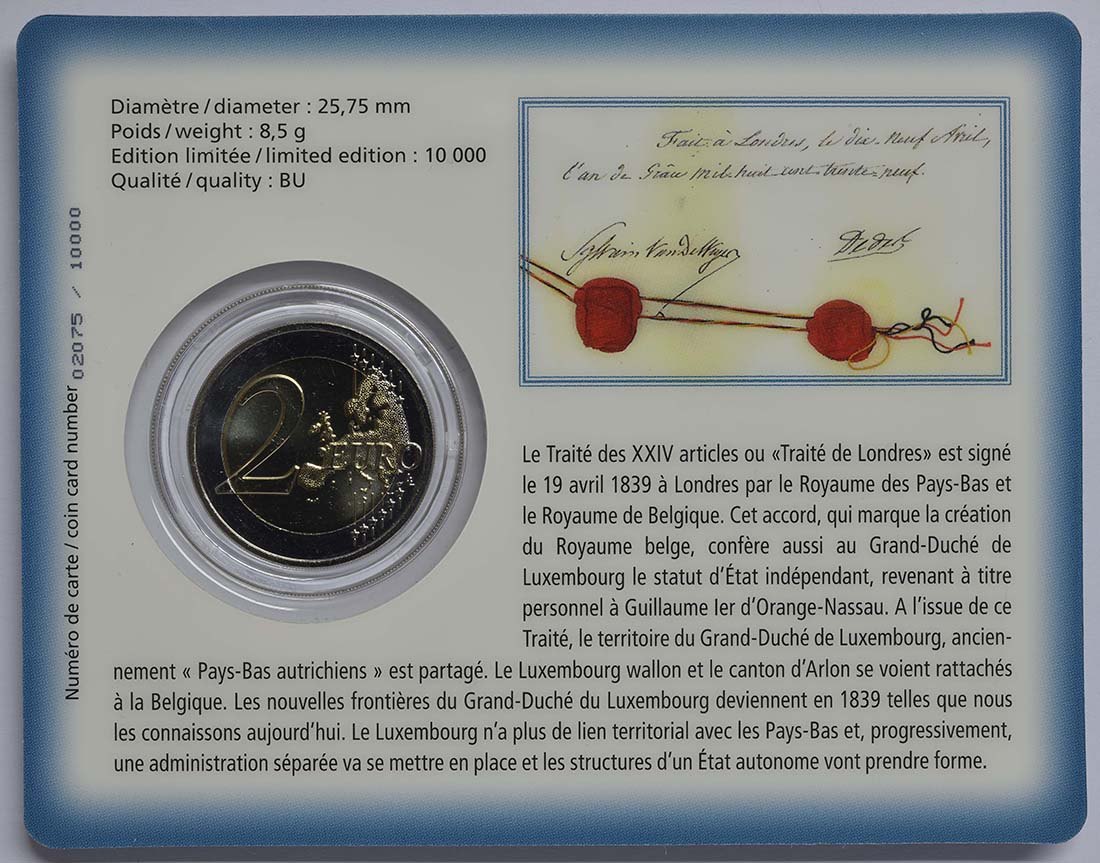
Mintage information from source: max. 10.000
Issue occasion
The commemorative coin honours the 175th anniversary of the independence of the Grand Duchy of Luxembourg. The design shows, on the right, the portrait of His Royal Highness Grand Duke Henri in profile facing right, and on the left the years “1839” and “2014” as well as the inscription “LËTZEBUERG”. Below are the words “ONOFHÄNGEGKEET” and “175 Joër”.
The design
The inner part of the coin shows a portrait of His Royal Highness Grand Duke Henri in profile facing right, and on the left side, arranged vertically, the years “1839” and “2014” as well as the name of the issuing country, “LËTZEBUERG”. In the lower part of the inner section, the words “ONOFHÄNGEGKEET” and “175 Joër” can be read.
The outer ring of the coin depicts the twelve stars of the European flag.
The outer ring of the coin depicts the twelve stars of the European flag.
Background on the topic
The year 1839 does not mark the founding of Luxembourg as a grand duchy. This had already taken place in 1815 at the Congress of Vienna (Wiener Kongress). At that time, Luxembourg was transferred to the Dutch King William I as an independent grand duchy and simultaneously became a member of the German Confederation (Deutscher Bund). A personal union existed: the Dutch king was also Grand Duke of Luxembourg in a personal union.
After the Belgian Revolution of 1830, a large part of the Luxembourg population joined the uprising against Dutch rule. In the following years, the country’s territorial affiliation was disputed. The Treaty of London of 19 April 1839 (Londoner Vertrag) finally regulated the division of Luxembourg. The predominantly French-speaking western part went to Belgium and today forms the Belgian province of Luxembourg. The eastern part remained a grand duchy under William I. Its territory essentially corresponds to the present-day state of Luxembourg.
The independence of 1839 was therefore part of a longer process of state development. Luxembourg initially remained connected to the Netherlands in a personal union and belonged to the German Confederation (Deutscher Bund) until its dissolution in 1866. The personal union ended in 1890 because different succession rules applied in the grand duchy than in the Netherlands. The Luxembourgish throne then passed to the House of Nassau-Weilburg (Haus Nassau-Weilburg).
Grand Duke Henri has been Luxembourg’s head of state since October 2000. He succeeded his father, Grand Duke Jean, following his abdication. As grand duke, Henri stands at the head of the constitutional monarchy; political decision-making takes place within the framework of parliamentary democracy. The portrait of the ruler on the coin thus establishes a connection between the historic state anniversary and the present form of government. Portraits of the reigning grand duke regularly feature in the design of Luxembourgish euro coins.
The anniversary provided an occasion to commemorate the territorial reorganization of 1839, from which present-day Luxembourg emerged. The Luxembourgish words “Onofhängegkeet” and “Joër” also refer to the role of Luxembourgish as the national language and as an expression of an independent state identity.
After the Belgian Revolution of 1830, a large part of the Luxembourg population joined the uprising against Dutch rule. In the following years, the country’s territorial affiliation was disputed. The Treaty of London of 19 April 1839 (Londoner Vertrag) finally regulated the division of Luxembourg. The predominantly French-speaking western part went to Belgium and today forms the Belgian province of Luxembourg. The eastern part remained a grand duchy under William I. Its territory essentially corresponds to the present-day state of Luxembourg.
The independence of 1839 was therefore part of a longer process of state development. Luxembourg initially remained connected to the Netherlands in a personal union and belonged to the German Confederation (Deutscher Bund) until its dissolution in 1866. The personal union ended in 1890 because different succession rules applied in the grand duchy than in the Netherlands. The Luxembourgish throne then passed to the House of Nassau-Weilburg (Haus Nassau-Weilburg).
Grand Duke Henri has been Luxembourg’s head of state since October 2000. He succeeded his father, Grand Duke Jean, following his abdication. As grand duke, Henri stands at the head of the constitutional monarchy; political decision-making takes place within the framework of parliamentary democracy. The portrait of the ruler on the coin thus establishes a connection between the historic state anniversary and the present form of government. Portraits of the reigning grand duke regularly feature in the design of Luxembourgish euro coins.
The anniversary provided an occasion to commemorate the territorial reorganization of 1839, from which present-day Luxembourg emerged. The Luxembourgish words “Onofhängegkeet” and “Joër” also refer to the role of Luxembourgish as the national language and as an expression of an independent state identity.
Interesting Facts
According to the BCL Numismatic Catalogue, this Coincard was issued only 7,500 times, contrary to the number printed on it. The mintage of 10,000 copies represents the maximum possible mintage.