
 Deutsch
 English
 Français
 Español
 Italiano
 Nederlands
 Português
 Slovenčina
 Hrvatski
 Slovenščina
 Lietuvių
 Eesti
Eesti Български
Reverse

Obverse

More images of the main coin

San Marino · 500th anniversary of the death of Pinturicchio
Issue date13 Sept 2013
Total mintage115,000
EU maximum115,000
Editions3
Edge lettering2 ★ × 6, alternately upright/inverted
InscriptionSAN MARINO / R / MOMONI / PINTURICCHIO / 1513 / 2013
DesignerClaudia Momoni
mintInstituto Poligrafico e Zecca Dello Stato, Roma
Issue occasion
The commemorative coin marks the 500th anniversary of the death of the Italian painter Pinturicchio. The design shows the fresco “Jesus among the Doctors” in the centre, surrounded by the inscription “PINTURICCHIO”, the years “1513” and “2013”, and the name “SAN MARINO”.
The design
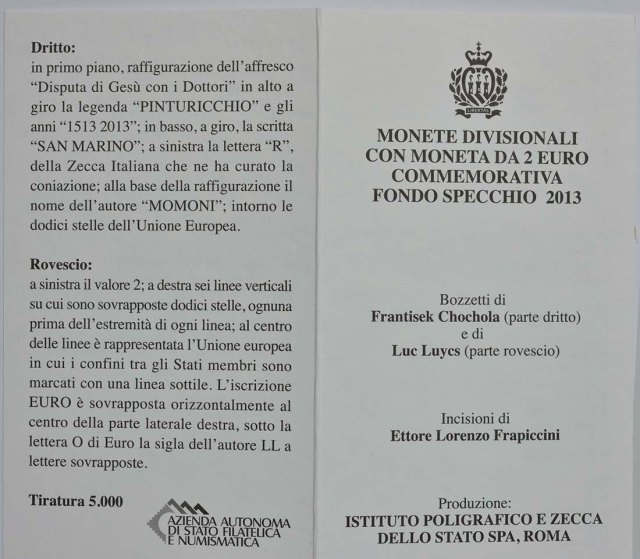
In the center, the fresco “Jesus among the Doctors” can be seen. In the lower part of the coin’s inner section, the name “SAN MARINO” is embossed in a semicircle, with the letter “R”, the symbol of the Italian mint, on the left, and the name of the engraver “MOMONI” below the fresco; above the fresco, the inscription “PINTURICCHIO” and the years “1513” and “2013” are arranged in a semicircle.
The twelve stars of the European flag are depicted on the coin’s outer ring.
The twelve stars of the European flag are depicted on the coin’s outer ring.
Background on the topic
Pinturicchio was the byname of Bernardino di Betto, born in Perugia around 1454. The name can be understood, roughly, as “little painter.” He belonged to the Umbrian school of Renaissance painting and worked primarily as a fresco painter. In Rome, he participated in the decoration of the Sixtinische Kapelle, probably in Perugino’s circle. Later, he decorated several rooms in the Vatican for Pope Alexander VI, now known as the Borgia-Appartements. His other works include the frescoes of the Piccolomini-Bibliothek in the cathedral of Siena. Pinturicchio died there in 1513.
The selected fresco is located in the Baglioni Chapel of the church of Santa Maria Maggiore in Spello, a town in Umbria. It forms part of a cycle of paintings depicting Mary and the childhood of Christ, which Pinturicchio executed around the turn of the 16th century on commission from Troilo Baglioni. The depiction combines the biblical narrative with the architecture of a town square designed according to the rules of central perspective. The figures and buildings are not historically reconstructed, but instead transferred into the visual world of the Italian Renaissance.
The scene is based on the Gospel of Luke. Twelve-year-old Jesus travels with Mary and Joseph to Jerusalem for the Passover festival. On the return journey, his parents notice that he is missing. After a three-day search, they find him in the Temple, listening to the scribes and speaking with them. The traditional “doctors” therefore do not refer to medical practitioners, but to teachers and interpreters of religious law.
No direct biographical connection between Pinturicchio and San Marino is evident. Rather, the selection forms part of San Marino’s coin issues dedicated to artists and cultural anniversaries from the Italian cultural sphere. Pinturicchio’s date of death provided a clearly datable occasion; the fresco also supplied a single work that could be used as a reference point even in the small coin format.
The selected fresco is located in the Baglioni Chapel of the church of Santa Maria Maggiore in Spello, a town in Umbria. It forms part of a cycle of paintings depicting Mary and the childhood of Christ, which Pinturicchio executed around the turn of the 16th century on commission from Troilo Baglioni. The depiction combines the biblical narrative with the architecture of a town square designed according to the rules of central perspective. The figures and buildings are not historically reconstructed, but instead transferred into the visual world of the Italian Renaissance.
The scene is based on the Gospel of Luke. Twelve-year-old Jesus travels with Mary and Joseph to Jerusalem for the Passover festival. On the return journey, his parents notice that he is missing. After a three-day search, they find him in the Temple, listening to the scribes and speaking with them. The traditional “doctors” therefore do not refer to medical practitioners, but to teachers and interpreters of religious law.
No direct biographical connection between Pinturicchio and San Marino is evident. Rather, the selection forms part of San Marino’s coin issues dedicated to artists and cultural anniversaries from the Italian cultural sphere. Pinturicchio’s date of death provided a clearly datable occasion; the fresco also supplied a single work that could be used as a reference point even in the small coin format.
eBay price analysis
For this issue, there is a price history based on actual eBay sales – with median, range and number of sales
View price analysisBlister BU – Issue 1 – Single page
- Packaging
- Blister pack
- Mintage
- 109,000
- Market price
- €39.00
- Edge lettering
- 2 ★ × 6, alternately upright/inverted
Mintage by issue type
Blister pack
110,000
2 Editions
Coin set
5,000
More editions
2
Mintages
San Marino
115,000Blister pack BU: 109,000
Blister pack BU: 1,000
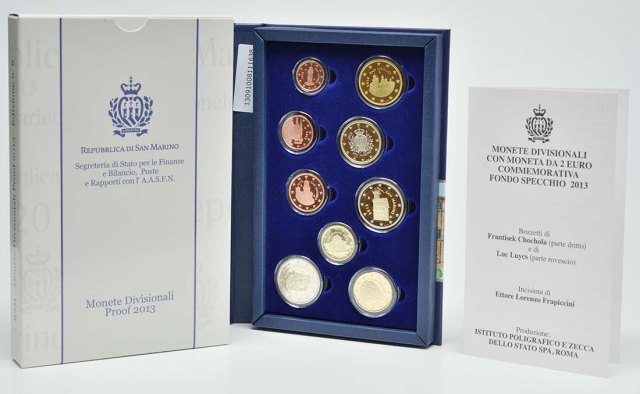
Coin set proof: 5,000
Official issue prices
2013 · Blister pack BU: €14.00
2013 · Coin set proof: €110.00
Additional information
Ausgabe des Blisters auf der Monety Expo & Fila Expo in Warschau Polen. Für die Messe gab es eine Sonderausgabe der Pinturicchio-Münze in einem speziellen Folder. Die Auflage ist auf 1.000 Exemplare beschränkt, die Vorlage der Eintrittkarte war notwendig. Ausgabepreis: Erst 25 €, später 18 €, plus 1,25 € Eintrittskarte.