
 Deutsch
 English
 Français
 Español
 Italiano
 Nederlands
 Português
 Slovenčina
 Hrvatski
 Slovenščina
 Lietuvių
 Eesti
Eesti Български
Reverse
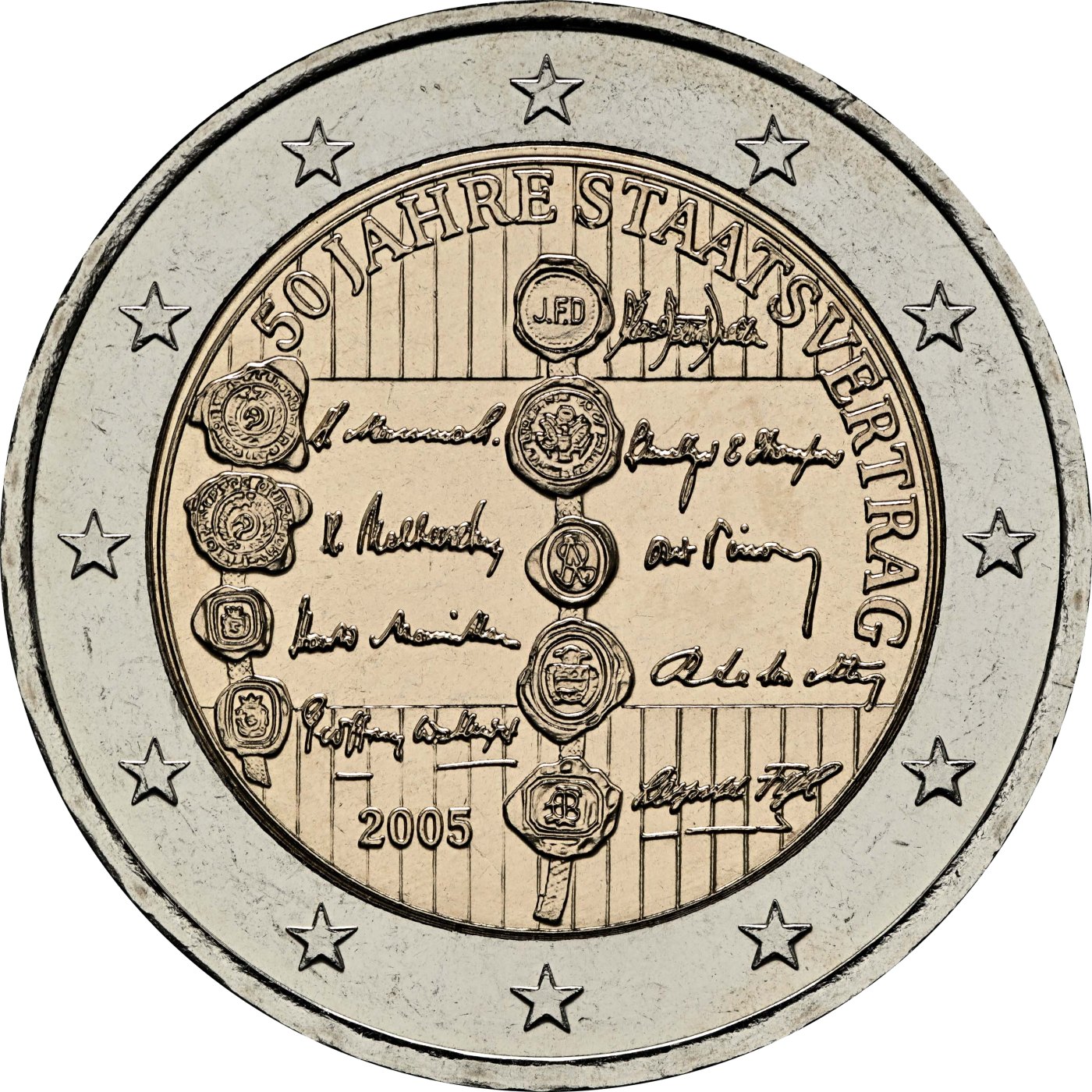
Obverse

Austria · 50 years State Treaty
Issue date11 May 2005
Total mintage7,000,000
EU maximum7,000,000
Editions4
Edge lettering2 EURO ★★★ × 4, alternating upright/inverted
Inscription50 JAHRE STAATSVERTRAG / 2005
DesignerHelmut Andexlinger
mintBisher wurden alle österreichischen 2€CC geprägt bei:
Münze Österreich AG, Wien
Issue occasion
The commemorative coin marks the 50th anniversary of the signing of the Austrian State Treaty. The design shows a reproduction of the signatures and seals on its final page; the treaty was signed in May 1955 by the foreign ministers and ambassadors of the Soviet Union, Great Britain, the United States and France, as well as by Austrian Foreign Minister Leopold Figl. Above this is the inscription “50 YEARS STATE TREATY”, while the vertically striped background heraldically depicts the Austrian national colours, red-white-red.
The design
The outer coin ring bears the twelve stars of the European Union. The inner part shows a reproduction of the signatures and seals on the final page of the Österreichischer Staatsvertrag, which was signed in May 1955 by the foreign ministers and ambassadors of the Soviet Union, Great Britain, the United States and France, as well as by the Austrian Foreign Minister at the time, Leopold Figl. Above the seals, the inscription “50 YEARS STATE TREATY” runs along the edge of the coin’s inner section in a semicircle slightly inclined to the right. The year of issue 2005 is located at the bottom left. The vertically striped background of the coin design represents the heraldic depiction of Austria’s national colours, red-white-red.
Background on the topic
After the “Anschluss” of Austria to the National Socialist German Reich in March 1938, Austria no longer existed as an independent state until the end of the Second World War. The Republic was re-established in April 1945. However, the country initially remained occupied by the four Allied powers and was divided into occupation zones; Vienna was also divided into four sectors. An Allied Commission exercised control rights, meaning that the Austrian federal government could act with only limited sovereignty.
Negotiations on a treaty-based restoration of state independence dragged on for years. One major reason was the beginning of the Cold War: the Western Allies and the Soviet Union were unable to reach agreement for a long time on the political and security-policy conditions. The breakthrough came in 1955 through an Austrian government delegation in Moscow. Austria held out the prospect of permanent neutrality based on the model of Switzerland. However, this was not laid down in the State Treaty itself, but was later adopted through a separate Federal Constitutional Law.
The treaty restored Austria as a sovereign, independent and democratic state. Among other things, it regulated the withdrawal of the occupation forces, prohibited a political or economic union with Germany and contained provisions against National Socialist organisations. It also guaranteed certain rights to the Slovenian and Croatian minorities. After it entered into force, the last Allied soldiers left the country in October 1955.
Leopold Figl was initially Federal Chancellor of the re-established Republic and later Federal Minister for Foreign Affairs. In this capacity, he was involved in the final negotiations. The presentation of the treaty at Vienna’s Schloss Belvedere is associated with the statement “Austria is free!”
The anniversary lent itself to a commemorative coin because, in Austria’s understanding of its history, the State Treaty stands for the end of the occupation period and the regaining of full freedom of action as a state. In Austria, the year 2005 was also used for extensive public discussion of the anniversaries of 1945 and 1955.
Negotiations on a treaty-based restoration of state independence dragged on for years. One major reason was the beginning of the Cold War: the Western Allies and the Soviet Union were unable to reach agreement for a long time on the political and security-policy conditions. The breakthrough came in 1955 through an Austrian government delegation in Moscow. Austria held out the prospect of permanent neutrality based on the model of Switzerland. However, this was not laid down in the State Treaty itself, but was later adopted through a separate Federal Constitutional Law.
The treaty restored Austria as a sovereign, independent and democratic state. Among other things, it regulated the withdrawal of the occupation forces, prohibited a political or economic union with Germany and contained provisions against National Socialist organisations. It also guaranteed certain rights to the Slovenian and Croatian minorities. After it entered into force, the last Allied soldiers left the country in October 1955.
Leopold Figl was initially Federal Chancellor of the re-established Republic and later Federal Minister for Foreign Affairs. In this capacity, he was involved in the final negotiations. The presentation of the treaty at Vienna’s Schloss Belvedere is associated with the statement “Austria is free!”
The anniversary lent itself to a commemorative coin because, in Austria’s understanding of its history, the State Treaty stands for the end of the occupation period and the regaining of full freedom of action as a state. In Austria, the year 2005 was also used for extensive public discussion of the anniversaries of 1945 and 1955.
eBay price analysis
For this issue, there is a price history based on actual eBay sales – with median, range and number of sales
View price analysis2 Euro BU – Single page
- Mintage
- 6,878,000
- Market price
- €6.00
- Edge lettering
- 2 EURO ★★★ × 4, alternating upright/inverted
Mintage by issue type
BU
6,878,000
Coin set
120,000
2 Editions
Numismatic cover
2,000
More editions
3


Mintages
Österreich
7,000,000Circulation: 6,878,000
BU Mint Set: 100,000
Coin set proof: 20,000
Numismatic cover: 2,000
Official issue prices
2005 · BU Mint Set: €19.00
2005 · Coin set proof: €66.00
2005 · Numismatic cover: €9.95
Additional information
KMS HGH (handgehoben) und KMS PP nur mit 2CC, Kursmünze wurde nicht geprägt. Die Österreichische Post gab in Zusammenarbeit mit der Münze Österreich einen Numisbrief mit der 2CC "Staatsvertrag" heraus.