
 Deutsch
 English
 Français
 Español
 Italiano
 Nederlands
 Português
 Slovenčina
 Hrvatski
 Slovenščina
 Lietuvių
 Eesti
Eesti Български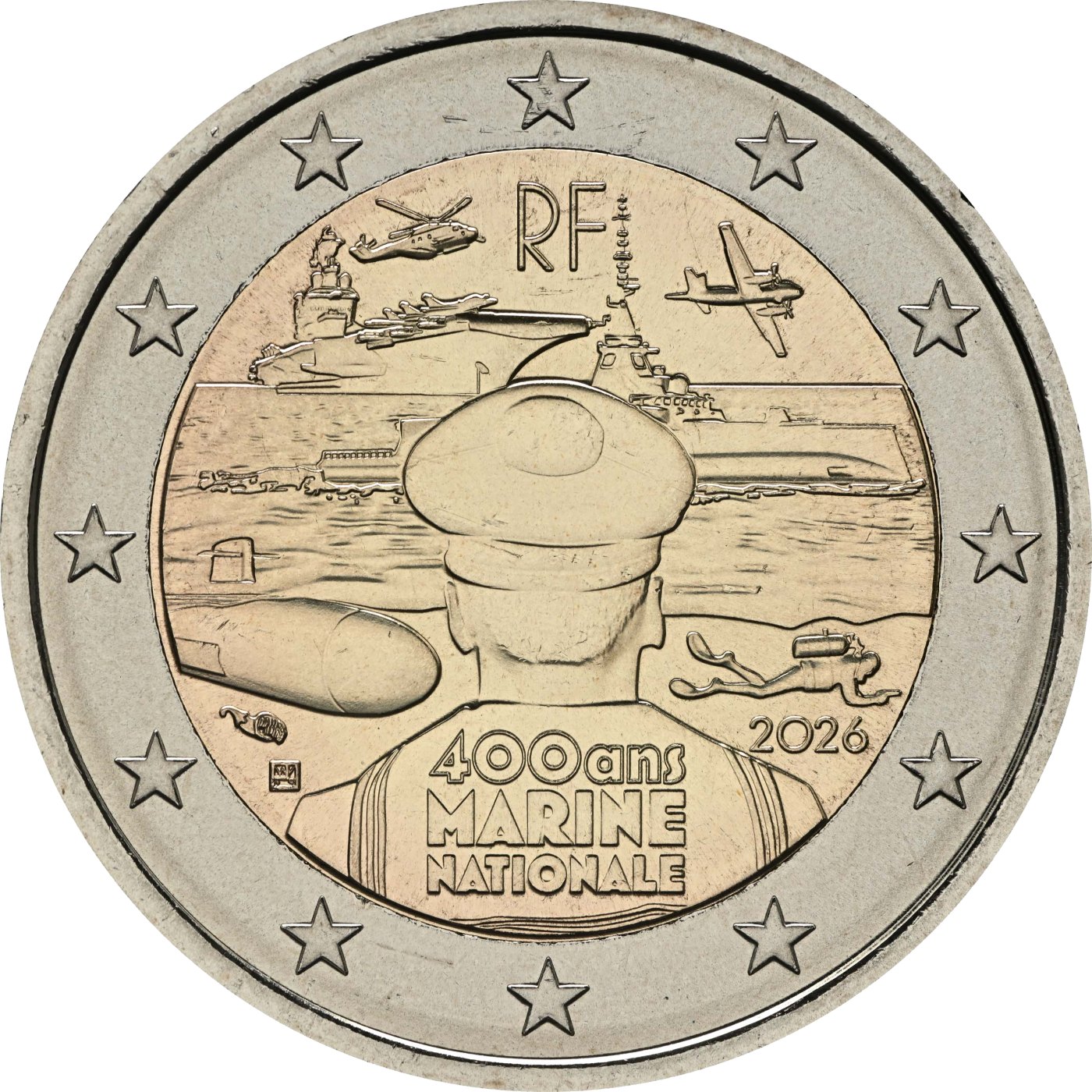
CC 605 2026
2 euro coin
BU Main coin Bank issue
2 Euro BU
France · 400 years of the French Navy
Mintage20,000,000
Issue date30 Jun 2026
Edge lettering2 ★ ★ × 6, alternating upright/inverted
Market price€3.50
Issue occasion
The issue commemorates the 400th anniversary of the French Navy. The anniversary refers to the year 1626, which is regarded as the beginning of its permanent state organisation.
Background on the topic
France already had war fleets in the Middle Ages and in the 16th century. However, these were often assembled only for individual campaigns and were subordinate to different regional commanders. Merchant ships could be armed and requisitioned in wartime. A unified administration, permanently maintained units and coordinated infrastructure existed only in rudimentary form.
The institutional reorganization is closely associated with Cardinal Richelieu. From 1624, he was the chief minister of Ludwigs XIII. and received the title of Grand Master, Chief and General Superintendent of Navigation and Trade. Richelieu wanted to consolidate the previously fragmented responsibilities, have warships built, expand ports and organize the supply and recruitment of crews under state control. The background was the conflicts with other European naval powers, the protection of French trade and control of the coasts. The siege of the Protestant port city of La Rochelle also demonstrated the military role that naval forces could play.
The centralization initiated by Richelieu was not a one-time founding act, but the beginning of a longer process. Under Ludwigs XIV., Finance and Navy Minister Jean-Baptiste Colbert continued the expansion. Arsenals and naval bases such as Brest, Rochefort and Toulon later formed the organizational foundation for operations in the Atlantic and the Mediterranean.
The name of the naval forces changed with France’s political systems: Royal, Revolutionary and Imperial navies followed one another. Nevertheless, today’s Marine nationale regards itself as the institutional successor to these earlier fleets. Its tasks include protecting French maritime and overseas territories, international operations and sea-based nuclear deterrence.
The reorganization under Richelieu is a suitable reference point for the coin’s design because it commemorates not a single naval battle, but the emergence of a navy permanently administered by the central state. This emphasizes institutional continuity across several forms of government.
The institutional reorganization is closely associated with Cardinal Richelieu. From 1624, he was the chief minister of Ludwigs XIII. and received the title of Grand Master, Chief and General Superintendent of Navigation and Trade. Richelieu wanted to consolidate the previously fragmented responsibilities, have warships built, expand ports and organize the supply and recruitment of crews under state control. The background was the conflicts with other European naval powers, the protection of French trade and control of the coasts. The siege of the Protestant port city of La Rochelle also demonstrated the military role that naval forces could play.
The centralization initiated by Richelieu was not a one-time founding act, but the beginning of a longer process. Under Ludwigs XIV., Finance and Navy Minister Jean-Baptiste Colbert continued the expansion. Arsenals and naval bases such as Brest, Rochefort and Toulon later formed the organizational foundation for operations in the Atlantic and the Mediterranean.
The name of the naval forces changed with France’s political systems: Royal, Revolutionary and Imperial navies followed one another. Nevertheless, today’s Marine nationale regards itself as the institutional successor to these earlier fleets. Its tasks include protecting French maritime and overseas territories, international operations and sea-based nuclear deterrence.
The reorganization under Richelieu is a suitable reference point for the coin’s design because it commemorates not a single naval battle, but the emergence of a navy permanently administered by the central state. This emphasizes institutional continuity across several forms of government.
eBay price analysis
For this issue, there is a price history based on actual eBay sales – with median, range and number of sales
View price analysis