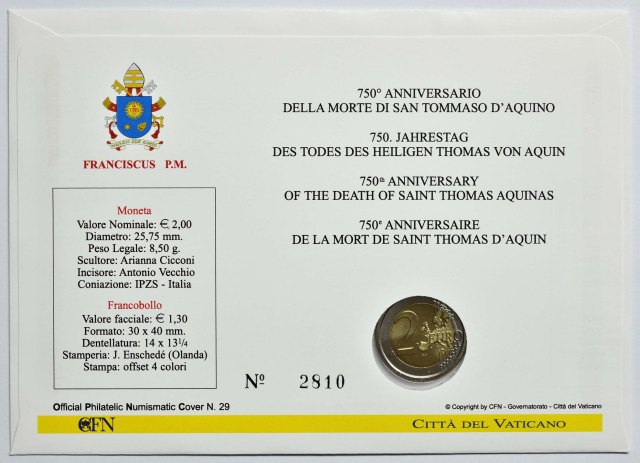
Issue date3 Jul 2024
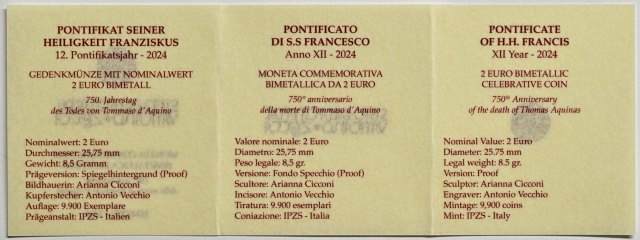
Total mintage80,900
EU maximum82,900
Editions3
Edge lettering2 ★ × 6, alternately upright/inverted
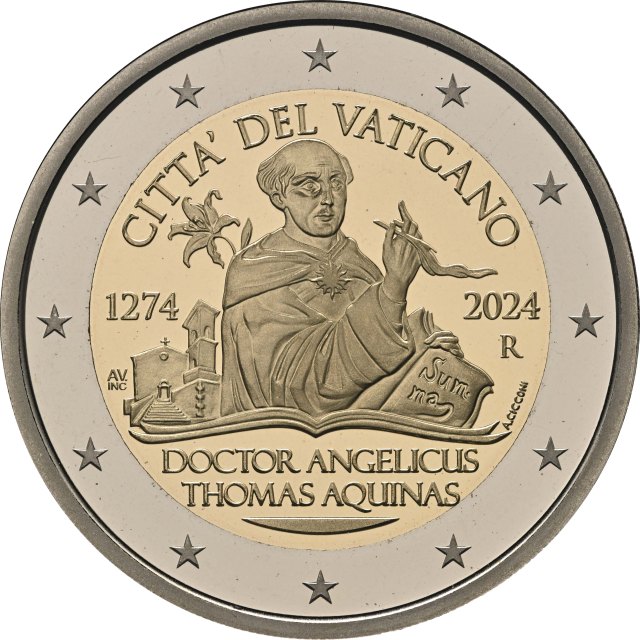
InscriptionDOCTOR ANGELICUS / CITTÀ DEL VATICANO / 1274 / 2024 / R / A. CICCONI
DesignerArianna Cicconi (Antonio Vecchio)
mintInstituto Poligrafico e Zecca Dello Stato, Roma
Issue occasion
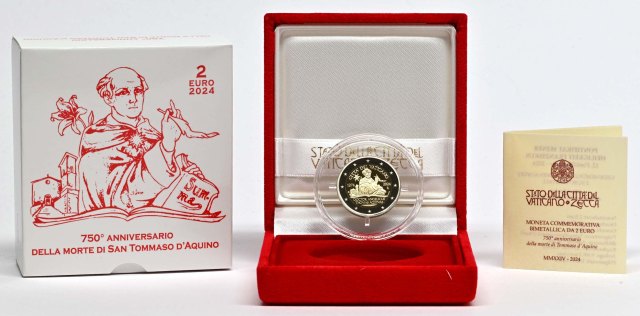
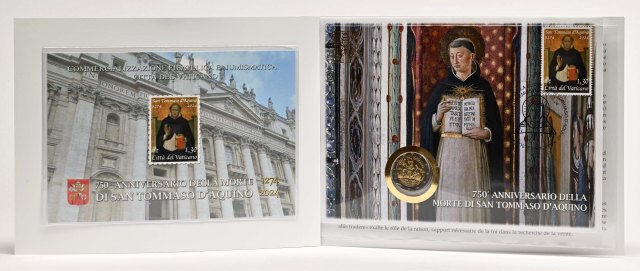
The commemorative coin marks the 750th anniversary of the death of Thomas Aquinas (Thomas von Aquin). The design depicts him in the habit of the Dominican Order (Dominikanerorden), holding his work “Summa Theologiae” and a quill; a radiant sun on his chest symbolizes his wisdom. The depiction is complemented by the inscription “Doctor Angelicus”, a lily as a symbol of chastity, and St. Thomas Church in Roccasecca, the first religious building erected in his honour.
The design
The coin design shows Thomas Aquinas in the habit of the Dominican Order, to which he belonged. In his left hand, he holds his most important work, “Summa Theologiae”, and in his right hand, a quill. A radiant sun on the saint’s chest symbolizes his great wisdom. Thomas Aquinas was also referred to, among other titles, as “Doctor Angelicus” (Angelic Doctor), a tribute to the extraordinary purity of his soul and body. This designation also appears as an inscription in the lower part of the coin. On the left side, a lily symbolizing chastity and the Church of St. Thomas in Roccasecca are depicted. The church was the first religious building in the world to be erected in honor of Thomas Aquinas, who was canonized by Pope John XXII on 18 July 1323. The inscription “CITTÀ DEL VATICANO” is located along the upper edge of the inner disc. The year “1274” appears on the left side and the year “2024” on the right side. The mintmark “R” and the artist’s name “A. CICCONI” are depicted along the lower edge.
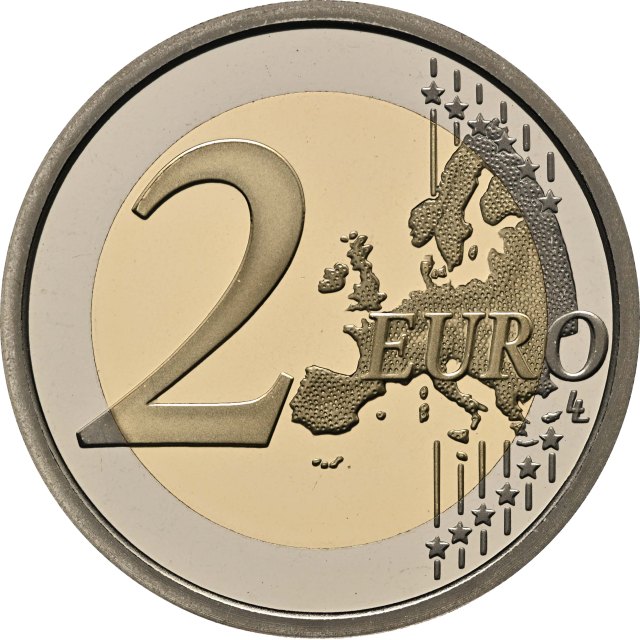
The twelve stars of the European flag are depicted on the outer ring of the coin.
Background on the topic
Thomas von Aquin was born around 1225 near Roccasecca in what is now Latium into a noble family. Against his family’s wishes, he joined the still young Dominikanerorden. He studied in Paris and Cologne, among others under Albertus Magnus, and later taught several times at the Universität Paris and in Italy. In 1274, he died at the Cistercian monastery of Fossanova on his way to the Second Council of Lyon.
His work belongs to the period of High Scholasticism. At medieval universities, theological and philosophical questions were examined according to a fixed method: first, objections were formulated, counterarguments were presented, and a reasoned answer was developed from them. At the same time, numerous ancient writings, particularly the works of Aristotle, became more comprehensively accessible in Western Europe through translations. This raised anew the question of how ancient philosophy and Christian revelation were related to each other.
Thomas held that reason and faith were different but mutually compatible paths to truth. Some insights could be gained by people through observation and logical reasoning; others were based on revelation. He adopted concepts from Aristotelian philosophy and integrated them into a Christian system. His writings address, among other subjects, the doctrine of God, ethics, natural law, human action, political order, and the sacraments. His arguments for the knowability of God also shaped later debates.
Within the Catholic Church, Thomas became an authoritative theological figure. In 1567, Pope Pius V declared him a Doctor of the Church. In 1879, Pope Leo XIII once again recommended his philosophy as the foundation of Catholic education in the encyclical *Aeterni Patris*. Thomism subsequently had a particular influence on the training of priests and on Catholic universities.
The Vatican’s choice of the anniversary is explained by this lasting position in theology, philosophy, and Church teaching. The round anniversary of his death provided an opportunity to commemorate a thinker whose concepts and methods are still used in Catholic teaching traditions today.
- Packaging
- Blister pack
- Mintage
- 68,000
- Market price
- €45.00
- Edge lettering
- 2 ★ × 6, alternately upright/inverted
Mintage by issue type
Proof
9,900
Blister pack
68,000
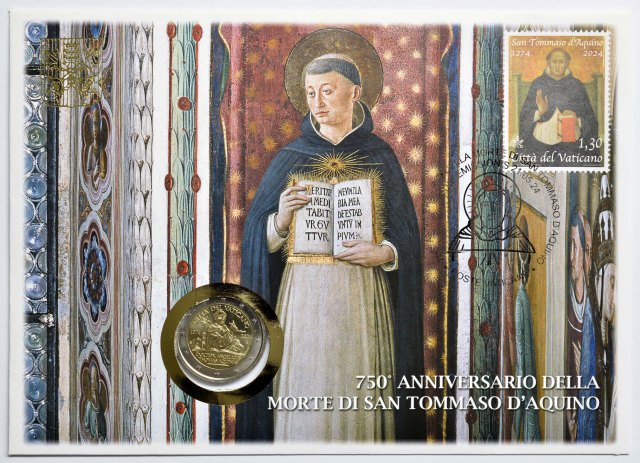
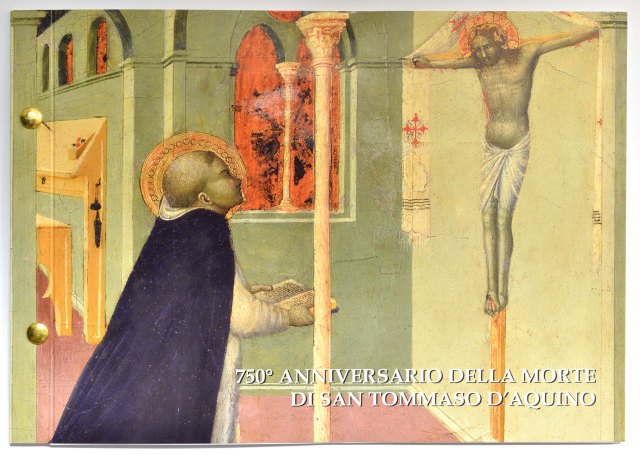
Numismatic cover
3,000
 Deutsch
 English
 Français
 Español
 Italiano
 Nederlands
 Português
 Slovenčina
 Hrvatski
 Slovenščina
 Lietuvių
 Eesti
Eesti Български