
 Deutsch
 English
 Français
 Español
 Italiano
 Nederlands
 Português
 Slovenčina
 Hrvatski
 Slovenščina
 Lietuvių
 Eesti
Eesti Български


CC 53 2009
Blister pack
Proof
Proof blister
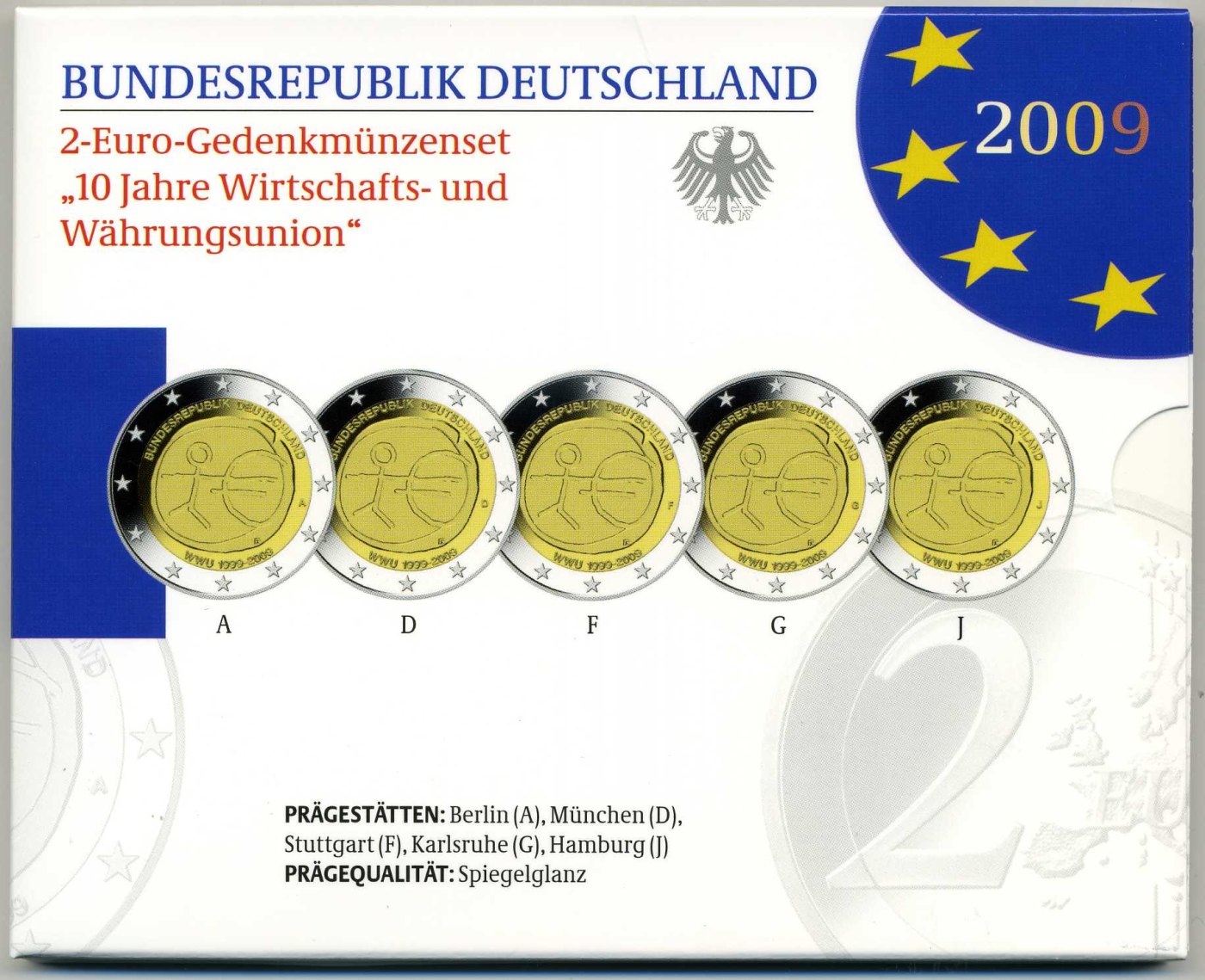
Germany · 10 years of EMU
Mintage20,000
Issue price€29.00
Issue date1 Jan 2009
PackagingBlister pack
Edge letteringEINIGKEIT UND RECHT UND FREIHEIT + Federal Eagle
Market price€99.00
Varieties
1Germany, A · A · Mint mark A · Proof · Blister pack · Mintage 20,000
Issue occasion
The occasion is the tenth anniversary of the Economic and Monetary Union (Wirtschafts- und Währungsunion) and the creation of the euro on 1 January 1999. The design by G. Stamatopoulos, selected in an online vote, shows a stylised human figure whose left arm merges into the euro symbol, supplemented by the years 1999–2009, the respective acronym of the EMU and twelve stars. The Luxembourg issue additionally features a portrait of the Grand Duke as a tilt effect.
The design
The coin features a stylized human figure in the centre, whose left arm is extended by the euro symbol. The artist’s initials ΓΣ appear below the euro symbol. The name of the issuing country in the national language(s) appears along the upper edge of the design, while 1999-2009 and the acronym EMU translated into the national language(s) appear along the lower edge.
The outer ring of the coin depicts the twelve stars of the European flag.
The outer ring of the coin depicts the twelve stars of the European flag.
Background on the topic
The Economic and Monetary Union emerged gradually from European integration. A central foundation was the Treaty of Maastricht, which entered into force in 1993. It paved the way for a common currency and established requirements for participation. These so-called convergence criteria include provisions on price stability, the budgetary situation, long-term interest rates and exchange-rate stability.
With the beginning of the third stage of monetary union, the exchange rates of the participating national currencies were irrevocably fixed. The euro initially served as a book money, means of payment and unit of account, for example in cashless payment transactions and on the financial markets. Banknotes and coins did not enter circulation until the beginning of 2002. Until then, people continued to pay in everyday life with D-Mark, francs, lire or pesetas, among other currencies; however, their value against the euro had already been fixed.
The Eurosystem is responsible for the common monetary policy. It consists of the European Central Bank and the national central banks of the states that have introduced the euro. The national governments, by contrast, largely retain responsibility for their budgetary and economic policies. This combination of a centralised monetary policy with financial policies that continue to be managed at national level characterises the structure of the monetary union.
The joint issue also fell during a period of expansion of the euro area. After the original participating states, further EU countries had adopted the common currency; Slovakia joined the euro area at the beginning of the year of issue. Not all Member States of the European Union belonged, or belong, to it, as participation requires legal and economic conditions to be met.
A uniform commemorative design was appropriate because the subject being commemorated was not a national anniversary but a joint European project. At the same time, the issues remained recognisable as coins struck by the individual states through their country designations, mint marks and different edge inscriptions. The coins thus combined the common monetary policy with the continuing responsibility of the Member States for the national sides of their circulation coins.
With the beginning of the third stage of monetary union, the exchange rates of the participating national currencies were irrevocably fixed. The euro initially served as a book money, means of payment and unit of account, for example in cashless payment transactions and on the financial markets. Banknotes and coins did not enter circulation until the beginning of 2002. Until then, people continued to pay in everyday life with D-Mark, francs, lire or pesetas, among other currencies; however, their value against the euro had already been fixed.
The Eurosystem is responsible for the common monetary policy. It consists of the European Central Bank and the national central banks of the states that have introduced the euro. The national governments, by contrast, largely retain responsibility for their budgetary and economic policies. This combination of a centralised monetary policy with financial policies that continue to be managed at national level characterises the structure of the monetary union.
The joint issue also fell during a period of expansion of the euro area. After the original participating states, further EU countries had adopted the common currency; Slovakia joined the euro area at the beginning of the year of issue. Not all Member States of the European Union belonged, or belong, to it, as participation requires legal and economic conditions to be met.
A uniform commemorative design was appropriate because the subject being commemorated was not a national anniversary but a joint European project. At the same time, the issues remained recognisable as coins struck by the individual states through their country designations, mint marks and different edge inscriptions. The coins thus combined the common monetary policy with the continuing responsibility of the Member States for the national sides of their circulation coins.