
 Deutsch
 English
 Français
 Español
 Italiano
 Nederlands
 Português
 Slovenčina
 Hrvatski
 Slovenščina
 Lietuvių
 Eesti
Eesti Български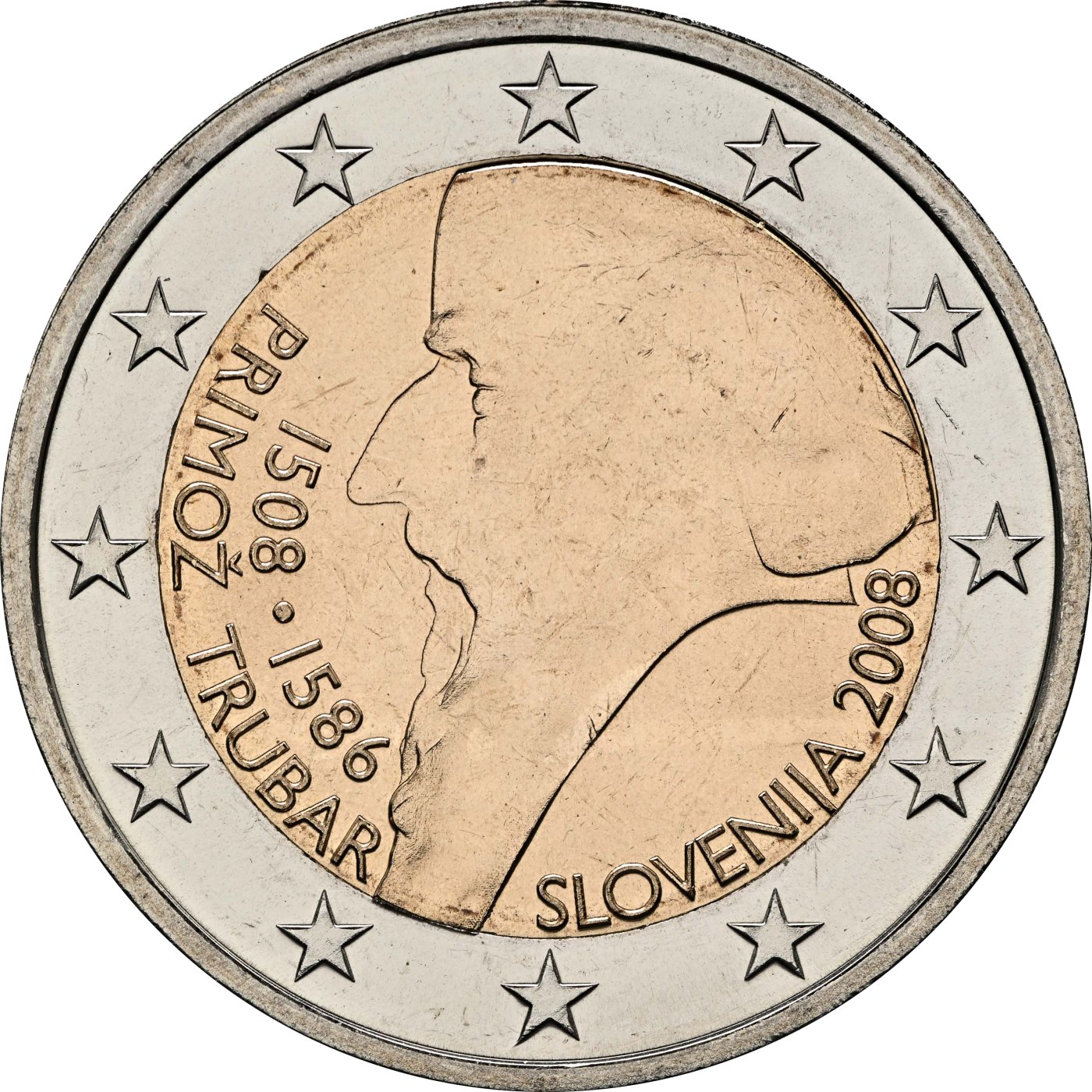
CC 44 2008
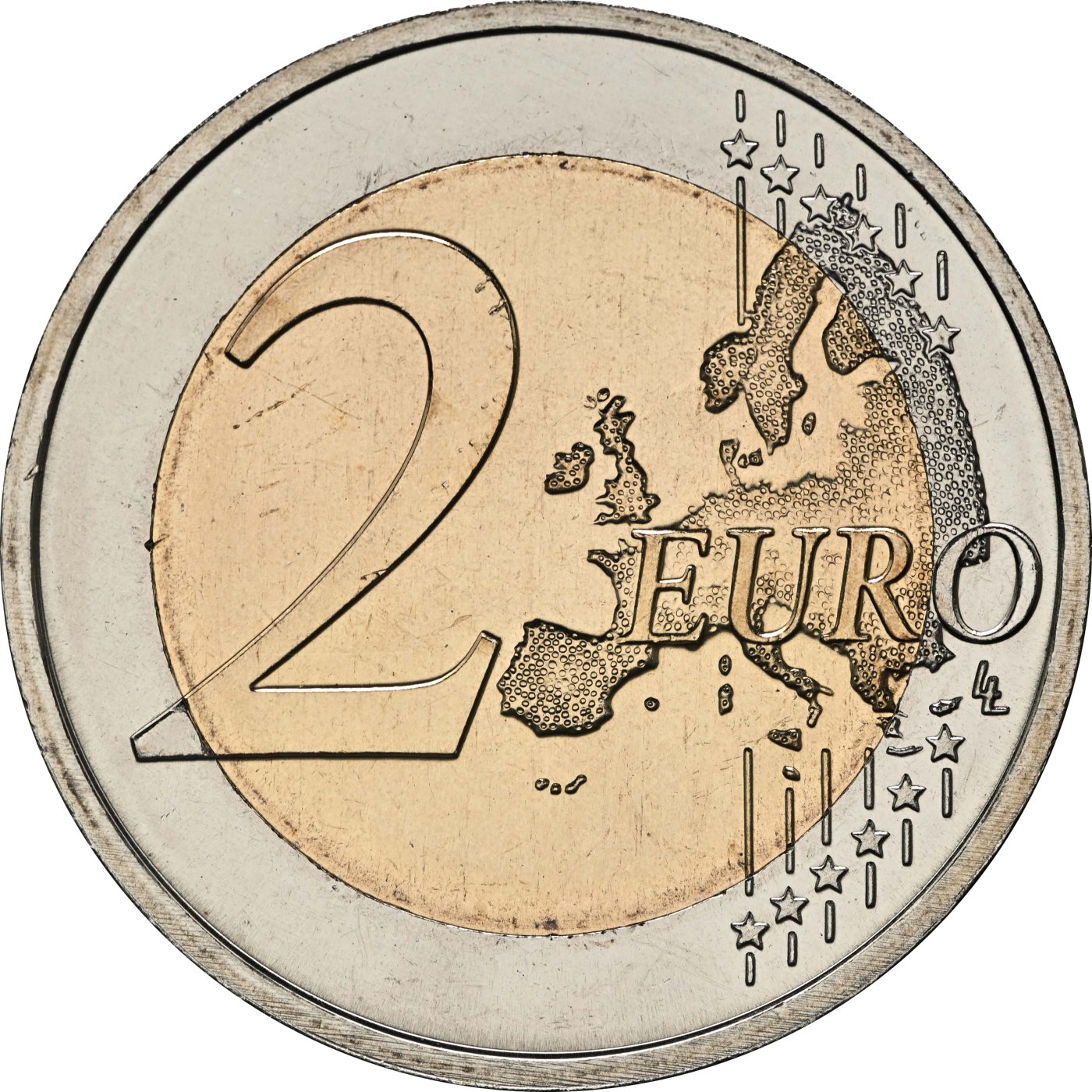
2 euro coin
BU Main coin Bank issue
2 Euro BU
Slovenia · 500th birthday of Primož Trubar
Mintage950,000
Issue date26 May 2008
Edge letteringSLOVENIJA •
Market price€5.90
Issue occasion
The commemorative coin honours the 500th birthday of Primož Trubar. The design shows his portrait in left profile, surrounded by his name, the dates of his life “1508–1586”, and the inscription “SLOVENIJA 2008”; the outer ring bears the twelve stars of the European flag.
The design
The coin features a left-facing portrait of Primož Trubar. Along the left edge of the inner part of the coin, the name “PRIMOŽ TRUBAR” and the years “1508-1586” are inscribed in two interlocking semicircles. Along the lower right edge, the inscription “SLOVENIJA 2008” appears in a semicircle.
The twelve stars of the European flag are depicted on the coin’s outer ring.
The twelve stars of the European flag are depicted on the coin’s outer ring.
Background on the topic
Primož Trubar was a clergyman, writer and representative of the Reformation. He came from the Duchy of Carniola (Herzogtum Krain), a Habsburg territory whose population spoke various Slovene dialects. There was no Slovene state at the time; Latin and German were used primarily in the Church, administration and scholarly literature.
Trubar initially became a Catholic priest, but under the influence of Reformation ideas he turned to Lutheranism. A fundamental idea of the Reformation was that believers should be able to read and understand religious texts in their own language. Because of his teachings, Trubar came into conflict with the Habsburg authorities and spent a large part of his life in exile in German territories. He returned to Carniola (Krain) temporarily and helped organise a Protestant church there, but was expelled again.
In 1550, Trubar published the first printed books in the Slovene language, the “Catechismus” and the “Abecedarium”. The “Abecedarium” was used for learning to read, while the catechism conveyed the foundations of the Protestant faith. Trubar later also translated the New Testament into Slovene and wrote further religious works. For these activities, he had to develop a supraregional written language that could be understood across different dialects. His language was based primarily on the dialect area of his homeland and was supplemented by features of the language of Ljubljana.
Trubar’s work was initially motivated by religion, but in the long term it had consequences for linguistic and cultural history. His books created a foundation for the Slovene written and literary language. In this way, he became a point of reference for the later development of Slovene cultural and national consciousness.
The anniversary therefore gave Slovenia an opportunity to commemorate not only a reformer, but also the beginnings of Slovene printing and Slovene-language literature. Trubar is also already among the personalities depicted on Slovene euro coins: his portrait appears on the country’s regular €1 coin.
Trubar initially became a Catholic priest, but under the influence of Reformation ideas he turned to Lutheranism. A fundamental idea of the Reformation was that believers should be able to read and understand religious texts in their own language. Because of his teachings, Trubar came into conflict with the Habsburg authorities and spent a large part of his life in exile in German territories. He returned to Carniola (Krain) temporarily and helped organise a Protestant church there, but was expelled again.
In 1550, Trubar published the first printed books in the Slovene language, the “Catechismus” and the “Abecedarium”. The “Abecedarium” was used for learning to read, while the catechism conveyed the foundations of the Protestant faith. Trubar later also translated the New Testament into Slovene and wrote further religious works. For these activities, he had to develop a supraregional written language that could be understood across different dialects. His language was based primarily on the dialect area of his homeland and was supplemented by features of the language of Ljubljana.
Trubar’s work was initially motivated by religion, but in the long term it had consequences for linguistic and cultural history. His books created a foundation for the Slovene written and literary language. In this way, he became a point of reference for the later development of Slovene cultural and national consciousness.
The anniversary therefore gave Slovenia an opportunity to commemorate not only a reformer, but also the beginnings of Slovene printing and Slovene-language literature. Trubar is also already among the personalities depicted on Slovene euro coins: his portrait appears on the country’s regular €1 coin.
eBay price analysis
For this issue, there is a price history based on actual eBay sales – with median, range and number of sales
View price analysis