
 Deutsch
 English
 Français
 Español
 Italiano
 Nederlands
 Português
 Slovenčina
 Hrvatski
 Slovenščina
 Lietuvių
 Eesti
Eesti Български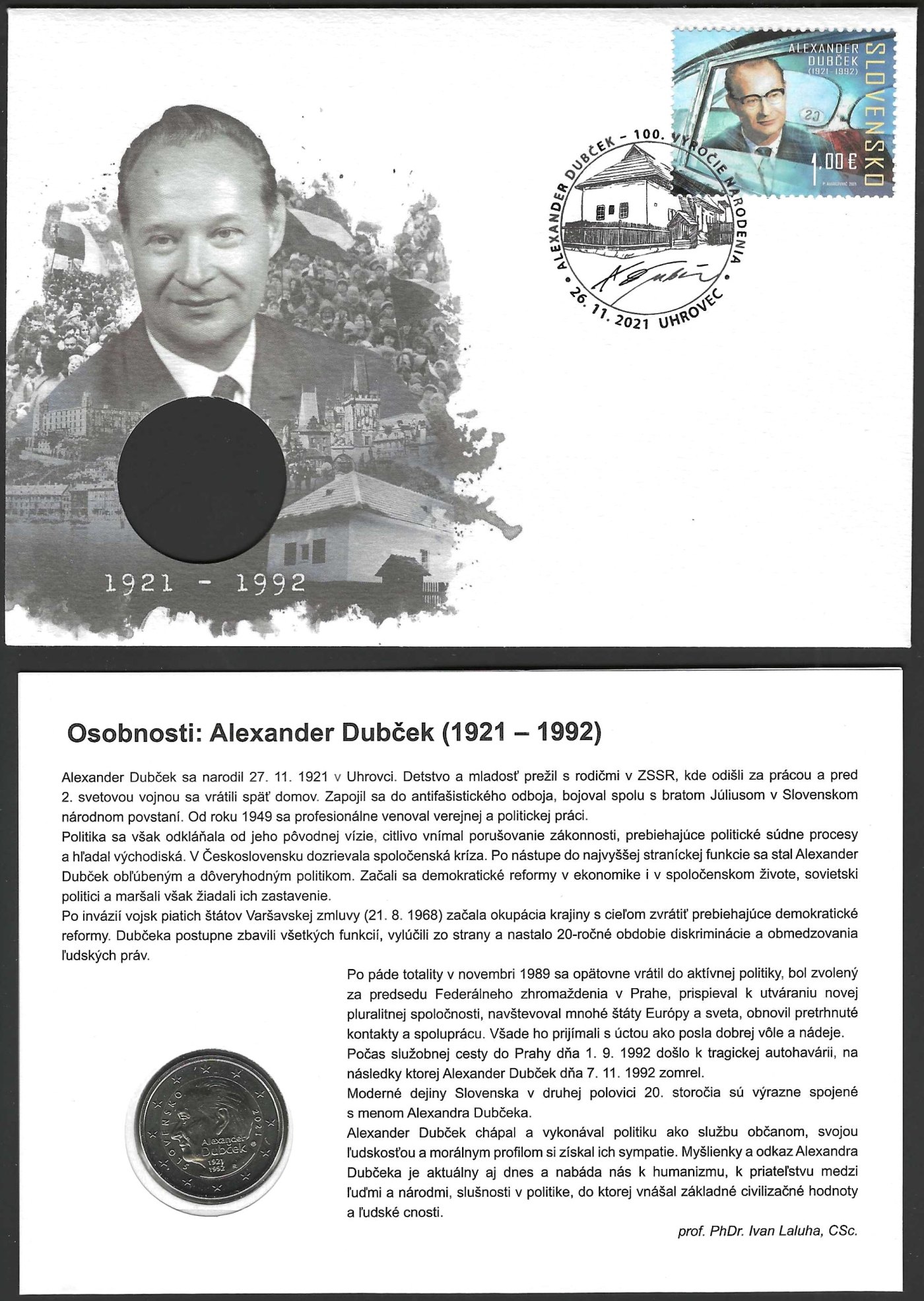
CC 426 2021
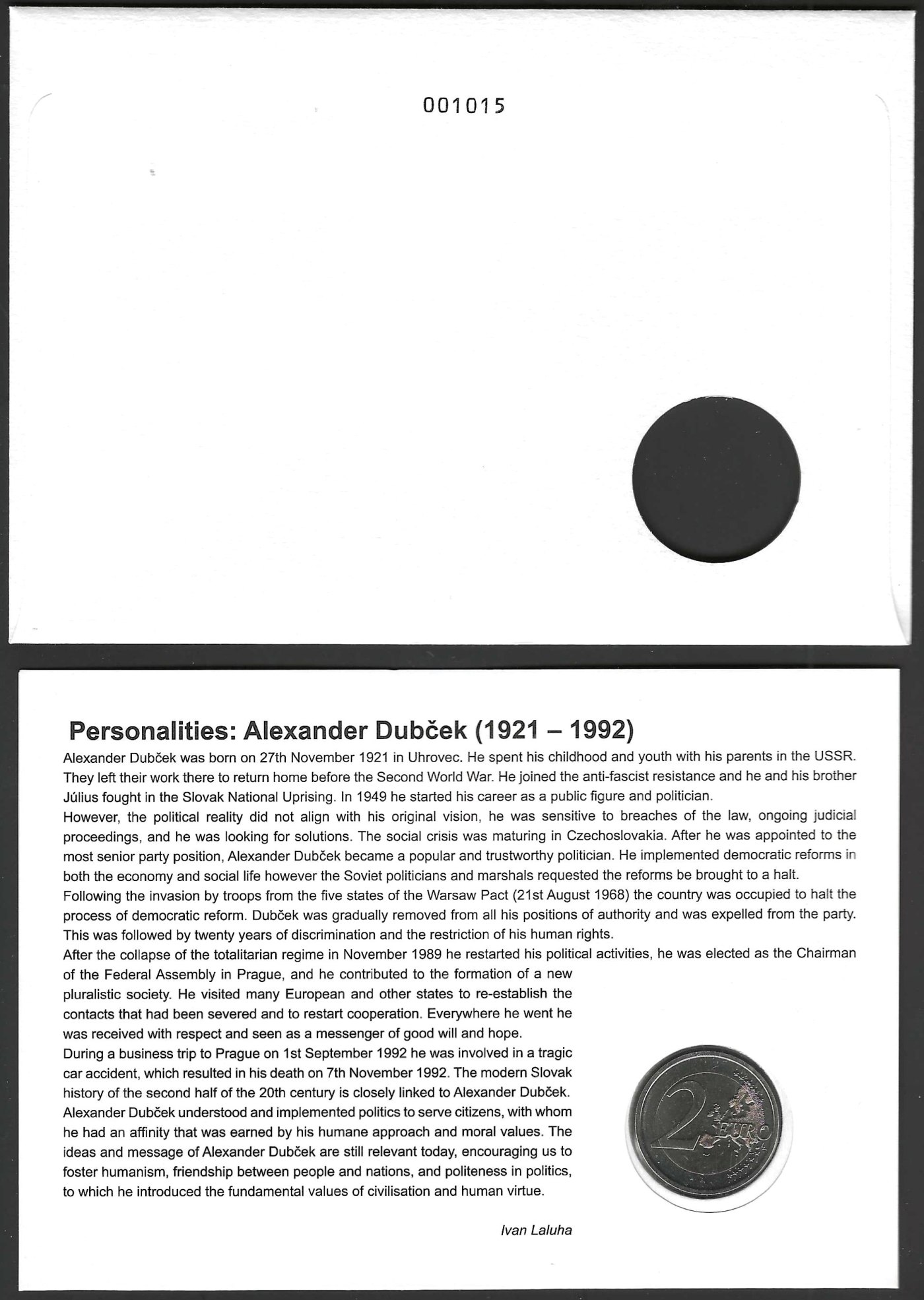
Numismatic cover
BU
Numismatic cover
Slovakia · 100th birthday of Alexander Dubček
Mintage2,000
Issue price€8.10
Issue date26 Nov 2021
PackagingNumismatic cover
Edge letteringSLOVENSKÁ REPUBLIKA + ★ + Linden leaf + ★
Issue occasion
The commemorative coin honours the 100th birthday of Slovak leading politician Alexander Dubček, whose efforts towards liberal reforms in Czechoslovakia in 1968 became known as the “Prague Spring (Prager Frühling)”. The design features a left-facing portrait of Dubček, as well as his name and the years of his life, “1921” and “1992”. It also includes the inscription “SLOVENSKO” and the twelve stars of the European flag.
The design
The coin design shows a left-facing portrait of the Slovak high-ranking politician Alexander Dubček, whose efforts toward liberal reforms in Czechoslovakia in 1968 later became known as the “Prague Spring”. The name of the issuing country, “SLOVENSKO”, is located along the left edge of the coin’s inner part. In the lower section, the portrait is overlaid by the name “Alexander Dubček” (the first name above the surname), and below it the year of birth “1921” and the year of death “1992” are shown, likewise arranged one above the other. Along the right edge of the coin’s inner part are the year of issue “2021” and, below it, the mint mark “MK” of the Kremnica Mint (Mincovňa Kremnica) between two minting forms. The stylized initials “BR” of the designer Branislav Ronai can be seen along the lower right edge.
The twelve stars of the European flag are depicted on the coin’s outer ring.
The twelve stars of the European flag are depicted on the coin’s outer ring.
Background on the topic
Alexander Dubček grew up partly in the Soviet Union and, during the Second World War, joined the resistance against the Slovak regime allied with the German Reich. He took part in the Slovak National Uprising of 1944 and pursued a career in the Communist Party after the war. In January 1968, he replaced Antonín Novotný as First Secretary of the Communist Party of Czechoslovakia.
Under Dubček’s leadership, a reform programme emerged that is often associated with the phrase “socialism with a human face”. The Communist Party was to retain its leading position, while greater freedom of opinion and of the press, partial economic decentralisation and greater public participation were envisaged. Censorship was relaxed, and a broad public debate on politics, culture and the Stalinist past began. This period also saw the reorganisation of the state as a federation consisting of a Czech and a Slovak constituent republic.
The Soviet leadership and several governments allied with it saw this as a threat to the political order of the Eastern Bloc. During the night of 21 August 1968, Warsaw Pact troops invaded Czechoslovakia. Dubček and other politicians were arrested and taken to Moscow. There, they were forced to agree to a protocol that initiated the gradual reversal of the reforms. In 1969, Dubček was replaced by Gustáv Husák; he later lost his party offices and was expelled from the party. He subsequently worked outside public political life.
During the upheavals of 1989, Dubček returned to the political stage. Following the Velvet Revolution (Samtene Revolution), he became Chairman of the Federal Assembly of Czechoslovakia. In this role, he represented a link between the failed reform attempt of 1968 and the end of communist rule. For Slovakia, there was also the fact that, as a Slovak politician, he had stood at the head of the common Czechoslovak state. This dual historical reference explains his selection as a national coin motif.
Under Dubček’s leadership, a reform programme emerged that is often associated with the phrase “socialism with a human face”. The Communist Party was to retain its leading position, while greater freedom of opinion and of the press, partial economic decentralisation and greater public participation were envisaged. Censorship was relaxed, and a broad public debate on politics, culture and the Stalinist past began. This period also saw the reorganisation of the state as a federation consisting of a Czech and a Slovak constituent republic.
The Soviet leadership and several governments allied with it saw this as a threat to the political order of the Eastern Bloc. During the night of 21 August 1968, Warsaw Pact troops invaded Czechoslovakia. Dubček and other politicians were arrested and taken to Moscow. There, they were forced to agree to a protocol that initiated the gradual reversal of the reforms. In 1969, Dubček was replaced by Gustáv Husák; he later lost his party offices and was expelled from the party. He subsequently worked outside public political life.
During the upheavals of 1989, Dubček returned to the political stage. Following the Velvet Revolution (Samtene Revolution), he became Chairman of the Federal Assembly of Czechoslovakia. In this role, he represented a link between the failed reform attempt of 1968 and the end of communist rule. For Slovakia, there was also the fact that, as a Slovak politician, he had stood at the head of the common Czechoslovak state. This dual historical reference explains his selection as a national coin motif.
Interesting Facts
Publisher: POFIS, Bratislava (Slovak Post)