
 Deutsch
 English
 Français
 Español
 Italiano
 Nederlands
 Português
 Slovenčina
 Hrvatski
 Slovenščina
 Lietuvių
 Eesti
Eesti Български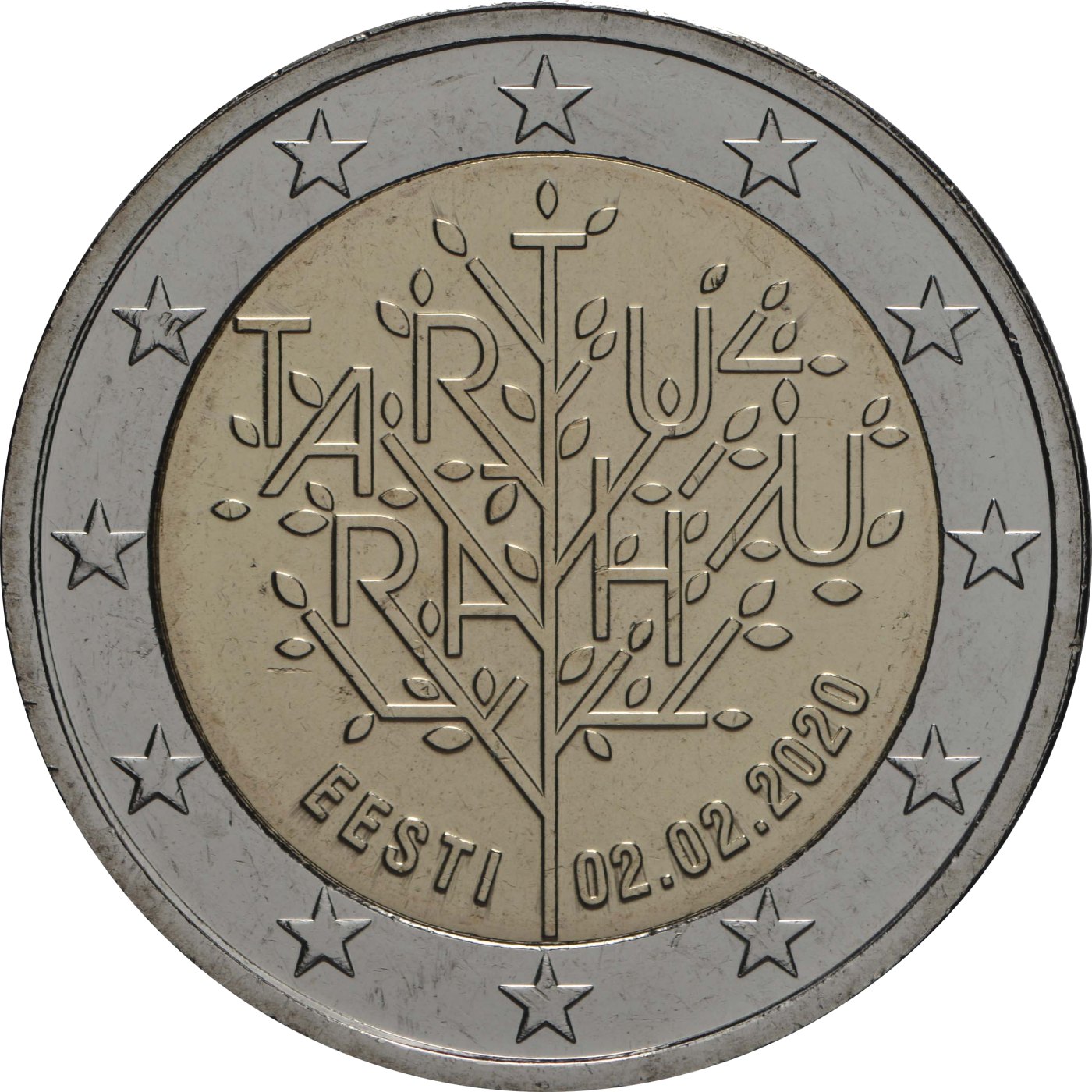
CC 369 2020
2 euro coin
BU Main coin Bank issue
2 Euro BU
Estonia · 100 years Treaty of Tartu
Mintage990,000
Issue date1 Feb 2020
Edge letteringEESTI × 2, alternating upright/inverted, separated by dots
Market price€4.50
Issue occasion
The coin commemorates the 100th anniversary of the Treaty of Tartu (Dorpat). The peace treaty concluded between Estonia and Soviet Russia in 1920 ended the War of Independence and established Estonia’s eastern border. The design depicts a tree whose branches are intertwined with the inscription “TARTU RAHU” (“Treaty of Tartu”); “EESTI” appears along the lower edge.
The design
The peace treaty signed between Estonia and Soviet Russia on 2 February 1920 established Estonia’s eastern border, thereby bringing the War of Independence to an end.
The design depicts a tree whose branches are intertwined with the inscription TARTU RAHU (“Tartu Peace Treaty”). The country name “EESTI” and the issue date “2 February 2020” are shown at the bottom of the design.
The outer ring of the coin features the twelve stars of the European flag.
The design depicts a tree whose branches are intertwined with the inscription TARTU RAHU (“Tartu Peace Treaty”). The country name “EESTI” and the issue date “2 February 2020” are shown at the bottom of the design.
The outer ring of the coin features the twelve stars of the European flag.
Background on the topic
Following the collapse of the Russian Empire and during the First World War, Estonia declared its state independence on 24 February 1918. Initially, however, the country was occupied by Germany. When German troops withdrew after the armistice of November 1918, the Red Army attacked Estonia. The resulting war was simultaneously part of the conflicts in the Baltic region and the Russian Civil War. The Estonian armed forces received support from Finnish volunteers and a British naval unit, among others.
The negotiations with Soviet Russia took place in Tartu, whose historical German name is Dorpat. The Estonian delegation was led by the lawyer and politician Jaan Poska, while the Soviet Russian delegation was led by Adolf Joffe. The conclusion was preceded by a military setback for the Red Army and an armistice that came into force at the beginning of January 1920.
In the treaty, Soviet Russia legally recognized Estonia’s independence and renounced former sovereignty claims dating from the time of the Tsarist Empire. In addition to territorial issues, the agreement regulated economic and financial matters, the return of residents, and the restitution of cultural property and archival materials, among other things. This gave the republic proclaimed only a few years earlier a treaty-based foundation for its international relations. Estonia became a member of the League of Nations (Völkerbund) in 1921.
The treaty acquired a special political role after the Soviet occupation and incorporation of Estonia in 1940. According to the Estonian understanding of statehood, the republic continued to exist in law because the incorporation had taken place under coercion. The restoration of independence in 1991 was based on this concept of state continuity. However, the border line agreed in the treaty does not fully correspond to the present-day actual border between Estonia and Russia.
The choice of the anniversary therefore refers not only to the end of a war, but also to a fundamental document of Estonia’s understanding of statehood and law. The issue date, on the calendar day of the signing, likewise establishes this connection.
The negotiations with Soviet Russia took place in Tartu, whose historical German name is Dorpat. The Estonian delegation was led by the lawyer and politician Jaan Poska, while the Soviet Russian delegation was led by Adolf Joffe. The conclusion was preceded by a military setback for the Red Army and an armistice that came into force at the beginning of January 1920.
In the treaty, Soviet Russia legally recognized Estonia’s independence and renounced former sovereignty claims dating from the time of the Tsarist Empire. In addition to territorial issues, the agreement regulated economic and financial matters, the return of residents, and the restitution of cultural property and archival materials, among other things. This gave the republic proclaimed only a few years earlier a treaty-based foundation for its international relations. Estonia became a member of the League of Nations (Völkerbund) in 1921.
The treaty acquired a special political role after the Soviet occupation and incorporation of Estonia in 1940. According to the Estonian understanding of statehood, the republic continued to exist in law because the incorporation had taken place under coercion. The restoration of independence in 1991 was based on this concept of state continuity. However, the border line agreed in the treaty does not fully correspond to the present-day actual border between Estonia and Russia.
The choice of the anniversary therefore refers not only to the end of a war, but also to a fundamental document of Estonia’s understanding of statehood and law. The issue date, on the calendar day of the signing, likewise establishes this connection.
eBay price analysis
For this issue, there is a price history based on actual eBay sales – with median, range and number of sales
View price analysis