
 Deutsch
 English
 Français
 Español
 Italiano
 Nederlands
 Português
 Slovenčina
 Hrvatski
 Slovenščina
 Lietuvių
 Eesti
Eesti Български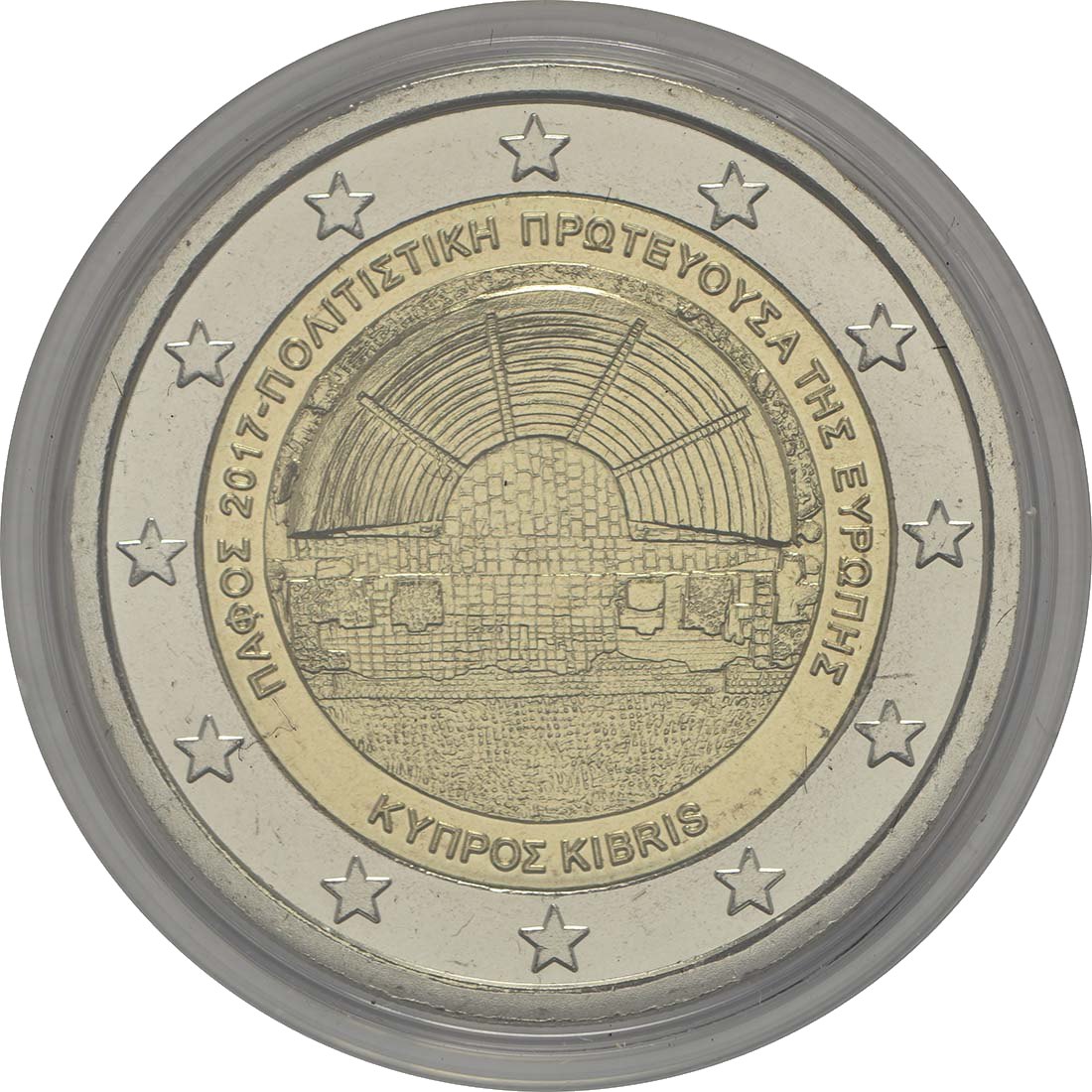

CC 288 2017
Other
BU
Other edition
Cyprus · Paphos – European Capital of Culture 2017
Mintage7,000
Issue price€3.00
Issue date3 Nov 2017
Edge lettering2 ΕΥΡΩ 2 EURO × 2
Market price€8.00
Issue occasion
The coin commemorates Paphos as the European Capital of Culture 2017 (Kulturhauptstadt Europas). The design depicts the ancient Odeon of Paphos, a small theatre dating from the 2nd century AD, which is now used in summer for music and theatre performances as well as events of the “Paphos 2017 — European Capital of Culture” programme. Also inscribed are “ΚΥΠΡΟΣ KIBRIS” and “Πάφος 2017 — Πολιτιστική πρωτεύουσα Ευρώπης”.
The design
The coin depicts the ancient Odeon of Paphos, a small odeon dating from the 2nd century AD. Today, it is used during the summer months for musical and theatrical performances; as part of the “Paphos 2017 — European Capital of Culture” programme, it serves as a venue for a series of events. The name of the issuing country, “ΚΥΠΡΟΣ KIBRIS” (Cyprus), and the wording “Πάφος 2017 — Πολιτιστική πρωτεύουσα Ευρώπης” (Paphos 2017 — European Capital of Culture) are engraved on the inner ring of the national side. The twelve stars of the European flag are depicted on the outer ring.
Background on the topic
The “European Capital of Culture” (Kulturhauptstadt Europas) initiative dates back to 1985. It aims to make Europe’s cultural diversity visible while also highlighting shared historical references. The selected cities develop a programme lasting several months, often associated with new cultural projects, the enhancement of public spaces and stronger international cooperation. In 2017, Paphos shared the title with the Danish city of Aarhus. Paphos was the first city in Zypern to become European Capital of Culture.
The programme was guided by the motto “Linking Continents – Bridging Cultures”. This referred to the geographical location of Zypern in the eastern Mediterranean and to the island’s long history as a contact zone between Europe, the Middle East and North Africa. Many events were held in public spaces under the concept of an “Open Air Factory”. The aim was to ensure that culture was not restricted to enclosed venues, but incorporated into the city and the surrounding landscape.
The Odeon is located in the archaeological area of Nea Paphos. This ancient city developed during the Hellenistic period and was a political and administrative centre of Zypern during Roman rule. The site includes, among other things, the remains of public buildings, residential houses and complexes with Roman floor mosaics. The archaeological sites of Paphos have been part of the UNESCO World Heritage since 1980. In Greco-Roman antiquity, an odeon was usually a covered or partially covered performance and assembly space, intended primarily for music, recitations and smaller performances.
The choice of this structure thus combines several aspects of the commemorative occasion: the city’s ancient past, its present-day cultural use and the European title. At the same time, the design refers to the concept of the European Capital of Culture year, incorporating historic sites and public spaces into contemporary cultural life. The coin issue made the time-limited title visible beyond Zypern throughout the euro area.
The programme was guided by the motto “Linking Continents – Bridging Cultures”. This referred to the geographical location of Zypern in the eastern Mediterranean and to the island’s long history as a contact zone between Europe, the Middle East and North Africa. Many events were held in public spaces under the concept of an “Open Air Factory”. The aim was to ensure that culture was not restricted to enclosed venues, but incorporated into the city and the surrounding landscape.
The Odeon is located in the archaeological area of Nea Paphos. This ancient city developed during the Hellenistic period and was a political and administrative centre of Zypern during Roman rule. The site includes, among other things, the remains of public buildings, residential houses and complexes with Roman floor mosaics. The archaeological sites of Paphos have been part of the UNESCO World Heritage since 1980. In Greco-Roman antiquity, an odeon was usually a covered or partially covered performance and assembly space, intended primarily for music, recitations and smaller performances.
The choice of this structure thus combines several aspects of the commemorative occasion: the city’s ancient past, its present-day cultural use and the European title. At the same time, the design refers to the concept of the European Capital of Culture year, incorporating historic sites and public spaces into contemporary cultural life. The coin issue made the time-limited title visible beyond Zypern throughout the euro area.