
 Deutsch
 English
 Français
 Español
 Italiano
 Nederlands
 Português
 Slovenčina
 Hrvatski
 Slovenščina
 Lietuvių
 Eesti
Eesti Български
CC 254 2016
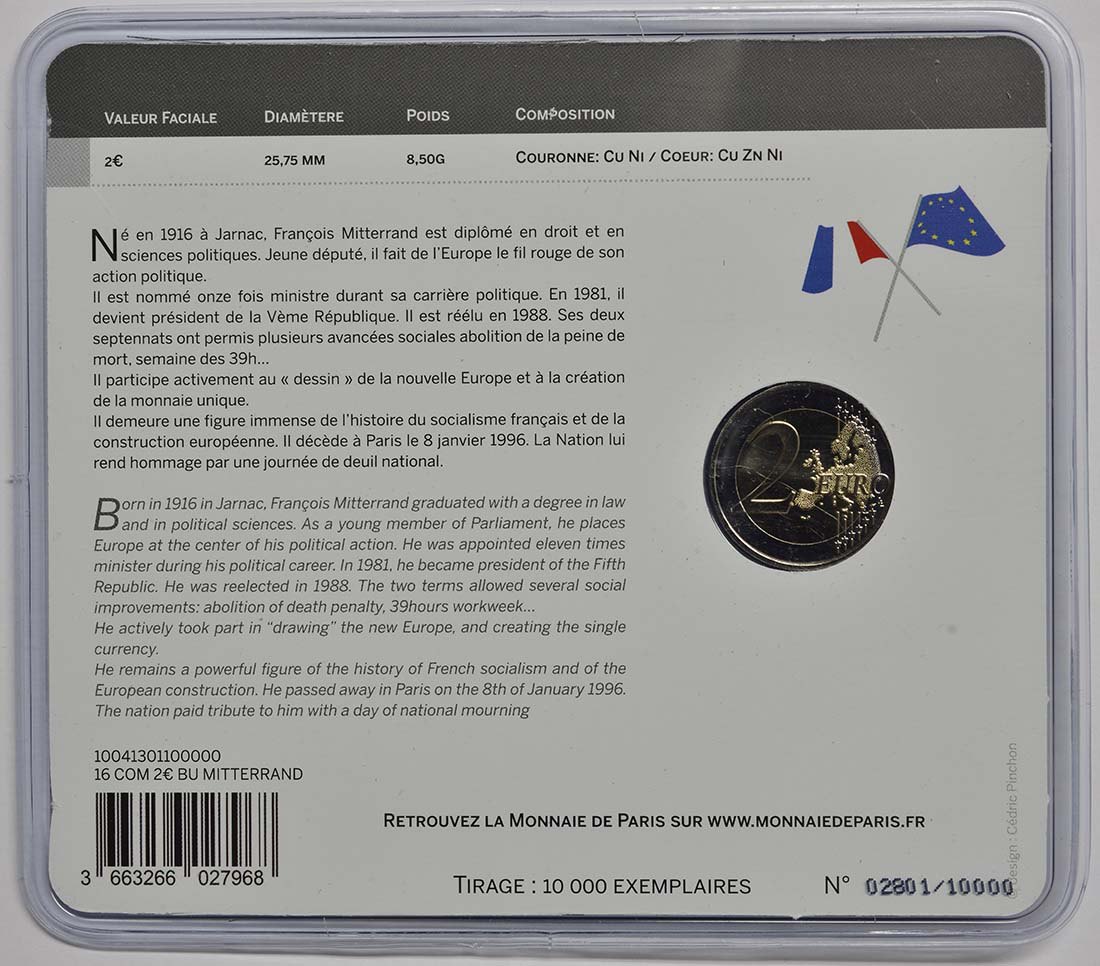
Blister pack
BU
Blister pack BU
France · 100th birthday and 20th anniversary of the death of François Mitterrand
Mintage10,000
Issue price€10.00
Issue date12 Sept 2016
PackagingBlister pack
Edge lettering2 ★ ★ × 6, alternating upright/inverted
Market price€25.00
Issue occasion
The commemorative coin honours the 100th birthday of François Mitterrand (1916–2016). The design shows him in profile in a contemplative pose, with his personal symbol on the right, an oak with an olive branch. The years “1916” and “2016” are shown on the left, with his name engraved above them.
The design
The inner disc of the coin shows a profile view of François Mitterrand in a contemplative pose. On the right, his personal symbol, the oak tree with the olive branch, is depicted. On the left, Mitterrand’s year of birth and the year of his hundredth birthday (“1916” and “2016”) are shown. His name is engraved above the design. The abbreviation of the issuing country, “RF”, is located at the bottom.
The outer ring of the coin features the twelve stars of the European flag.
The outer ring of the coin features the twelve stars of the European flag.
Background on the topic
François Mitterrand shaped French politics over several decades. During the Second World War, he was captured by the Germans as a soldier, managed to escape and later joined the Résistance. During the Fourth Republic, he held various ministerial offices. After the founding of the Fifth Republic (Fünfte Republik), he became a leading opponent of Charles de Gaulle and, from the 1970s onward, played a role in uniting the French left under the leadership of the Socialist Party.
In 1981, Mitterrand was elected the first socialist president of the Fifth Republic (Fünfte Republik). Following his re-election in 1988, he remained in office until 1995; his fourteen-year presidency is the longest in the history of this republic. Domestic measures during the first years of his presidency included the abolition of the death penalty, the decentralization of state responsibilities, nationalizations and social reforms. In view of economic difficulties, the government shifted in 1983 to a policy focused more strongly on budgetary stability.
Mitterrand’s term in office also saw the first so-called cohabitations: Because the parliamentary majority belonged to the opposition’s conservative camp, the socialist president had to govern at times with conservative prime ministers. This constellation shaped the institutional relationship between the president, the government and the National Assembly (Nationalversammlung).
In foreign policy, Mitterrand focused on European integration and close cooperation with Chancellor Helmut Kohl. Both supported the development of the European Community (Europäische Gemeinschaft) and the path toward Economic and Monetary Union (Wirtschafts- und Währungsunion). The Maastricht Treaty (Vertrag von Maastricht), which established the European Union and created the conditions for the common currency, was signed during his presidency. Their joint commemoration of the war dead at Verdun in 1984 also became well known.
France’s tribute is explained by Mitterrand’s long presidency, the domestic changes during his term in office and his role in the process of European unification. His life thus touches on key periods of 20th-century French history.
In 1981, Mitterrand was elected the first socialist president of the Fifth Republic (Fünfte Republik). Following his re-election in 1988, he remained in office until 1995; his fourteen-year presidency is the longest in the history of this republic. Domestic measures during the first years of his presidency included the abolition of the death penalty, the decentralization of state responsibilities, nationalizations and social reforms. In view of economic difficulties, the government shifted in 1983 to a policy focused more strongly on budgetary stability.
Mitterrand’s term in office also saw the first so-called cohabitations: Because the parliamentary majority belonged to the opposition’s conservative camp, the socialist president had to govern at times with conservative prime ministers. This constellation shaped the institutional relationship between the president, the government and the National Assembly (Nationalversammlung).
In foreign policy, Mitterrand focused on European integration and close cooperation with Chancellor Helmut Kohl. Both supported the development of the European Community (Europäische Gemeinschaft) and the path toward Economic and Monetary Union (Wirtschafts- und Währungsunion). The Maastricht Treaty (Vertrag von Maastricht), which established the European Union and created the conditions for the common currency, was signed during his presidency. Their joint commemoration of the war dead at Verdun in 1984 also became well known.
France’s tribute is explained by Mitterrand’s long presidency, the domestic changes during his term in office and his role in the process of European unification. His life thus touches on key periods of 20th-century French history.