
 Deutsch
 English
 Français
 Español
 Italiano
 Nederlands
 Português
 Slovenčina
 Hrvatski
 Slovenščina
 Lietuvių
 Eesti
Eesti Български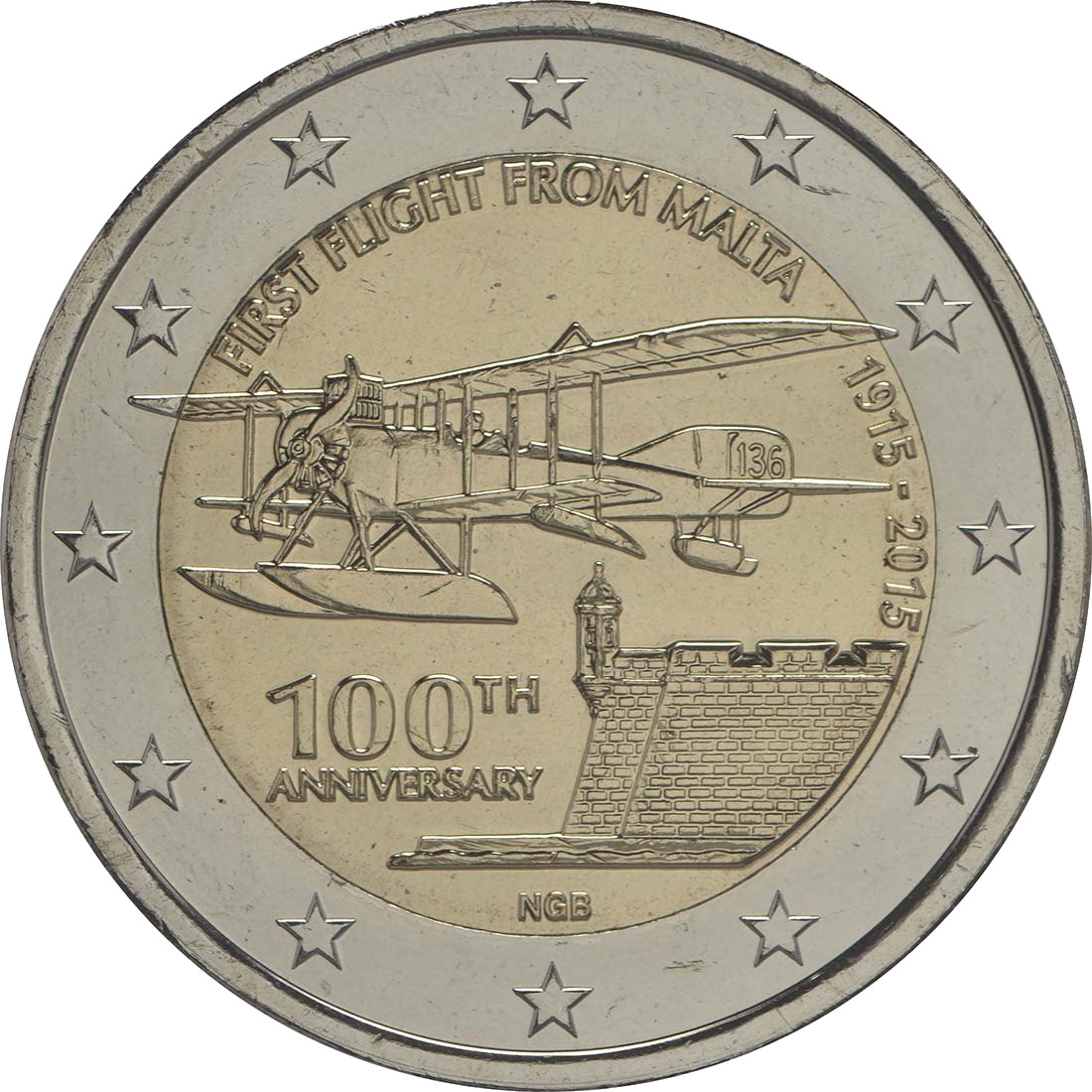

CC 194 2015
2 euro coin
BU Main coin Bank issue
2 Euro BU
Malta · 100 years since the first flight from Malta
Mintage300,000
Issue date25 May 2015
Edge lettering2 ✠✠ × 6, alternately upright/inverted
Market price€7.90
Varieties
21.1 · BU · Coincard BU · Mintage 25,000
Münzzeichen der niederländischen Münze
100th anniversary of the first flight from Malta · Circulation · Rolls · Mintage 300,000
ohne Münzzeichen (Standard)
Issue occasion
The coin commemorates the 100th anniversary of the first flight from Malta. On 13 February 1915, Captain Kilmer took off in a seaplane from the Grand Harbour and landed there again 55 minutes later. The design depicts the seaplane in front of the viewpoint in Senglea, as well as the inscriptions “FIRST FLIGHT FROM MALTA” and “100TH ANNIVERSARY” and the years “1915-2015”.
The design
The coin commemorates an important milestone in the history of Maltese aviation — the 100th anniversary of the first flight from Malta. On 13 February 1915, Captain Kilmer took off from the Grand Harbour in a seaplane carried by the seaplane carrier HMS Ark Royal. The aircraft landed back in the harbour after a flight time of 55 minutes. The design shows Captain Kilmer’s seaplane with the lookout point in Senglea in the background, a distinctive landmark of the Grand Harbour. The semicircular inscription “FIRST FLIGHT FROM MALTA” is located at the top. The years “1915-2015” can be read on the right. The inscription “100TH ANNIVERSARY” is located at the bottom left, while the artist’s initials “NGB” (Noel Galea Bason) can be discerned at the bottom.
The twelve stars of the European flag are depicted on the outer ring of the coin.
The twelve stars of the European flag are depicted on the outer ring of the coin.
Background on the topic
In 1915, Malta was a British Crown Colony and, because of its location in the central Mediterranean, an important base for the Royal Navy. Grand Harbour served as a sheltered naval, supply and repair port. During the First World War, the island was integrated into British operations in the Mediterranean. At the same time, wounded soldiers from the fighting around the Dardanelles were treated there, which is why Malta was temporarily referred to as the “Nurse of the Mediterranean”.
HMS *Ark Royal* was among the early ships specially equipped for the deployment of seaplanes. Unlike later aircraft carriers, it did not have a continuous flight deck. The aircraft were lowered into the water by cranes and took off from the water’s surface; after landing, they could be lifted back on board. Such aircraft were used primarily for reconnaissance: they were intended to observe coasts, ports, ship movements and enemy positions. *Ark Royal* was deployed in the eastern Mediterranean in 1915, including in connection with the operations at the Dardanelles.
The flight commemorated by the coin thus marks the beginning of Malta’s aviation history, but was also part of the connection between the navy and military aviation at the time. Captain Kilmer was the pilot of this flight; however, the coin depicts not him but his seaplane.
The viewpoint recognisable in the background is the so-called Gardjola at the tip of Senglea. It is part of the fortifications at Grand Harbour and served to observe the harbour and its approaches. Its relief symbols, including an eye and an ear, refer to vigilance. The combination of the Gardjola and the seaplane clearly locates the historical event in the Maltese harbour landscape.
The occasion was suitable for the coin issue because the anniversary marked a clearly datable beginning of Maltese aviation while also highlighting Malta’s role at the time as a British naval and military base.
HMS *Ark Royal* was among the early ships specially equipped for the deployment of seaplanes. Unlike later aircraft carriers, it did not have a continuous flight deck. The aircraft were lowered into the water by cranes and took off from the water’s surface; after landing, they could be lifted back on board. Such aircraft were used primarily for reconnaissance: they were intended to observe coasts, ports, ship movements and enemy positions. *Ark Royal* was deployed in the eastern Mediterranean in 1915, including in connection with the operations at the Dardanelles.
The flight commemorated by the coin thus marks the beginning of Malta’s aviation history, but was also part of the connection between the navy and military aviation at the time. Captain Kilmer was the pilot of this flight; however, the coin depicts not him but his seaplane.
The viewpoint recognisable in the background is the so-called Gardjola at the tip of Senglea. It is part of the fortifications at Grand Harbour and served to observe the harbour and its approaches. Its relief symbols, including an eye and an ear, refer to vigilance. The combination of the Gardjola and the seaplane clearly locates the historical event in the Maltese harbour landscape.
The occasion was suitable for the coin issue because the anniversary marked a clearly datable beginning of Maltese aviation while also highlighting Malta’s role at the time as a British naval and military base.
eBay price analysis
For this issue, there is a price history based on actual eBay sales – with median, range and number of sales
View price analysis