
 Deutsch
 English
 Français
 Español
 Italiano
 Nederlands
 Português
 Slovenčina
 Hrvatski
 Slovenščina
 Lietuvių
 Eesti
Eesti Български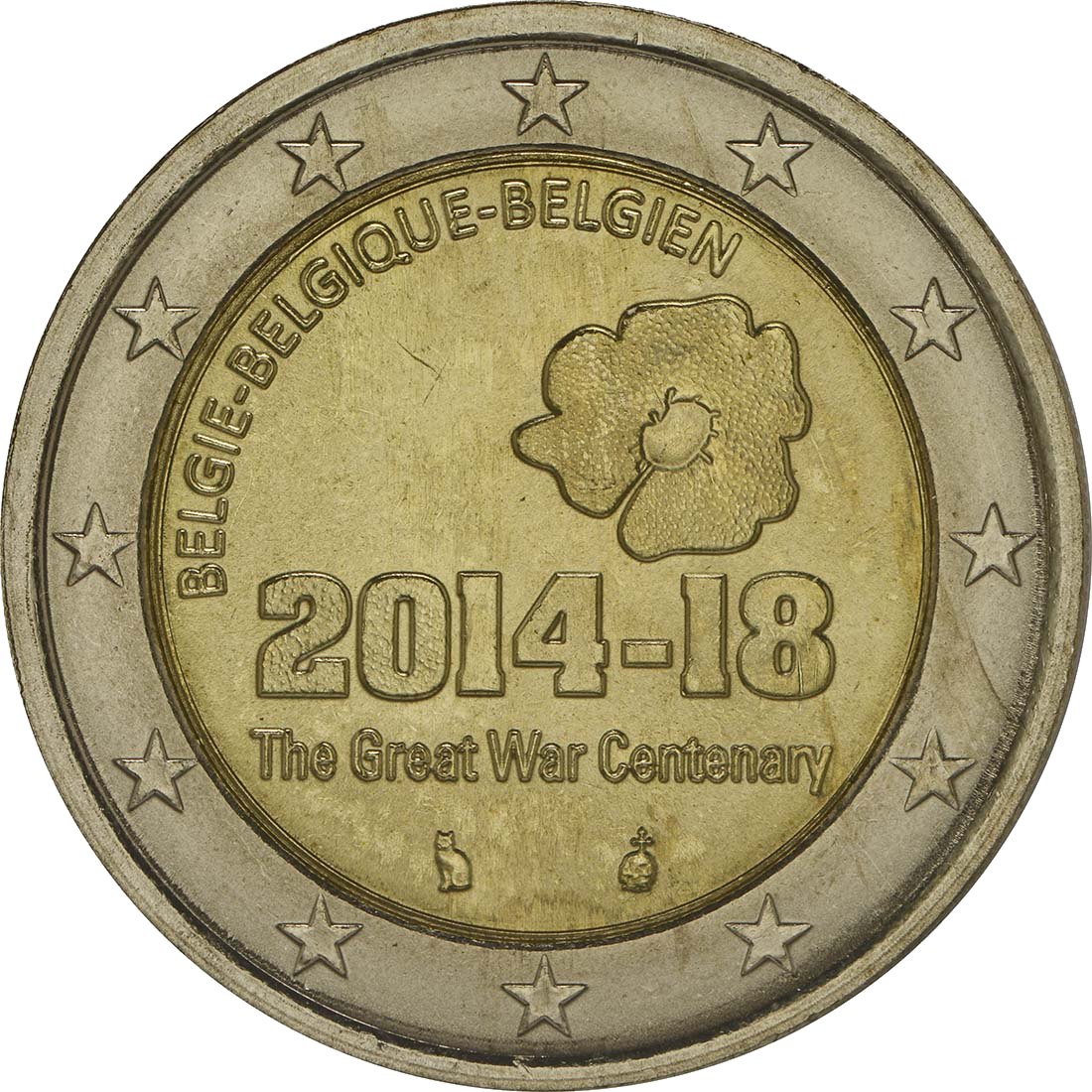

CC 164 2014
2 euro coin
BU Main coin Bank issue
2 Euro BU
Belgium · 100 years since the beginning of the First World War
Mintage1,700,000
Issue date12 May 2014
Edge lettering2 ★ ★ × 6, alternating upright/inverted
Market price€3.90
Issue occasion
The commemorative coin commemorates the beginning of the First World War (1914–1918) 100 years ago. The design shows a poppy above the years “2014-18” and the inscription “The Great War Centenary”. It also features the mint master’s mark, the Brussels mint mark with the helmeted head of the Archangel Michael, and the country designation “BELGIE — BELGIQUE — BELGIEN”.
The design
The inner part of the coin depicts a poppy above the years “2014-18”. Below these years, the inscription “The Great War Centenary” can be read; below it are the mint master’s mark and the mint mark of Brussels, the helmeted head of the Archangel Michael. The country designation in three languages, “BELGIE — BELGIQUE — BELGIEN”, is engraved along the upper edge of the inner part of the coin.
The twelve stars of the European flag are depicted on the outer ring of the coin.
The twelve stars of the European flag are depicted on the outer ring of the coin.
Background on the topic
The First World War arose from a European crisis following the assassination of the Austro-Hungarian heir to the throne, Franz Ferdinand, in Sarajevo. Alliance obligations, mobilizations and reciprocal declarations of war widened the conflict within a few weeks. Belgium had declared itself neutral. Nevertheless, Germany demanded free passage for its troops in order to attack France from the north. After the Belgian government rejected this, the German army crossed the border on 4 August 1914.
The invasion shaped Belgium’s experience of the war. Numerous civilians were killed in the fighting and under the occupation; towns and cultural assets were destroyed. The burning of the University Library of Löwen became particularly well known. Most of the country remained occupied until the end of the war. The Belgian army under King Albert I held a small, unoccupied strip of land behind the Yser. Many inhabitants fled to France, Great Britain or the neutral Netherlands.
West Flanders (Westflandern) also became part of the Western Front. Several costly battles took place around Ypern. In 1915, one of the first large-scale uses of poison gas on the Western Front also occurred there. The years of trench warfare left military cemeteries, memorials and traces still visible in the landscape today.
The poppy became a symbol of remembrance for the war dead, particularly in the English-speaking world. Its connection with Flanders dates back to the poem “In Flanders Fields” by the Canadian military doctor John McCrae. He wrote it in 1915 after the death of a comrade near Ypern. The poem describes poppies among the graves of fallen soldiers; later, the artificial red poppy became widespread as a symbol of remembrance.
For Belgium, the centenary commemorated at that time therefore provided a directly national occasion. The country was not only a theatre of war, but also experienced invasion, occupation, flight and destruction. The English designation “Great War” at the same time refers to an internationally widespread culture of remembrance, particularly in states of the former British Empire whose soldiers fought and lie buried in Belgium.
The invasion shaped Belgium’s experience of the war. Numerous civilians were killed in the fighting and under the occupation; towns and cultural assets were destroyed. The burning of the University Library of Löwen became particularly well known. Most of the country remained occupied until the end of the war. The Belgian army under King Albert I held a small, unoccupied strip of land behind the Yser. Many inhabitants fled to France, Great Britain or the neutral Netherlands.
West Flanders (Westflandern) also became part of the Western Front. Several costly battles took place around Ypern. In 1915, one of the first large-scale uses of poison gas on the Western Front also occurred there. The years of trench warfare left military cemeteries, memorials and traces still visible in the landscape today.
The poppy became a symbol of remembrance for the war dead, particularly in the English-speaking world. Its connection with Flanders dates back to the poem “In Flanders Fields” by the Canadian military doctor John McCrae. He wrote it in 1915 after the death of a comrade near Ypern. The poem describes poppies among the graves of fallen soldiers; later, the artificial red poppy became widespread as a symbol of remembrance.
For Belgium, the centenary commemorated at that time therefore provided a directly national occasion. The country was not only a theatre of war, but also experienced invasion, occupation, flight and destruction. The English designation “Great War” at the same time refers to an internationally widespread culture of remembrance, particularly in states of the former British Empire whose soldiers fought and lie buried in Belgium.
eBay price analysis
For this issue, there is a price history based on actual eBay sales – with median, range and number of sales
View price analysis