
 Deutsch
 English
 Français
 Español
 Italiano
 Nederlands
 Português
 Slovenčina
 Hrvatski
 Slovenščina
 Lietuvių
 Eesti
Eesti Български

CC 162 2014
Coincard
BU
Coincard
Slovakia · 10th anniversary of accession to the EU
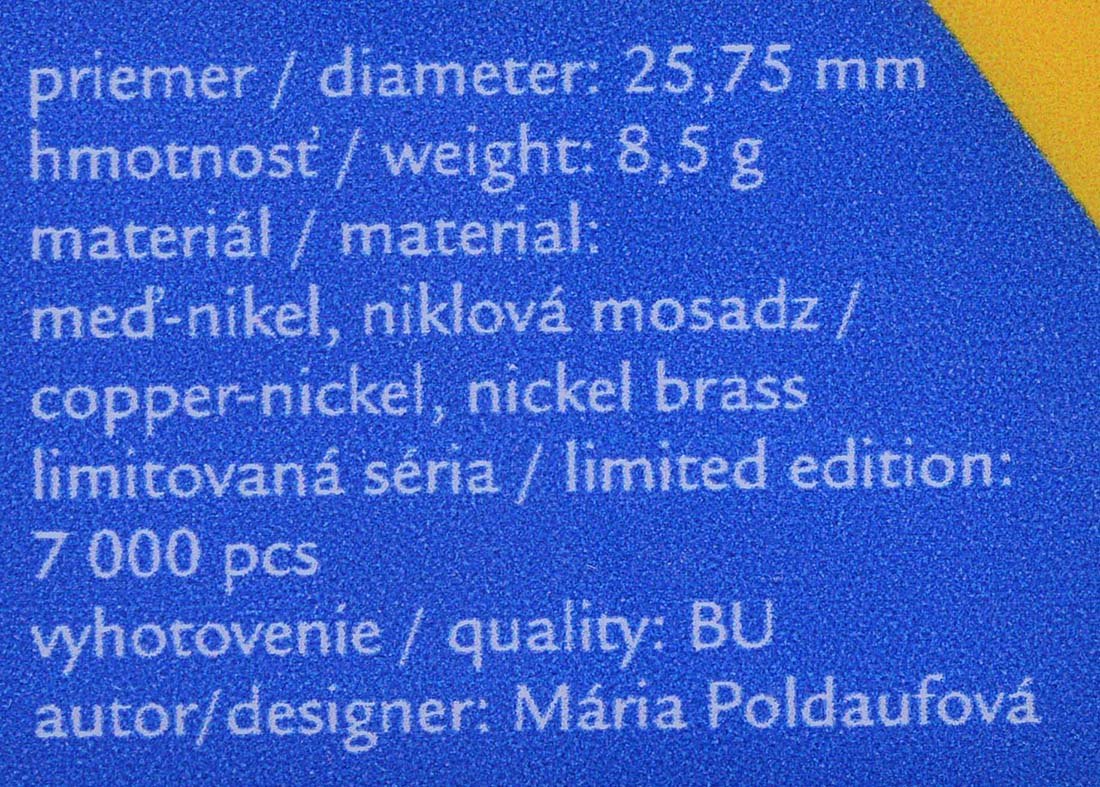
Mintage7,000
Issue price€7.70
Issue date1 Apr 2014
PackagingCoincard
Edge letteringSLOVENSKÁ REPUBLIKA + ★ + Linden leaf + ★
Market price€129.00
Issue occasion
The coin commemorates the 10th anniversary of the Slovak Republic’s accession to the European Union. The design features the stylized letters “EÚ” and the coat of arms of the Slovak Republic, as well as the accession date “1.5.2004” and the year “2014”. The inscriptions “SLOVENSKO” and “10. VÝROČIE VSTUPU DO EURÓPSKEJ ÚNIE” are also included.
The design
At the centre of the national side, the letters “EÚ”, as an abbreviation for the European Union, and the coat of arms of the Slovak Republic are depicted in stylised lettering in the foreground. To their right, the accession date of the Slovak Republic to the European Union, “1.5.2004”, is engraved on two lines, with the year “2014” directly below it. Along the lower edge of the inner part of the coin, the name of the issuing country, “SLOVENSKO”, can be read; along the upper edge, in a semicircular arrangement, is the inscription “10. VÝROČIE VSTUPU DO EURÓPSKEJ ÚNIE”. The mintmark of the Kremnica Mint is located at the bottom left, consisting of the letters “MK” between two minting dies; at the bottom right, the initials “MP” of the coin designer Mária Poldaufová appear in stylised lettering.
The outer ring of the coin features the twelve stars of the European flag.
The outer ring of the coin features the twelve stars of the European flag.
Background on the topic
After the end of communist rule in Czechoslovakia in 1989, the country oriented itself politically and economically towards Western Europe. The peaceful dissolution of Czechoslovakia led to the establishment of the independent Slovak Republic in 1993. Subsequently, rapprochement with the European Union became one of the new state’s central foreign policy objectives. The prerequisites included democratic institutions, a functioning market economy and the adoption of the EU acquis.
Slovakia submitted its application for membership in 1995. Accession negotiations began in 2000 and covered numerous areas, including competition, agriculture, environmental protection, justice and the safeguarding of the external borders. In a referendum in May 2003, a large majority of those voting supported accession. The Accession Treaty was subsequently ratified. Slovakia thus belonged to the group of ten states from Central and Eastern Europe and the Mediterranean region through whose admission the EU carried out its largest enlargement to date. This enlargement was connected with the political reorganisation of Europe following the end of the Cold War.
European integration continued after accession. At the end of 2007, Slovakia became part of the Schengen Area, in which checks at the common internal borders are generally abolished. At the beginning of 2009, it introduced the euro. The issue of a Slovak euro commemorative coin for an EU accession anniversary thus combines two stages of this development: membership of the Union and subsequent participation in its common currency.
The Slovak national coat of arms also refers to the national state tradition. It shows a silver double cross on three blue hills against a red background. The double cross is a historical heraldic symbol that was used long before the establishment of the present-day republic. The three hills are traditionally interpreted as Tatra, Fatra and Mátra. Its combination with the EU abbreviation places national statehood and European affiliation side by side on the coin.
Slovakia submitted its application for membership in 1995. Accession negotiations began in 2000 and covered numerous areas, including competition, agriculture, environmental protection, justice and the safeguarding of the external borders. In a referendum in May 2003, a large majority of those voting supported accession. The Accession Treaty was subsequently ratified. Slovakia thus belonged to the group of ten states from Central and Eastern Europe and the Mediterranean region through whose admission the EU carried out its largest enlargement to date. This enlargement was connected with the political reorganisation of Europe following the end of the Cold War.
European integration continued after accession. At the end of 2007, Slovakia became part of the Schengen Area, in which checks at the common internal borders are generally abolished. At the beginning of 2009, it introduced the euro. The issue of a Slovak euro commemorative coin for an EU accession anniversary thus combines two stages of this development: membership of the Union and subsequent participation in its common currency.
The Slovak national coat of arms also refers to the national state tradition. It shows a silver double cross on three blue hills against a red background. The double cross is a historical heraldic symbol that was used long before the establishment of the present-day republic. The three hills are traditionally interpreted as Tatra, Fatra and Mátra. Its combination with the EU abbreviation places national statehood and European affiliation side by side on the coin.