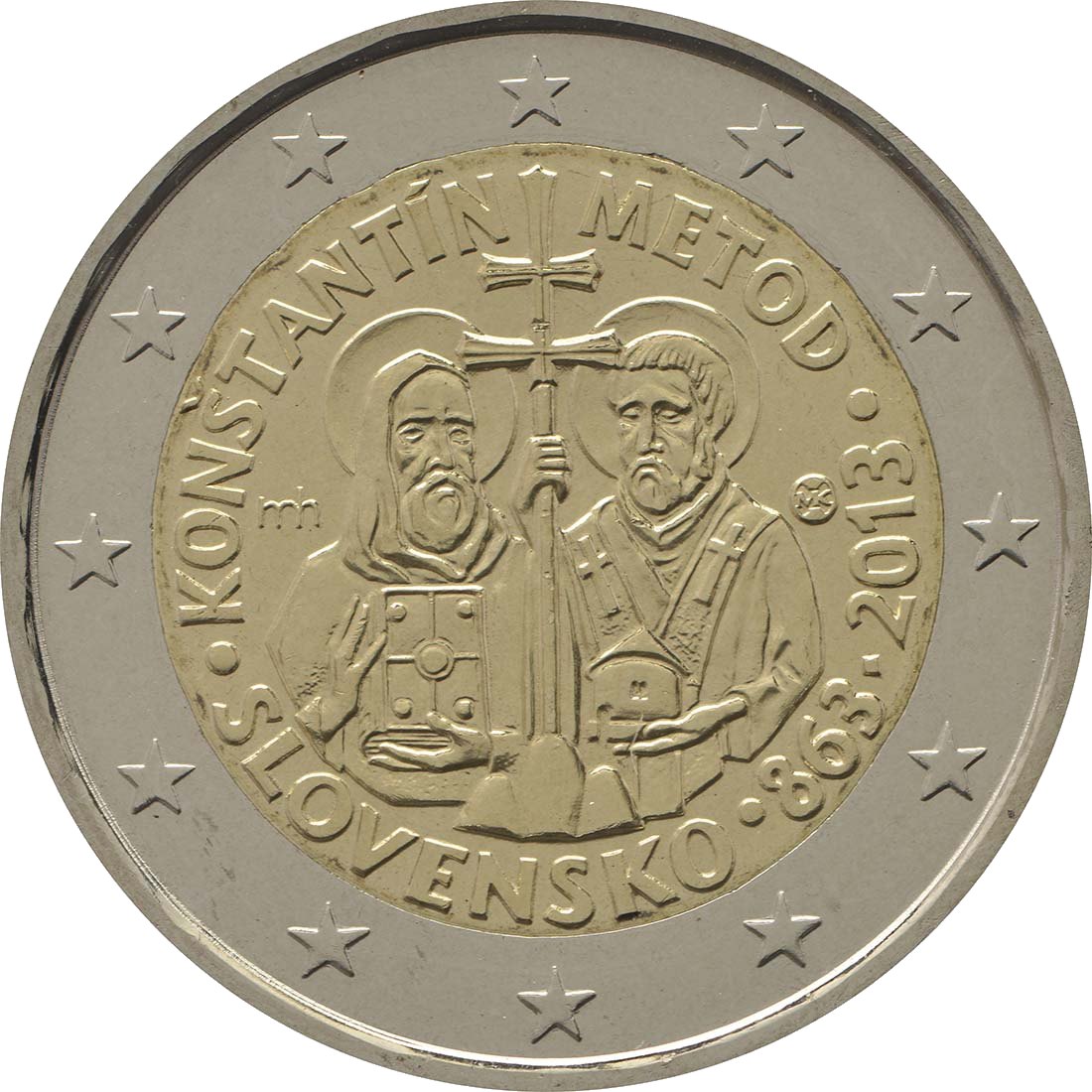
The coin commemorates the 1150th anniversary of the arrival of the mission of Konstantin and Method in Great Moravia, the first Slavic state in Central Europe. The design depicts the brothers with the Byzantine double cross on three hills; Konstantin holds a book as a symbol of education and faith, while Method holds a church as a symbol of faith and institutional Christianity. The names “KONŠTANTÍN” and “METOD” and the years “863” and “2013” are also included.
The design
The coin depicts the brothers Konstantin and Method from Thessaloniki with the Byzantine double cross on three hills. The cross is held as a bishop’s staff, thereby linking a state symbol with a Christian symbol and underscoring the significance of the mission that helped grant Great Moravia — the first Slavic state in Central Europe — full sovereignty and legitimacy. Konstantin holds a book in his hands, symbolising education and faith, while Method is depicted with a church, representing faith and institutional Christianity. At the lower edge of the inner part of the coin, the name of the issuing country “SLOVENSKO”, the year “863” and the year “2013” are inscribed; at the upper edge of the inner part of the coin are the names “KONŠTANTÍN” and “METOD”. To the left of the brothers are the initials of the coin designer Miroslav Hric in stylised lettering, while to their right, between two minting dies, the “MK” mark of the Kremnica Mint can be seen.
The twelve stars of the European flag are depicted on the outer ring of the coin.
Background on the topic
Konstantin, who later adopted the monastic name Kyrill, and his older brother Method came from Byzantine Thessaloniki. Both were educated clergymen and presumably had knowledge of Slavic dialects. The Moravian prince Rastislav had asked the Byzantine emperor for missionaries who could convey the Christian faith in a language understandable to the population. At the same time, he wanted to reduce ecclesiastical dependence on clergy from the East Frankish region.
For their work, Konstantin created the Glagolitic script, the oldest known alphabet for a Slavic language. The brothers and their associates translated liturgical and biblical texts into Old Church Slavonic. This made it possible for worship, religious instruction and written administration to take place, at least in part, in a Slavic language. This was unusual, as Latin was used predominantly as the language of liturgy and education in the Western Church.
The use of Slavonic met with resistance from parts of the Latin clergy. Konstantin and Method therefore travelled to Rome to secure ecclesiastical approval for their work. Pope Hadrian II approved the Slavonic liturgical books. Konstantin died in Rome; Method returned as an archbishop to the Central European mission area. After his death, many of his pupils were expelled. Some reached Southeastern Europe, where the Slavic writing and liturgical tradition was continued. The Cyrillic script that emerged later was named after Konstantin-Kyrill, but does not derive directly from him.
In Slovakia, this mission is regarded as a reference point for the country’s early Christian, linguistic and cultural development. The preamble to the Slovak Constitution also invokes the spiritual legacy of Kyrill and Method as well as the historical heritage of Great Moravia (Großmähren). The anniversary therefore provided a state-supported and culturally rooted occasion for a commemorative coin. The double cross and the three hills also establish a connection to the Slovak coat of arms.
eBay price analysis
For this issue, there is a price history based on actual eBay sales – with median, range and number of sales
PP: 10.000 Ex. in Kapsel, Folder im Umschlag, 300 Ex. im Etui; die PP-Münzen werden angeblich von der Nationalbank für die Feierlichkeiten zum 1150. Jahrestag reserviert. Ein Verkauf der Proofexemplare ist amtlich nicht geplant.

 Deutsch
 English
 Français
 Español
 Italiano
 Nederlands
 Português
 Slovenčina
 Hrvatski
 Slovenščina
 Lietuvių
 Eesti
Eesti Български