
 Deutsch
 English
 Français
 Español
 Italiano
 Nederlands
 Português
 Slovenčina
 Hrvatski
 Slovenščina
 Lietuvių
 Eesti
Eesti Български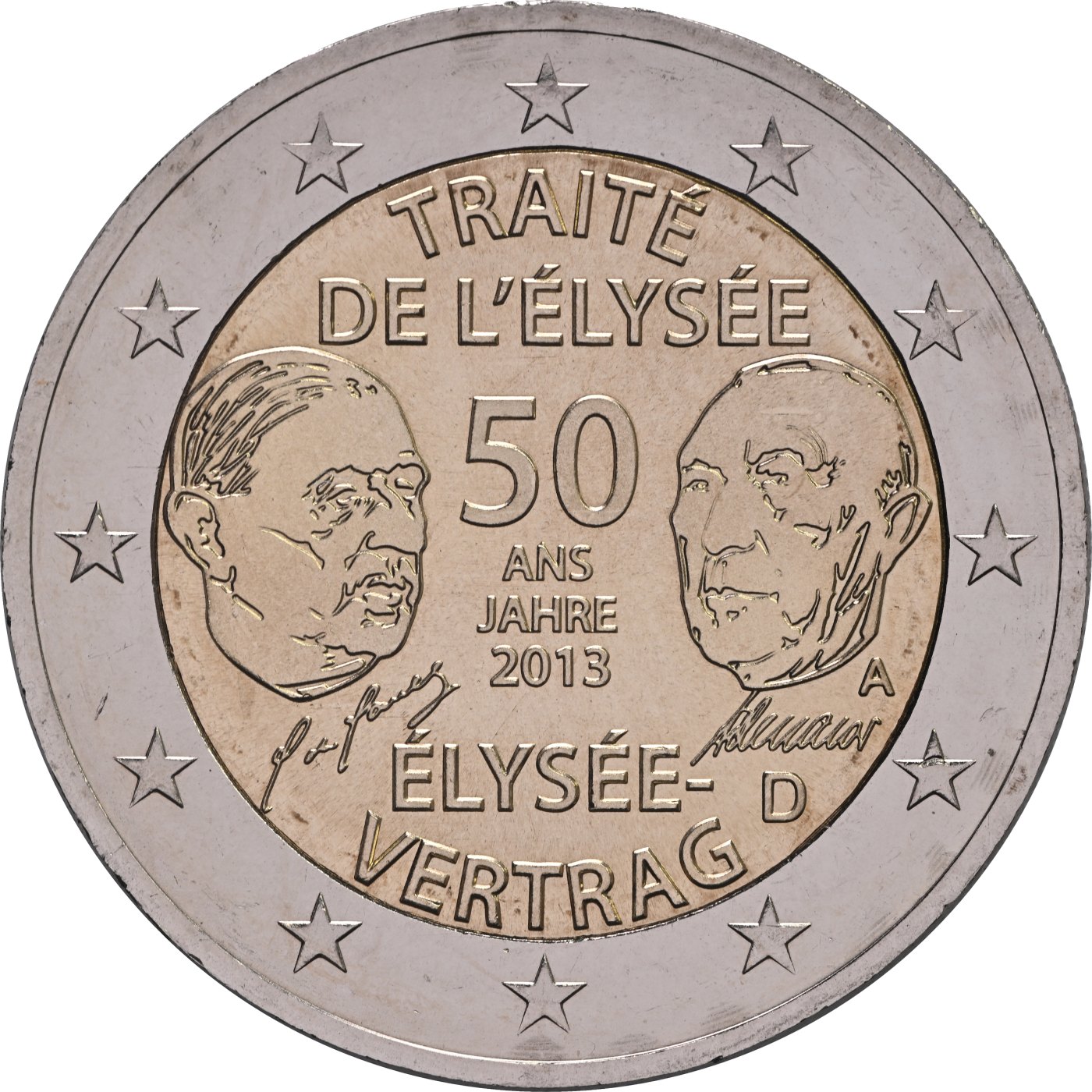
CC 136 2013
2 euro coin
BU Mint mark A/D/F/G/J Main coin Bank issue
2 Euro BU
Germany · Joint issue, Germany - France, 50th anniversary of the Élysée Treaty
Mintage11,000,000
Issue date22 Jan 2013
Edge letteringEINIGKEIT UND RECHT UND FREIHEIT + Federal Eagle
Market price€3.90
Mintage information from source: 2200000 | 2310000 | 2640000 | 1540000
Varieties
5Germany, A · A · Mint mark A · BU · Mintage 2,200,000
Germany, D · D · Mint mark D · BU · Mintage 2,310,000
Germany, F · F · Mint mark F · BU · Mintage 2,640,000
Germany, G · G · Mint mark G · BU · Mintage 1,540,000
Germany, J · J · Mint mark J · BU · Mintage 2,310,000
Issue occasion
The coin commemorates the 50th anniversary of the signing of the Élysée Treaty. The design shows stylized portraits of the signatories Konrad Adenauer and Charles de Gaulle with their signatures. Between them are “50 ANS JAHRE” and “2013”, supplemented by the designations “TRAITÉ DE L’ÉLYSÉE” and “ÉLYSÉE-VERTRAG”.
The design
The coin, designed by Yves Sampo of Monnaie de Paris, Stefanie Lindner of Staatliche Münze Berlin, Alina Hoyer (Berlin) and Sneschana Russewa-Hoyer (Berlin), shows stylised portraits of the signatories of the Élysée Treaty (the then Chancellor of the Federal Republic of Germany, Konrad Adenauer, and the then President of the French Republic, Charles de Gaulle), along with their signatures, the inscription “50 ANS JAHRE” and the year “2013” between them, as well as the inscription “TRAITÉ DE L’ÉLYSÉE” at the top and “ÉLYSÉE-VERTRAG” at the bottom of the coin’s inner part. The mintmark (“A”, “D”, “F”, “G” or “J”) and the issuing country mark (“D”) can be seen on the right edge of the coin’s inner part.
The twelve stars of the European flag are depicted on the outer ring.
The twelve stars of the European flag are depicted on the outer ring.
Background on the topic
The Élysée Treaty was concluded on 22 January 1963 at the Élysée-Palast in Paris. It marked the end of a longer rapprochement between the Federal Republic of Germany (Bundesrepublik Deutschland) and France. After several wars, the German occupation of France and the crimes of the Second World War, the former enmity was to be replaced by permanently regulated cooperation. As early as the 1950s, both states had cooperated in establishing the European Coal and Steel Community and the European Economic Community.
The treaty obliged the governments to hold regular consultations. These concerned above all foreign policy, defence, and educational and youth affairs. It therefore did not create a new European body, but institutionalised bilateral coordination. One immediate consequence was the establishment of the Franco-German Youth Office (Deutsch-Französisches Jugendwerk) in 1963. Exchange programmes, town twinning and meetings between school pupils and students were intended to anchor mutual understanding in society as well.
Konrad Adenauer was the first Federal Chancellor of the Federal Republic from 1949 to 1963. His policy aimed at integrating West Germany into the Western alliances and promoting European cooperation. Charles de Gaulle, a leading representative of Free France (“Freies Frankreich”) during the Second World War, had been President of the Fifth French Republic since 1959. Both politicians shared the goal of close Franco-German cooperation, even though their views on the foreign-policy orientation of Europe did not fully coincide.
These differences became apparent during the German ratification: The Bundestag prefaced the treaty with a preamble that expressly emphasised relations with the United States, NATO and European integration. De Gaulle, by contrast, had a Europe more independent of the United States in mind.
In 2013, Germany and France issued coins with a joint design. The choice of a coordinated motif corresponded to the subject commemorated: The treaty is regarded as the basis for regular Franco-German governmental cooperation and shaped the political coordination of both states within Europe.
The treaty obliged the governments to hold regular consultations. These concerned above all foreign policy, defence, and educational and youth affairs. It therefore did not create a new European body, but institutionalised bilateral coordination. One immediate consequence was the establishment of the Franco-German Youth Office (Deutsch-Französisches Jugendwerk) in 1963. Exchange programmes, town twinning and meetings between school pupils and students were intended to anchor mutual understanding in society as well.
Konrad Adenauer was the first Federal Chancellor of the Federal Republic from 1949 to 1963. His policy aimed at integrating West Germany into the Western alliances and promoting European cooperation. Charles de Gaulle, a leading representative of Free France (“Freies Frankreich”) during the Second World War, had been President of the Fifth French Republic since 1959. Both politicians shared the goal of close Franco-German cooperation, even though their views on the foreign-policy orientation of Europe did not fully coincide.
These differences became apparent during the German ratification: The Bundestag prefaced the treaty with a preamble that expressly emphasised relations with the United States, NATO and European integration. De Gaulle, by contrast, had a Europe more independent of the United States in mind.
In 2013, Germany and France issued coins with a joint design. The choice of a coordinated motif corresponded to the subject commemorated: The treaty is regarded as the basis for regular Franco-German governmental cooperation and shaped the political coordination of both states within Europe.
eBay price analysis
For this issue, there is a price history based on actual eBay sales – with median, range and number of sales
View price analysis