
 Deutsch
 English
 Français
 Español
 Italiano
 Nederlands
 Português
 Slovenčina
 Hrvatski
 Slovenščina
 Lietuvių
 Eesti
Eesti Български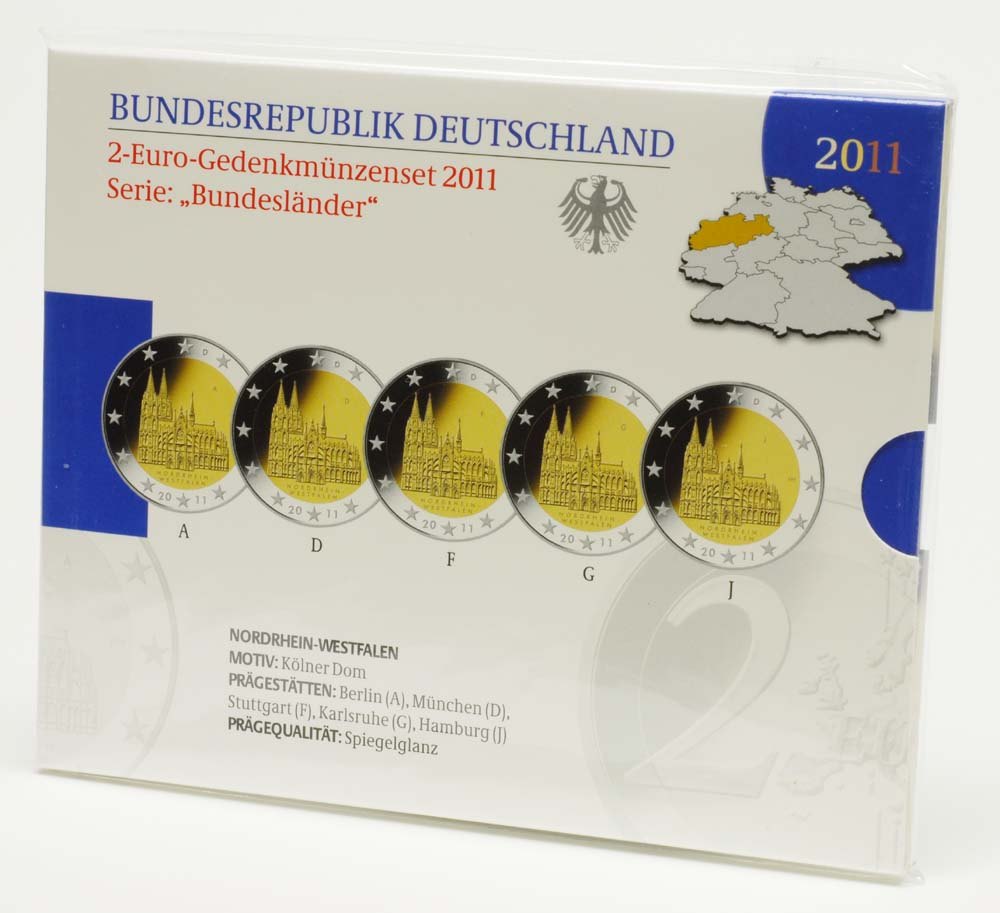
CC 91 2011
Blister pack
Proof
Proof blister
Germany · North Rhine-Westphalia, Cologne Cathedral
Mintage55,000
Issue price€29.00
Issue date28 Jan 2011
PackagingBlister pack
Edge letteringEINIGKEIT UND RECHT UND FREIHEIT + Federal Eagle
Market price€25.00
Varieties
1Germany, A · A · Mint mark A · Proof · Blister pack · Mintage 55,000
Issue occasion
The commemorative coin is dedicated to the federal state of Nordrhein-Westfalen. The design shows an overall view of Cologne Cathedral (Kölner Dom), a masterpiece of Gothic architecture, with the south portal particularly highlighted. Below it is the name of the federal state, “NORDRHEIN-WESTFALEN”; the initials of the artist Heinz Hoyer are also inscribed.
The design
The inner part of the coin depicts a full view of Cologne Cathedral—a masterpiece of Gothic architecture. The view of the south portal particularly highlights its beauty. The country name “NORDRHEIN-WESTFALEN” directly below establishes a connection between the depicted building and the federal state. The respective mint can be identified by one of the letters A, D, F, G or J at the upper right in the inner part of the coin; the artist’s initials, Heinz Hoyer, are embossed diagonally below and to the right.
The outer ring of the coin features the twelve stars of the flag of the European Union. Between the stars, the year “2011” is shown at the bottom and the issuing country “D” at the top.
The outer ring of the coin features the twelve stars of the flag of the European Union. Between the stars, the year “2011” is shown at the bottom and the issuing country “D” at the top.
Background on the topic
North Rhine-Westphalia emerged after the Second World War. In 1946, the British military government united the northern part of the former Prussian Rhine Province (Rheinprovinz) with the Province of Westphalia (Provinz Westfalen); the state of Lippe was added in 1947. Düsseldorf became the state capital, while Köln is the most populous city in the federal state. The combination of Rhenish, Westphalian and Lippe regions characterizes the state’s federal structure.
Cologne Cathedral (Kölner Dom) is the cathedral of the Archdiocese of Cologne (Erzbistum Köln). Construction began in 1248 on the site of older churches. One reason for the new construction was the safekeeping of the relics of the Three Kings, which Archbishop Rainald von Dassel had brought from Milan to Köln in 1164. The Shrine of the Three Kings (Dreikönigenschrein), which is located in the choir of the church, was created for them. As a result, Köln developed into a much-visited pilgrimage site.
After several centuries, construction work largely came to a standstill. It was not resumed until the 19th century, taking into account surviving medieval plans. In 1880, the cathedral was considered complete. At the time, its completion was also understood as a national event in the German Empire (Deutsches Reich), founded in 1871. During the Second World War, the building suffered damage, but remained standing despite the extensive destruction of central Köln. Since 1996, it has been a UNESCO World Heritage Site.
The issue was not primarily connected with a single cathedral anniversary. It was part of the German 2-euro series “Bundesländer”, which had begun in 2006. In this series, each of the 16 federal states is represented by a building or landmark. The order was generally based on the rotating presidency of the Bundesrat, the representation of the federal states at the national level. Nordrhein-Westfalen held the Bundesrat presidency during the period in which the issue appeared. The choice of the cathedral thus linked the federal representation of the state with a building closely associated with the history of Köln, Catholic Rhineland and German architectural history.
Cologne Cathedral (Kölner Dom) is the cathedral of the Archdiocese of Cologne (Erzbistum Köln). Construction began in 1248 on the site of older churches. One reason for the new construction was the safekeeping of the relics of the Three Kings, which Archbishop Rainald von Dassel had brought from Milan to Köln in 1164. The Shrine of the Three Kings (Dreikönigenschrein), which is located in the choir of the church, was created for them. As a result, Köln developed into a much-visited pilgrimage site.
After several centuries, construction work largely came to a standstill. It was not resumed until the 19th century, taking into account surviving medieval plans. In 1880, the cathedral was considered complete. At the time, its completion was also understood as a national event in the German Empire (Deutsches Reich), founded in 1871. During the Second World War, the building suffered damage, but remained standing despite the extensive destruction of central Köln. Since 1996, it has been a UNESCO World Heritage Site.
The issue was not primarily connected with a single cathedral anniversary. It was part of the German 2-euro series “Bundesländer”, which had begun in 2006. In this series, each of the 16 federal states is represented by a building or landmark. The order was generally based on the rotating presidency of the Bundesrat, the representation of the federal states at the national level. Nordrhein-Westfalen held the Bundesrat presidency during the period in which the issue appeared. The choice of the cathedral thus linked the federal representation of the state with a building closely associated with the history of Köln, Catholic Rhineland and German architectural history.