
 Deutsch
 English
 Français
 Español
 Italiano
 Nederlands
 Português
 Slovenčina
 Hrvatski
 Slovenščina
 Lietuvių
 Eesti
Eesti Български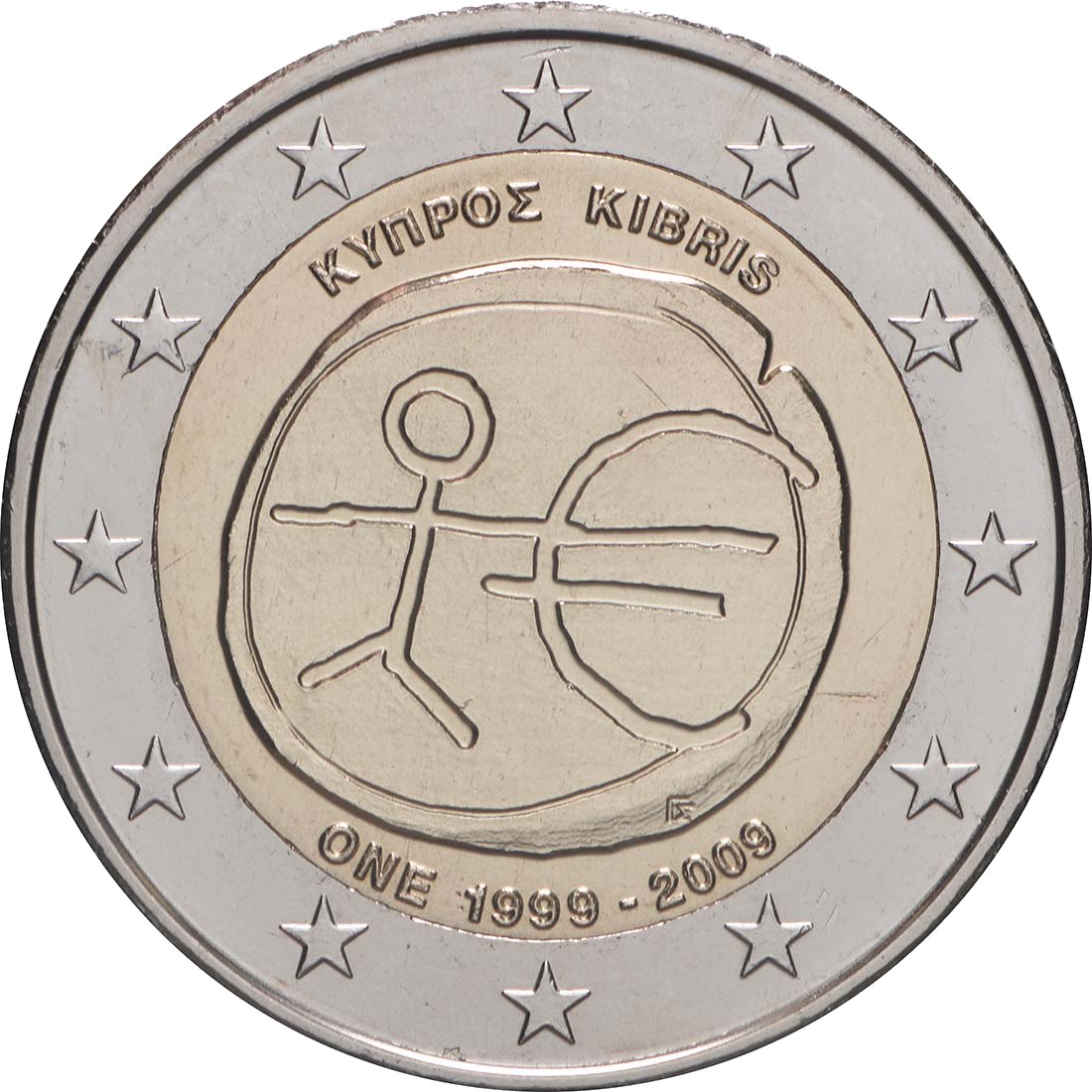
CC 67 2009
2 euro coin
BU Main coin Bank issue
2 Euro BU
Cyprus · 10 years EMU
Mintage965,000
Issue date1 Jan 2009
Edge lettering2 ΕΥΡΩ 2 EURO × 2
Market price€7.90
Issue occasion
The commemorative coin marks ten years of Economic and Monetary Union and the creation of the euro on 1 January 1999. The design by G. Stamatopoulos features a stylised human figure whose left arm merges into the euro symbol, complemented by the years 1999–2009, the respective acronym of the EMU and twelve stars. The design was selected in an online vote by citizens and residents of the European Union.
The design
The coin depicts a stylized human figure in the center, whose left arm is extended by the euro symbol. The artist’s initials ΓΣ appear below the euro symbol. The name of the issuing country in the national language(s) appears along the upper edge of the design, while the inscription 1999-2009 and the acronym EMU translated into the national language(s) appear along the lower edge.
The twelve stars of the European flag are depicted on the outer ring of the coin.
The twelve stars of the European flag are depicted on the outer ring of the coin.
Background on the topic
The Economic and Monetary Union is the result of a European integration process that took place over several decades. After the end of the Bretton Woods system of fixed exchange rates, the states of the European Community attempted to limit the strong exchange-rate fluctuations between their currencies. The European exchange rate association was followed in 1979 by the European Monetary System (Europäisches Währungssystem). Its accounting unit, the ECU, was not yet a generally usable means of payment, but it laid the institutional foundations for a common currency.
The legal basis for the monetary union was established by the Maastricht Treaty (Vertrag von Maastricht), which entered into force in 1993. It provided for a gradual transition and laid down so-called convergence criteria. These included requirements relating to price stability, public debt, budget deficits, long-term interest rates and exchange-rate stability. With the establishment of the European Central Bank (Europäische Zentralbank) in 1998, responsibility for the common monetary policy was transferred to a supranational institution.
At the beginning, eleven states participated in the monetary union. Their national exchange rates were irrevocably fixed; monetary policy and financial markets henceforth operated on a euro basis. Banknotes and coins, however, did not enter circulation until 2002. Until then, the new currency appeared primarily in cashless payment transactions, government budgets, financial markets and accounting. Greece joined before the introduction of cash. Later, the euro area was gradually expanded to include additional member states.
The monetary union combines centrally organised monetary policy with fiscal and economic policy that continues to be managed predominantly at national level. This led to rules for coordinating budgets, in particular the Stability and Growth Pact. The common currency was intended to eliminate exchange-rate risks within the currency area, facilitate cross-border price comparisons and complement the single market.
The common coin issue therefore refers not only to a means of payment, but also to an institutional reorganisation of European monetary policy. The deliberately simple figure, reminiscent of early pictorial representations, symbolically places the euro within the long development of exchange, trade and monetary systems. A uniform design on the national sides also emphasised the communal character of the occasion.
The legal basis for the monetary union was established by the Maastricht Treaty (Vertrag von Maastricht), which entered into force in 1993. It provided for a gradual transition and laid down so-called convergence criteria. These included requirements relating to price stability, public debt, budget deficits, long-term interest rates and exchange-rate stability. With the establishment of the European Central Bank (Europäische Zentralbank) in 1998, responsibility for the common monetary policy was transferred to a supranational institution.
At the beginning, eleven states participated in the monetary union. Their national exchange rates were irrevocably fixed; monetary policy and financial markets henceforth operated on a euro basis. Banknotes and coins, however, did not enter circulation until 2002. Until then, the new currency appeared primarily in cashless payment transactions, government budgets, financial markets and accounting. Greece joined before the introduction of cash. Later, the euro area was gradually expanded to include additional member states.
The monetary union combines centrally organised monetary policy with fiscal and economic policy that continues to be managed predominantly at national level. This led to rules for coordinating budgets, in particular the Stability and Growth Pact. The common currency was intended to eliminate exchange-rate risks within the currency area, facilitate cross-border price comparisons and complement the single market.
The common coin issue therefore refers not only to a means of payment, but also to an institutional reorganisation of European monetary policy. The deliberately simple figure, reminiscent of early pictorial representations, symbolically places the euro within the long development of exchange, trade and monetary systems. A uniform design on the national sides also emphasised the communal character of the occasion.
eBay price analysis
For this issue, there is a price history based on actual eBay sales – with median, range and number of sales
View price analysis