
 Deutsch
 English
 Français
 Español
 Italiano
 Nederlands
 Português
 Slovenčina
 Hrvatski
 Slovenščina
 Lietuvių
 Eesti
Eesti Български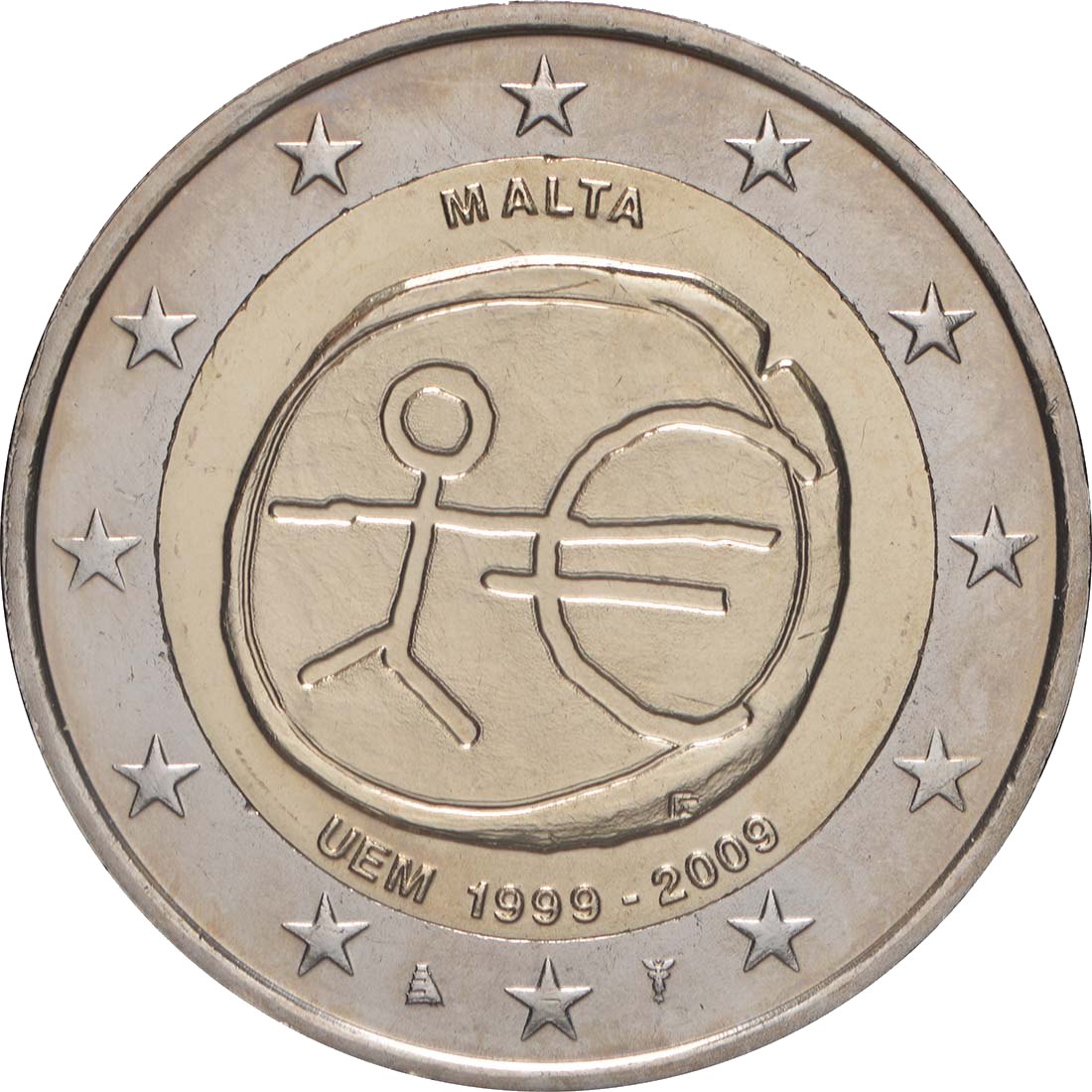
Malta · 10 years WWU
Issue occasion
The commemorative coin marks the tenth anniversary of the Economic and Monetary Union and the creation of the euro on 1 January 1999. The common design features a stylised human figure whose left arm merges into the euro symbol; beneath it are the initials ΓΣ of the artist G. Stamatopoulos. The design is completed by the years 1999–2009, the respective national-language acronym for the Economic and Monetary Union, and the twelve stars of the European flag.
The design
The twelve stars of the European flag are depicted on the outer ring of the coin.
Background on the topic
Initially, eleven states participated in the monetary union. Their exchange rates were fixed irrevocably, and monetary policy was transferred to the European level. At first, the euro was used only as book money, for example in cashless payments, finance and government accounts. Banknotes and coins did not enter circulation until 2002. Until then, the previous national means of payment remained in use, but were already economically fixed subdivisions of the euro. Greece joined the monetary union in 2001; further states followed after the introduction of cash.
The common currency was intended to complement the European internal market. It eliminated exchange-rate risks and conversion costs within the currency area, facilitated cross-border payments and made prices more directly comparable. At the same time, the participating states relinquished an independent national monetary and exchange-rate policy. Decisions on key interest rates and the money supply have since been taken centrally, while fiscal and budgetary policy fundamentally remained the responsibility of the individual states.
Its issue as a joint commemorative coin reflected this cross-border character. The design was not determined solely by a national mint: citizens and residents of the European Union were able to vote online on several proposals. The design by the Greek sculptor Georgios Stamatopoulos, who worked at the mint of the Bank of Greece (griechischen Zentralbank), was selected. His reduced visual language presents the common currency as the result of a long process of development in trade and economic exchange. The nearly simultaneous issue by the euro states at the time made the anniversary itself a joint numismatic occasion.
Interesting Facts
Unlike all other 2-euro coins from Malta since 2008, Malta’s two 2-euro joint issues from 2009 and 2012 do not bear the usual edge lettering, consisting of “2 ✠✠ × 6, alternately upright/inverted”, but rather “2 ★ ★ × 6, alternately upright/inverted”.
eBay price analysis
For this issue, there is a price history based on actual eBay sales – with median, range and number of sales
View price analysis2 Euro BU
- Mintage
- 700,000
- Market price
- €4.50
- Edge lettering
- 2 ★ ★ × 6, alternating upright/inverted