
 Deutsch
 English
 Français
 Español
 Italiano
 Nederlands
 Português
 Slovenčina
 Hrvatski
 Slovenščina
 Lietuvių
 Eesti
Eesti Български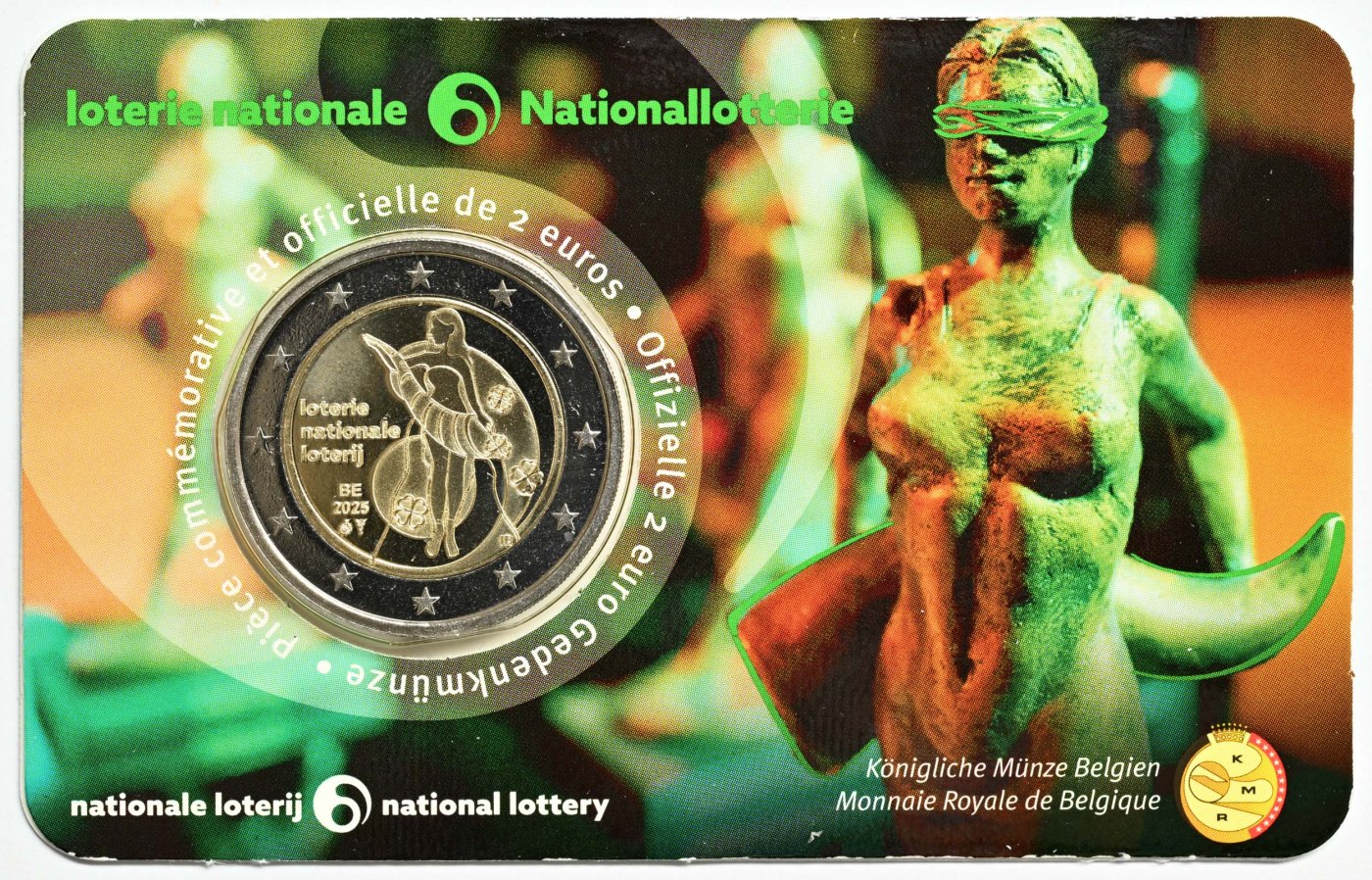
CC 551 2025
Coincard
BU Französisch
Coincard – French version
Belgium · National Lottery of Belgium
Mintage75,000
Issue price€11.00
Issue date23 Jan 2025
PackagingCoincard
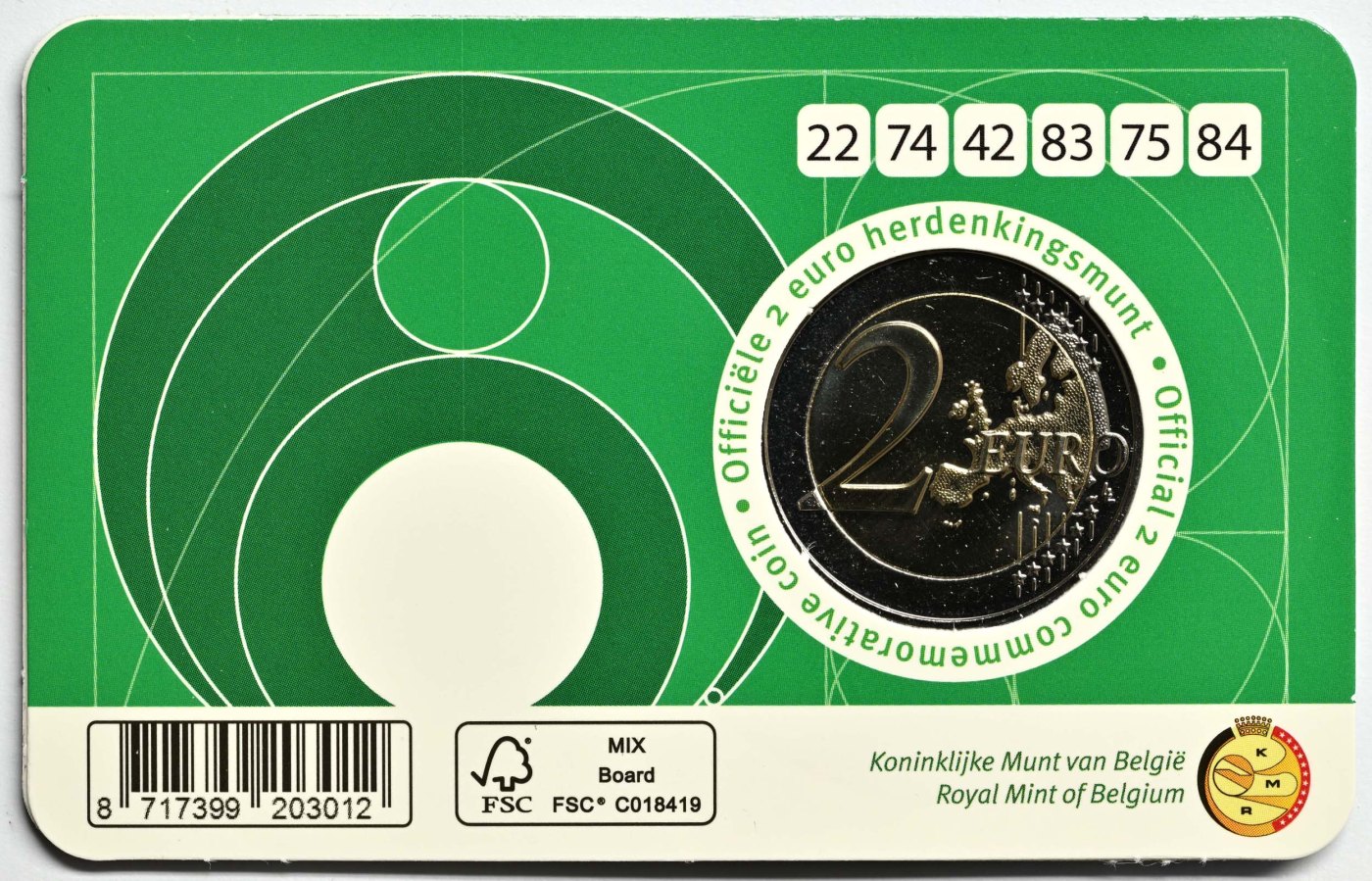
Edge lettering2 ★ ★ × 6, alternating upright/inverted
Market price€16.00
Mintage information from source: Gesamt 150.000 · 1:1 auf NL/FR geteilt
Issue occasion
The commemorative coin is dedicated to the Belgian National Lottery (Belgische Nationallotterie). At the centre is the goddess of fortune, Fortuna, with a cornucopia; four four-leaf clovers are depicted on the right and at the bottom as further symbols of good luck. The background is formed by the logo of the National Lottery, supplemented by the inscription “loterie nationale loterij”.
The design
The coin design shows in the centre the classical allegorical representation of good fortune in the form of the goddess Fortuna with the cornucopia. On the right and in the lower part, four four-leaf clovers are depicted, another commonly used symbol of good fortune. The background is formed by the logo of the National Lottery. The inscription “loterie nationale loterij” can be seen on the left side of the coin design. The country code BE and the year of issue 2025 appear in the lower left. The initials of the coin designer Iris Bruijns are located in the lower right. As the coins are minted by the Royal Dutch Mint, a caduceus as the mint mark of Utrecht and an aster before an Erlenmeyer flask as the mark of the Belgian mint master are arranged next to each other beneath the year. The twelve stars of the European flag are depicted on the outer ring of the coin.
Background on the topic
The present-day Belgian National Lottery dates back to the Colonial Lottery, founded in 1934. It was established during the Great Depression to raise revenue for the Belgian colony of Congo at the time. Its early history is therefore directly connected with the Belgian colonial system. Following the independence of Congo, the institution was initially continued as the African Lottery; since 1962, it has been known as the National Lottery.
Over time, it developed into a state-controlled gambling provider. Today, it is a public-law company under the supervision of the Belgian Minister of Finance. In addition to traditional draw lotteries, it offers, among other things, scratch cards and sports betting. Part of the funds generated flows to the state and to charitable projects through legally and politically defined allocation procedures. The beneficiaries include social, cultural, scientific and sporting projects. This financing model explains why the lottery is perceived as a public institution beyond its role as a gambling operator.
The French and Dutch names of the institution reflect Belgium’s multilingualism. Federal institutions generally appear in several national languages; in addition to French and Dutch, German is also an official language. The linguistic design of state symbols and publications is therefore also an expression of the country’s federal structure.
Fortuna originated in Roman religion and personified luck, fate and the changeable outcome of human endeavours. Since antiquity, the cornucopia has symbolised abundance and prosperity. Such symbols later became closely associated with lotteries and games of chance, whose outcomes depend on luck.
The institutional occasion is connected with the Belgian lottery’s approximately ninety-year existence since its foundation in 1934. Its selection as the theme of the coin refers both to its long state tradition and to its role in financing public and charitable tasks.
Over time, it developed into a state-controlled gambling provider. Today, it is a public-law company under the supervision of the Belgian Minister of Finance. In addition to traditional draw lotteries, it offers, among other things, scratch cards and sports betting. Part of the funds generated flows to the state and to charitable projects through legally and politically defined allocation procedures. The beneficiaries include social, cultural, scientific and sporting projects. This financing model explains why the lottery is perceived as a public institution beyond its role as a gambling operator.
The French and Dutch names of the institution reflect Belgium’s multilingualism. Federal institutions generally appear in several national languages; in addition to French and Dutch, German is also an official language. The linguistic design of state symbols and publications is therefore also an expression of the country’s federal structure.
Fortuna originated in Roman religion and personified luck, fate and the changeable outcome of human endeavours. Since antiquity, the cornucopia has symbolised abundance and prosperity. Such symbols later became closely associated with lotteries and games of chance, whose outcomes depend on luck.
The institutional occasion is connected with the Belgian lottery’s approximately ninety-year existence since its foundation in 1934. Its selection as the theme of the coin refers both to its long state tradition and to its role in financing public and charitable tasks.