
 Deutsch
 English
 Français
 Español
 Italiano
 Nederlands
 Português
 Slovenčina
 Hrvatski
 Slovenščina
 Lietuvių
 Eesti
Eesti Български
Reverse
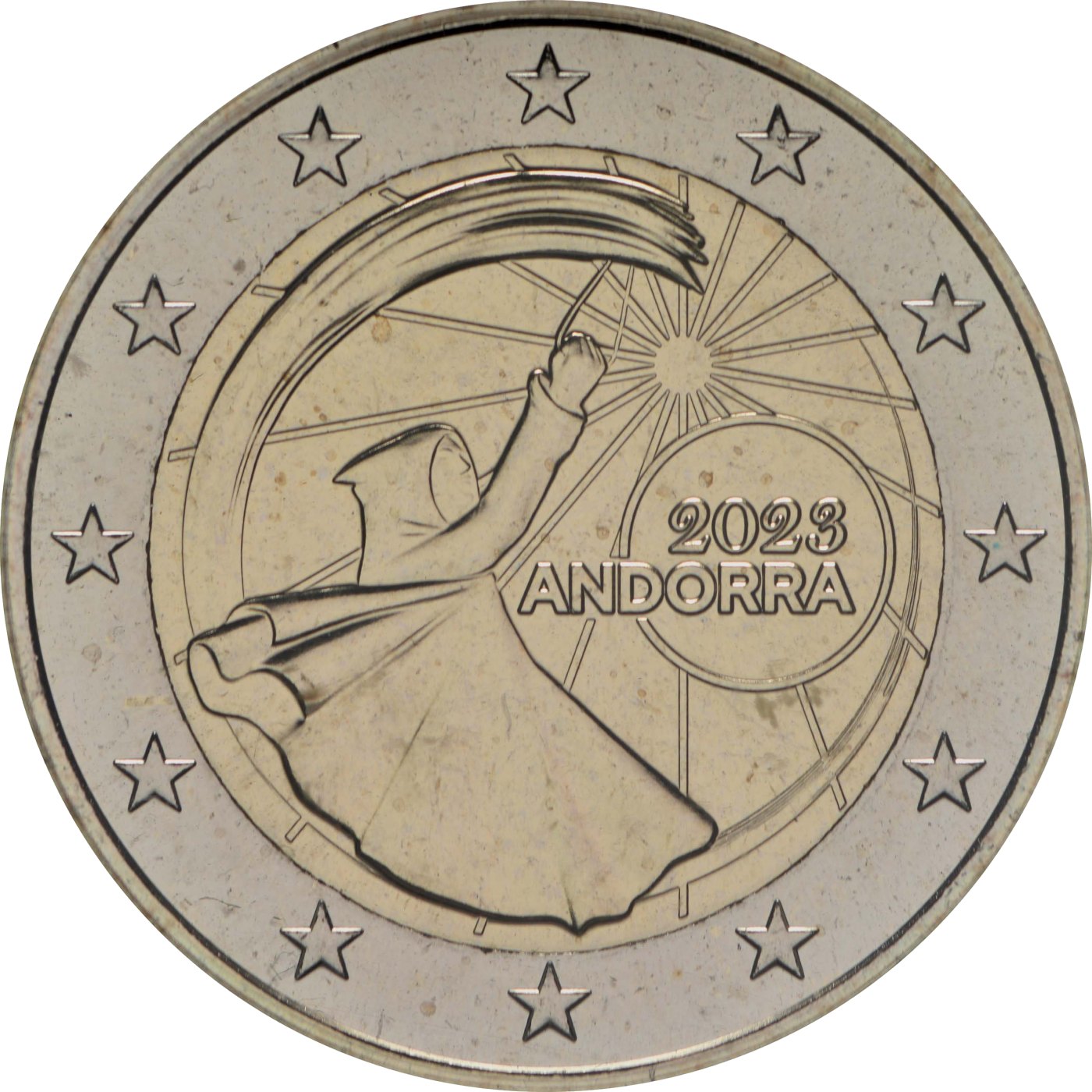
Obverse
More images of the main coin
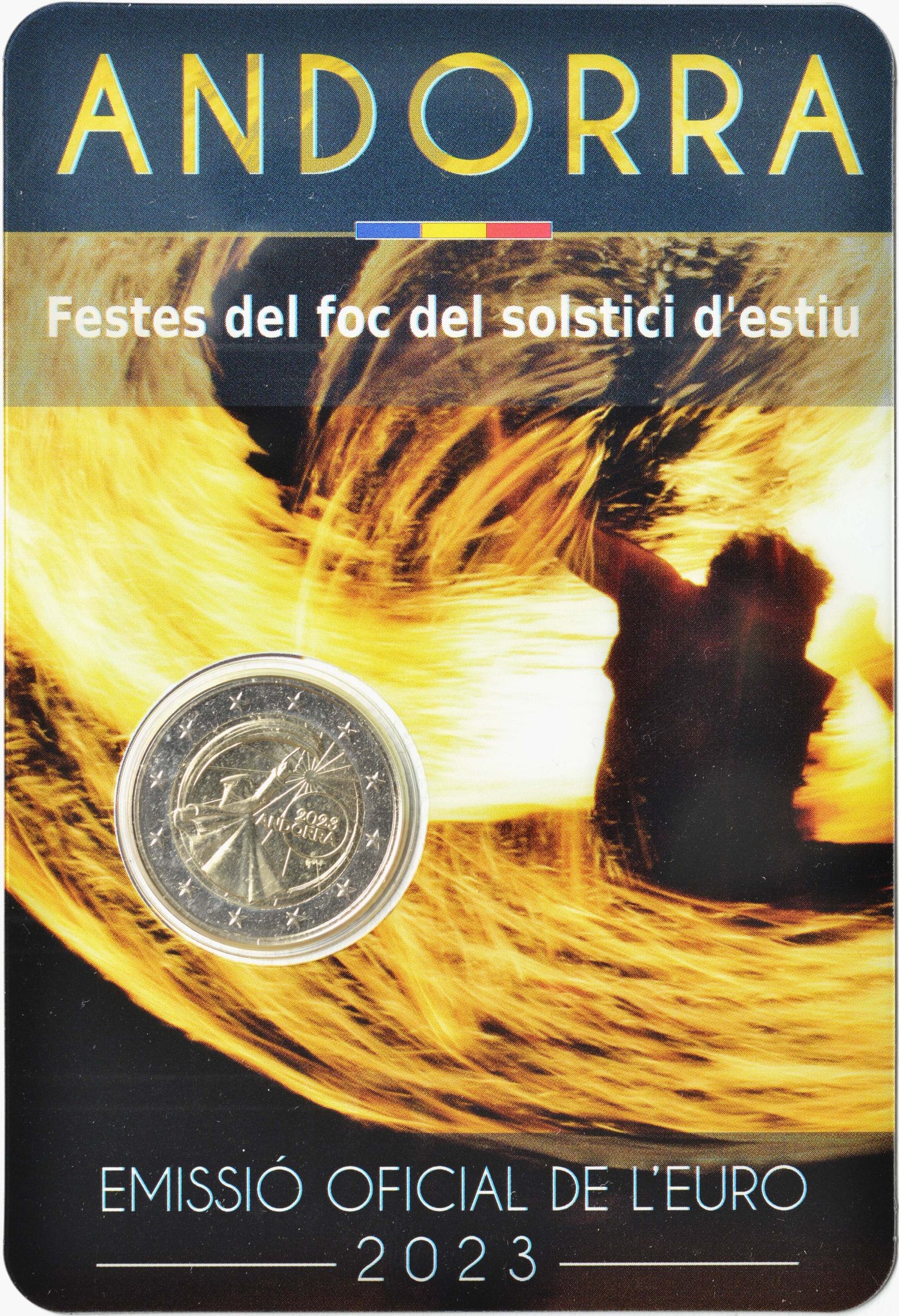

Andorra · Summer Solstice Festival
Issue date27 Nov 2023
Total mintage70,000
EU maximum70,000
Editions1
Edge lettering2 ★ ★ × 6, alternating upright/inverted
InscriptionAndorra / 2023
DesignerJoaquin Jimenez
mintMonnaie de Paris, Pessac
Issue occasion
The commemorative coin honours the traditional fire festivals at the summer solstice in the Pyrenees, which were added to UNESCO’s Representative List of the Intangible Cultural Heritage of Humanity in 2015. The design shows a “Fallaire” in a traditional hooded cloak, drawing a trail of fire in the air with a torch made of tree bark known as a “Falla”. Graphic lines in the background symbolise the summer solstice; “Andorra” and the year “2023” are also shown.
The design
The summer solstice fire festivals were inscribed by UNESCO on the Representative List of the Intangible Cultural Heritage of Humanity in 2015. These traditional and popular festivals are celebrated annually throughout Andorra. The coin’s design depicts the so-called “Fallaire” in his traditional hooded cloak, drawing a trail of fire through the air with his “Falla”. The torches made of tree bark, known as “Falla”, play a central role in the festivals. They are set alight and swung forcefully through the air, creating large trails of fire. The background features graphic lines representing the summer solstice, as well as the country name “Andorra” and the year “2023”.
The outer ring of the coin bears the twelve stars of the European flag.
The outer ring of the coin bears the twelve stars of the European flag.
Background on the topic
The fire traditions are practised in numerous communities in the central Pyrenees and constitute a cross-border cultural heritage of Andorra, France and Spain. Their specific form varies from place to place. Fires are often lit in elevated locations. Participants then carry burning pieces of wood or torches downhill to the settlement, where a communal fire and further celebrations take place. Elsewhere, burning torches are swung in the village square or carried around an upright tree trunk.
The timing close to the longest day of the year links the festival to the seasonal change. Fire serves as a highly visible sign connecting the mountain, the village and the festival community. No uniform statements can be made about the origins and age of the individual traditions. Interpretations as pre-Christian sun worship are widespread, but historically cannot be demonstrated for every local tradition. In present-day practice, there may also be connections with St John’s Day on 24 June.
Preparation is carried out communally: the required wood is collected and processed, the procedures are organised, and knowledge about making and safely handling the fire carriers is passed on. Children and young people are gradually involved. In some places, taking part actively for the first time marks the transition to a new age or community role. Music, dance and communal meals may accompany the torch processions.
In Andorra, the practice declined for a time and was revived by local groups in the late 20th century. Today, it forms part of the public preservation of regional traditions. The international recognition concerns not just a festival in a single location, but a group of related traditions supported by the respective communities. As a coin theme, the subject is therefore also suitable as an indication of Andorra’s own culture and of the historical connections across the national borders of the Pyrenees. The issue also relates to the state’s responsibility to make visible a living cultural heritage preserved through practical transmission.
The timing close to the longest day of the year links the festival to the seasonal change. Fire serves as a highly visible sign connecting the mountain, the village and the festival community. No uniform statements can be made about the origins and age of the individual traditions. Interpretations as pre-Christian sun worship are widespread, but historically cannot be demonstrated for every local tradition. In present-day practice, there may also be connections with St John’s Day on 24 June.
Preparation is carried out communally: the required wood is collected and processed, the procedures are organised, and knowledge about making and safely handling the fire carriers is passed on. Children and young people are gradually involved. In some places, taking part actively for the first time marks the transition to a new age or community role. Music, dance and communal meals may accompany the torch processions.
In Andorra, the practice declined for a time and was revived by local groups in the late 20th century. Today, it forms part of the public preservation of regional traditions. The international recognition concerns not just a festival in a single location, but a group of related traditions supported by the respective communities. As a coin theme, the subject is therefore also suitable as an indication of Andorra’s own culture and of the historical connections across the national borders of the Pyrenees. The issue also relates to the state’s responsibility to make visible a living cultural heritage preserved through practical transmission.
eBay price analysis
For this issue, there is a price history based on actual eBay sales – with median, range and number of sales
View price analysisCoincard
- Packaging
- Coincard
- Mintage
- 70,000
- Market price
- €25.90
- Edge lettering
- 2 ★ ★ × 6, alternating upright/inverted
Mintage by issue type
Coincard
70,000
Official issue prices
2023 · Coincard: €14.50
Additional information
In den Umlaufmünzensätzen Andorras ist diese Gedenkmünze nicht enthalten.