
 Deutsch
 English
 Français
 Español
 Italiano
 Nederlands
 Português
 Slovenčina
 Hrvatski
 Slovenščina
 Lietuvių
 Eesti
Eesti Български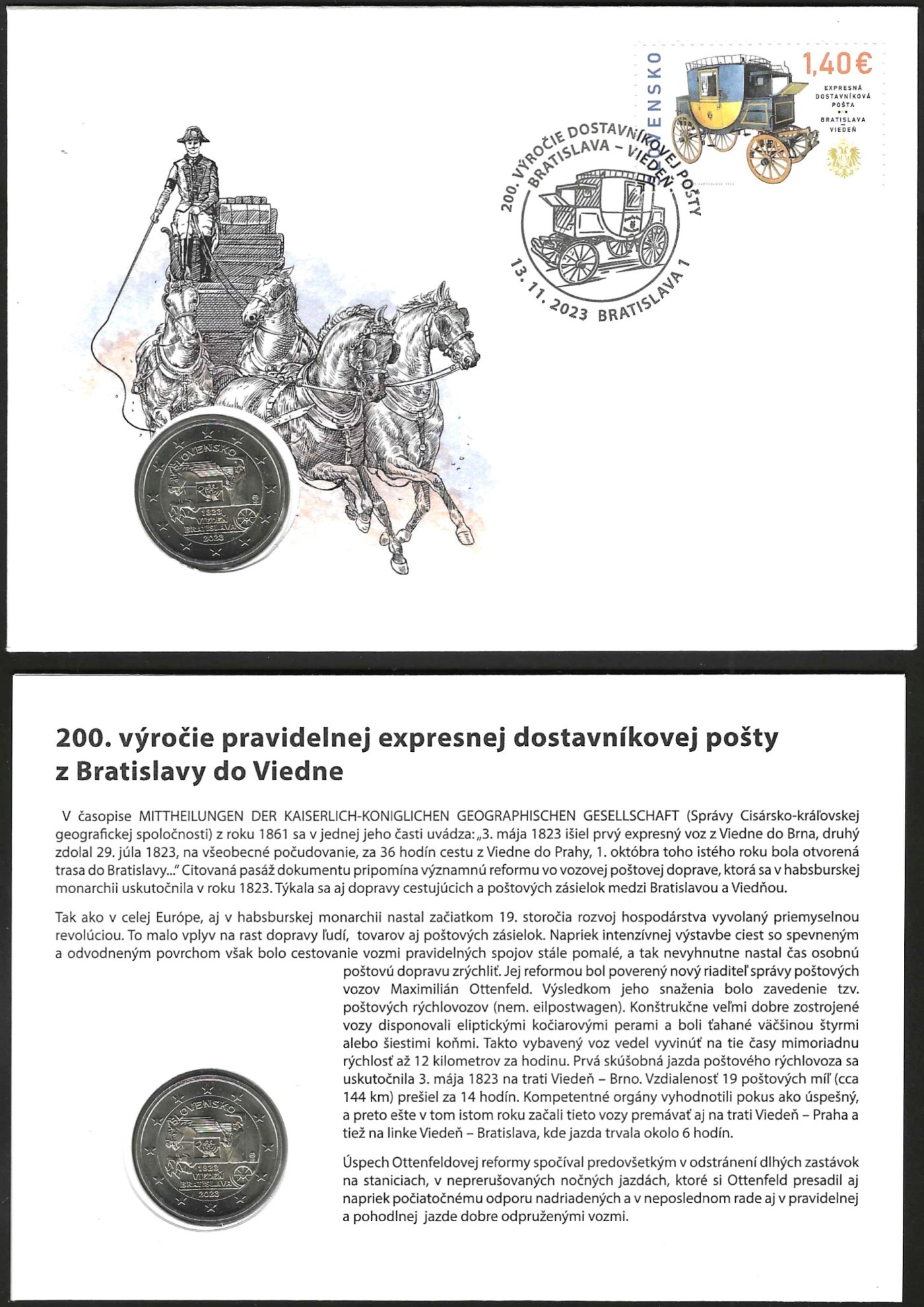
CC 507 2023
Numismatic cover
BU
Numismatic cover
Slovakia · 200 years since the commencement of the regular horse-drawn express mail service between Wien and Bratislava
Mintage2,000
Issue price€8.61
Issue date11 Oct 2023
PackagingNumismatic cover
Edge letteringSLOVENSKÁ REPUBLIKA + ★ + Linden leaf + ★
Issue occasion
The coin commemorates the 200th anniversary of the horse-drawn express mail service between Vienna (Wien) and Bratislava, which began operating in 1823. The design features a fast-moving postal horse-drawn carriage and an inset rectangle with a post horn. Below it are the year “1823” and the city names “VIEDEŇ” and “BRATISLAVA”.
The design
The coin design depicts a post horse-drawn carriage in rapid motion as a symbol of the horse-drawn express mail service between Wien and Bratislava, with a recessed rectangle featuring a post horn in the centre. Beneath the carriage, the year “1823” is shown, when the express mail service was introduced, and below it the names of the cities “VIEDEŇ” and “BRATISLAVA” in Slovak. At the bottom of the inner coin design, separated from the city names by a horizontal line, is the year of issue “2023”. The name of the issuing country, “SLOVENSKO”, adorns the upper edge of the coin design. To the right of the carriage, the mark of the Kremnica Mint (Mincovňa Kremnica), “MK”, can be seen between two cuboid mint marks. Directly below the mint mark are the stylised initials of the designer of the national side, Mária Poldaufová, “MP”.
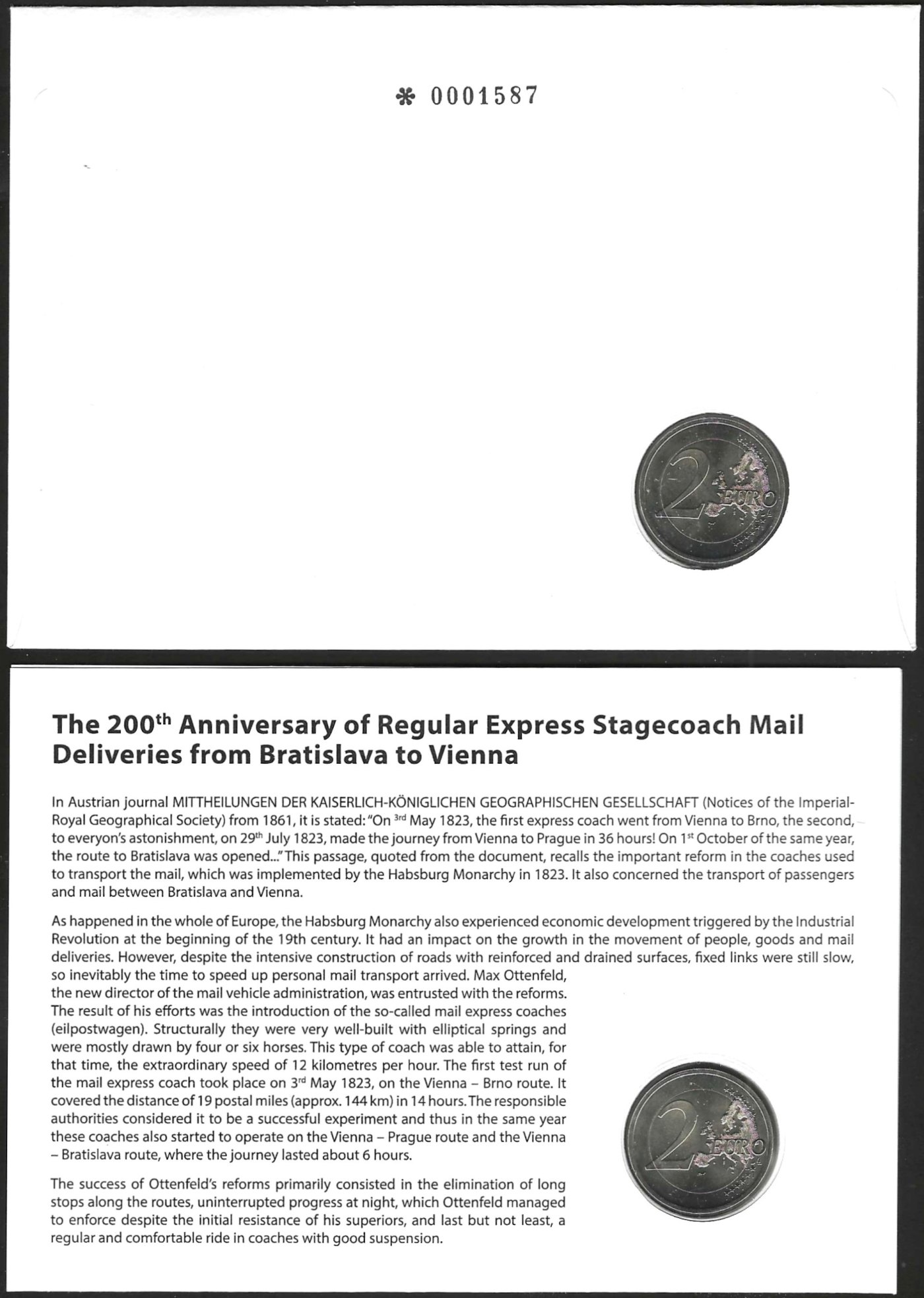
The twelve stars of the European flag are depicted on the outer coin ring.
The twelve stars of the European flag are depicted on the outer coin ring.
Background on the topic
At the beginning of the 19th century, Vienna (Wien) and what is now Bratislava belonged to the same realm. Vienna was the residential city of the Austrian Empire (Kaisertum Österreich), while Bratislava belonged to the Kingdom of Hungary (Königreich Ungarn) within the Habsburg Monarchy (Habsburgermonarchie). At that time, the city was known primarily by the names Pressburg, Pozsony and Prešporok; its present name did not become official until the 20th century. The Hungarian Diet met in Pressburg, resulting in lively political, economic and personal exchanges between the two cities.
Before the expansion of the railway, stagecoaches were a central means of transporting news and travellers over land. They operated according to timetables on fixed routes. At post stations, horses could be changed so that the journey could continue without lengthy rest periods. An express post differed from slower postal connections mainly through shorter stops and an organisation geared towards speed. In addition to letters and official consignments, stagecoaches often also carried passengers.
The post horn originally served a practical function. Using established signals, the postilion announced the arrival or departure and could arrange for fresh horses to be prepared at a station. At the same time, the horn identified the official mail, which enjoyed special privileges on many roads.
The connection between the cities, which are only around 60 kilometres apart, represents a transitional phase in the history of transport. Long-distance traffic still relied on horsepower and a network of stations; a few decades later, railways took over an increasing share of passenger and mail transport. The railway line between Vienna (Wien) and Pressburg was opened in the middle of the 19th century.
From a Slovak perspective, the anniversary was suitable as an occasion for a coin because the route illustrates Bratislava’s historical integration into the transport and communication networks of the Habsburg Monarchy (Habsburgermonarchie). At the same time, it points to the close cross-border connection between the two neighbouring capitals that continues to this day.
Before the expansion of the railway, stagecoaches were a central means of transporting news and travellers over land. They operated according to timetables on fixed routes. At post stations, horses could be changed so that the journey could continue without lengthy rest periods. An express post differed from slower postal connections mainly through shorter stops and an organisation geared towards speed. In addition to letters and official consignments, stagecoaches often also carried passengers.
The post horn originally served a practical function. Using established signals, the postilion announced the arrival or departure and could arrange for fresh horses to be prepared at a station. At the same time, the horn identified the official mail, which enjoyed special privileges on many roads.
The connection between the cities, which are only around 60 kilometres apart, represents a transitional phase in the history of transport. Long-distance traffic still relied on horsepower and a network of stations; a few decades later, railways took over an increasing share of passenger and mail transport. The railway line between Vienna (Wien) and Pressburg was opened in the middle of the 19th century.
From a Slovak perspective, the anniversary was suitable as an occasion for a coin because the route illustrates Bratislava’s historical integration into the transport and communication networks of the Habsburg Monarchy (Habsburgermonarchie). At the same time, it points to the close cross-border connection between the two neighbouring capitals that continues to this day.
Interesting Facts
Issuer: POFIS, Bratislava (Slovak Post)