
 Deutsch
 English
 Français
 Español
 Italiano
 Nederlands
 Português
 Slovenčina
 Hrvatski
 Slovenščina
 Lietuvių
 Eesti
Eesti Български
Reverse

Obverse

More images of the main coin


Malta · Napoléon Bonaparte and the French in Malta
Issue date14 Sept 2023
Total mintage85,500
EU maximum85,500
Editions2
Edge lettering2 ✠✠ × 6, alternately upright/inverted
Inscription225th ANNIVERSARY / ARRIVAL OF THE FRENCH IN MALTA / 2023 / Liberté / Egalité / 1798-2023
DesignerNoel Galea Bason
mintKoninklijke Nederlandse Munt, Utrecht
Issue occasion
The coin commemorates the 225th anniversary of the arrival of the French in Malta in 1798. Napoleon Bonaparte ended the rule of the Order of St John there and introduced far-reaching reforms, against which an uprising broke out shortly afterwards. The design features a personified representation of the French Republic based on the model of official letterheads of the time, accompanied by the inscriptions “Liberté”, “Egalité” and “ARRIVAL OF THE FRENCH IN MALTA”.
The design
In June 1798, Napoleon Bonaparte ended the rule of the Order of St John in Malta. During his brief stay there, he established a republican government and implemented far-reaching legal and administrative reforms. Among other measures, slavery and the privileges of the nobility were abolished, the separation of religion and state was introduced, and the Inquisition tribunal was abolished. The extensive reforms did not receive general approval in Malta at the time, and an uprising broke out shortly afterwards.
The coin design features a personified depiction of the French Republic, as it appeared on official letterheads at the time. Along the left side of the inner edge of the coin runs the inscription “225th ANNIVERSARY”, and continuing from the top towards the right is the inscription “ARRIVAL OF THE FRENCH IN MALTA”. The year of issue “2023” can be seen at the bottom. To the left and right of the image are “Liberté” and “Egalité”, respectively. The years “1798-2023” appear above the word “Egalité” on the left.
The twelve stars of the European flag are depicted on the outer ring of the coin.
The coin design features a personified depiction of the French Republic, as it appeared on official letterheads at the time. Along the left side of the inner edge of the coin runs the inscription “225th ANNIVERSARY”, and continuing from the top towards the right is the inscription “ARRIVAL OF THE FRENCH IN MALTA”. The year of issue “2023” can be seen at the bottom. To the left and right of the image are “Liberté” and “Egalité”, respectively. The years “1798-2023” appear above the word “Egalité” on the left.
The twelve stars of the European flag are depicted on the outer ring of the coin.
Background on the topic
The Order of St John, also known as the Order of Malta, had ruled the island group since 1530. Emperor Charles V had granted it to the order after it lost its former seat on Rhodes. From Malta, the order maintained a fleet and fortified the area around the Grand Harbour (Großen Hafen) in particular. Towards the end of the 18th century, however, its political and military position had weakened. In addition, the upheavals of the French Revolution deprived the internationally composed order of property and income in France.
In 1798, Napoleon was not yet an emperor but a general of the French Republic. Malta lay on the route of his expedition to Egypt, with which France sought to strengthen its position in the Mediterranean and disrupt British trade links with India. After the capitulation of the order, Napoleon remained on the islands for only a few days. He then moved on with the main part of his forces; a French garrison remained behind.
The rejection of the new rule was connected not only with the political changes. Requisitions, financial burdens and interference with Church property intensified the conflict in a strongly Catholic society. In September 1798, parts of the population rose up. The insurgents soon controlled large areas outside the fortified port cities, while the French troops entrenched themselves there. With British and Neapolitan support, they were blockaded. In 1800, the French garrison capitulated. Malta then came under British control and later became part of the British colonial empire.
The female personification of the Republic depicted on the coin belongs to the imagery of the French Revolution. Such allegorical figures did not represent a specific person, but rather the republican state and its political principles. This later developed into the symbolic figure known as Marianne in France.
The anniversary was chosen because 1798 marked the transition from centuries of rule by the order to a brief French occupation and finally to the British era. The coin thus addresses a turning point in Malta’s political and social development.
In 1798, Napoleon was not yet an emperor but a general of the French Republic. Malta lay on the route of his expedition to Egypt, with which France sought to strengthen its position in the Mediterranean and disrupt British trade links with India. After the capitulation of the order, Napoleon remained on the islands for only a few days. He then moved on with the main part of his forces; a French garrison remained behind.
The rejection of the new rule was connected not only with the political changes. Requisitions, financial burdens and interference with Church property intensified the conflict in a strongly Catholic society. In September 1798, parts of the population rose up. The insurgents soon controlled large areas outside the fortified port cities, while the French troops entrenched themselves there. With British and Neapolitan support, they were blockaded. In 1800, the French garrison capitulated. Malta then came under British control and later became part of the British colonial empire.
The female personification of the Republic depicted on the coin belongs to the imagery of the French Revolution. Such allegorical figures did not represent a specific person, but rather the republican state and its political principles. This later developed into the symbolic figure known as Marianne in France.
The anniversary was chosen because 1798 marked the transition from centuries of rule by the order to a brief French occupation and finally to the British era. The coin thus addresses a turning point in Malta’s political and social development.
eBay price analysis
For this issue, there is a price history based on actual eBay sales – with median, range and number of sales
View price analysisCoincard – Single page
- Packaging
- Coincard
- Mintage
- 80,500
- Market price
- €28.90
- Edge lettering
- 2 ✠✠ × 6, alternately upright/inverted
Mintage by issue type
BU
85,500
2 Editions
More editions
1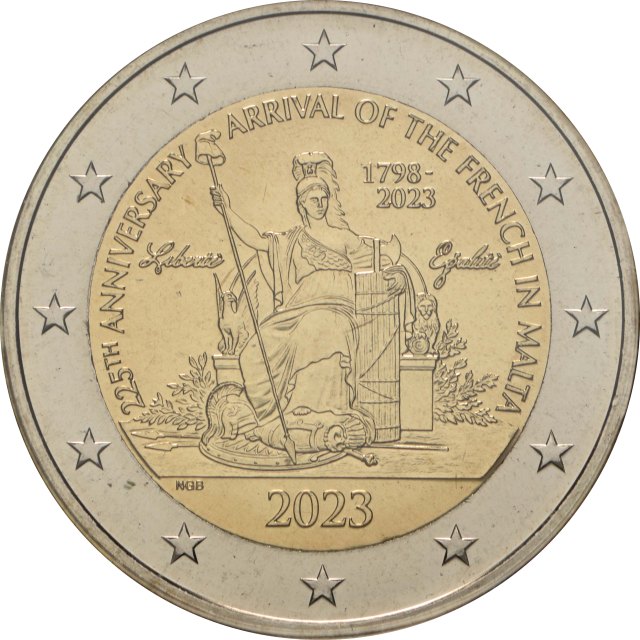

Issue date
214 Sept 2023 · Malta – Napoléon Bonaparte und die Franzosen auf Malta
2 Euro Stgl./BU
14 Sept 2023 · Malta – Napoléon Bonaparte und die Franzosen auf Malta
Coincard
Mintages
Malta
85,500Circulation: 5,000
Coincard: 80,500
Official issue prices
2023 · Coincard: €16.00