
 Deutsch
 English
 Français
 Español
 Italiano
 Nederlands
 Português
 Slovenčina
 Hrvatski
 Slovenščina
 Lietuvių
 Eesti
Eesti Български
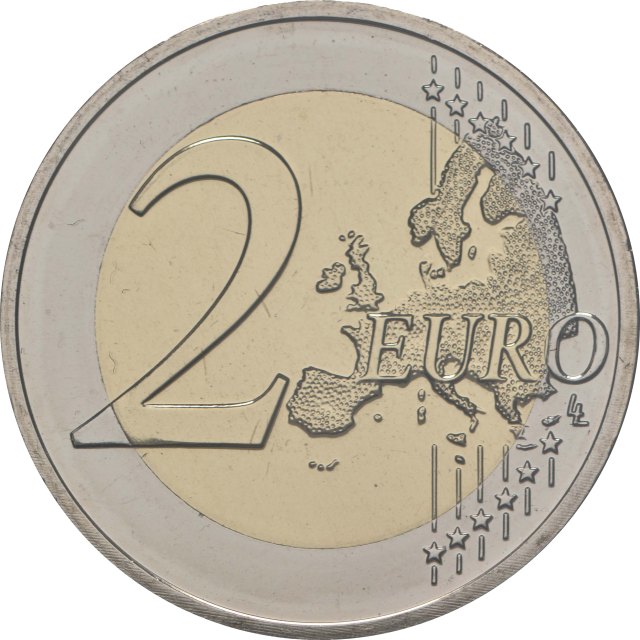
Reverse

Obverse

More images of the main coin


Malta · 550th birthday of Nikolaus Kopernikus
Issue date14 Sept 2023
Total mintage95,500
EU maximum95,500
Editions3
Edge lettering2 ✠✠ × 6, alternately upright/inverted
InscriptionNICOLAUS COPERNICUS 1473-1543 / MALTA / 2023 / FUSCO
DesignerDaniela Fusco
mintKoninklijke Nederlandse Munt, Utrecht
Issue occasion
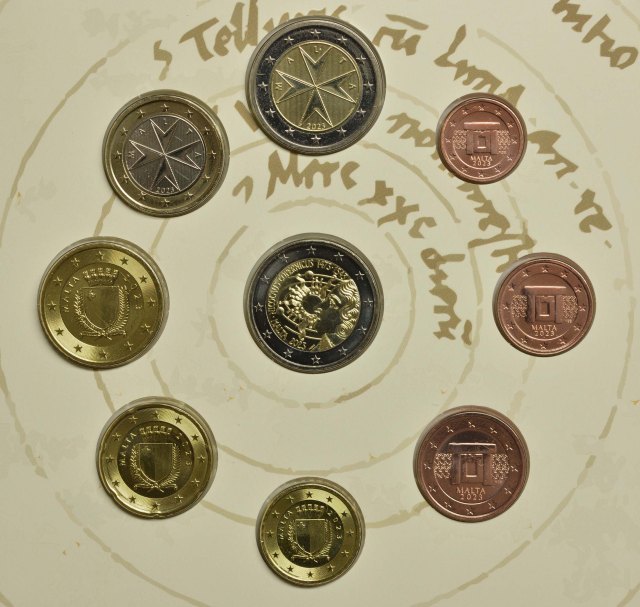
The commemorative coin honours the 550th birthday of Nikolaus Kopernikus. The design depicts him in profile against a stylised representation of his heliocentric model of the universe, along with the inscription “NICOLAUS COPERNICUS 1473-1543” and the signature of the coin designer Daniela Fusco.
The design
Kopernikus is depicted in profile on the coin, in front of a stylized representation of his heliocentric model of the universe. The inscription “NICOLAUS COPERNICUS 1473-1543” appears at the top left, while the name of the issuing country, “MALTA”, and the year of issue, “2023”, can be seen at the bottom left. The signature of the coin designer Daniela Fusco, “FUSCO”, also appears at the bottom.
The twelve stars of the European flag are depicted on the outer ring of the coin.
The twelve stars of the European flag are depicted on the outer ring of the coin.
Background on the topic
Nicolaus Copernicus was born in Thorn, now Toruń in Poland. At the time, the city belonged to Royal Prussia within the Kingdom of Poland. He studied, among other subjects, in Kraków (Krakau) and at several Italian universities. In addition to astronomy and mathematics, he studied canon law and medicine. He later served as a canon in the Prince-Bishopric of Ermland and assumed ecclesiastical, economic and administrative duties there. He spent a large part of his life in Frombork (Frauenburg).
In European astronomy, the geocentric system based on ancient ideas dominated during his time. According to this system, the Earth rested at the centre, while the Sun, Moon, planets and fixed stars revolved around it. To explain the observed planetary movements, astronomers used a complicated system of circular orbits and additional auxiliary circles.
Copernicus set against this a mathematically elaborated heliocentric model. In it, the Earth moves around the Sun annually and at the same time rotates daily on its axis. The apparent daily movement of the heavens could thus be explained as a consequence of the Earth’s rotation. The planets’ temporarily retrograde apparent motion also became understandable as a perspective effect resulting from the different orbital movements of the Earth and the planets.
Copernicus published his ideas in his principal work, “De revolutionibus orbium coelestium”, which was not printed until near the end of his life. His model did not yet correspond to modern astronomy: Copernicus adhered to uniform circular motion and still required auxiliary circles. Johannes Kepler later replaced these with elliptical orbits; the observations of Galileo Galilei and the physics of Isaac Newton contributed to the further substantiation of the new view of the world.
The Copernican doctrine fundamentally changed the position of the Earth in astronomical thought over the long term and became a starting point for early modern science. The anniversary of his birth therefore provided a commemorative occasion understandable throughout Europe. No particular direct connection between Copernicus and Malta is apparent from the coin’s commemorative occasion.
In European astronomy, the geocentric system based on ancient ideas dominated during his time. According to this system, the Earth rested at the centre, while the Sun, Moon, planets and fixed stars revolved around it. To explain the observed planetary movements, astronomers used a complicated system of circular orbits and additional auxiliary circles.
Copernicus set against this a mathematically elaborated heliocentric model. In it, the Earth moves around the Sun annually and at the same time rotates daily on its axis. The apparent daily movement of the heavens could thus be explained as a consequence of the Earth’s rotation. The planets’ temporarily retrograde apparent motion also became understandable as a perspective effect resulting from the different orbital movements of the Earth and the planets.
Copernicus published his ideas in his principal work, “De revolutionibus orbium coelestium”, which was not printed until near the end of his life. His model did not yet correspond to modern astronomy: Copernicus adhered to uniform circular motion and still required auxiliary circles. Johannes Kepler later replaced these with elliptical orbits; the observations of Galileo Galilei and the physics of Isaac Newton contributed to the further substantiation of the new view of the world.
The Copernican doctrine fundamentally changed the position of the Earth in astronomical thought over the long term and became a starting point for early modern science. The anniversary of his birth therefore provided a commemorative occasion understandable throughout Europe. No particular direct connection between Copernicus and Malta is apparent from the coin’s commemorative occasion.
eBay price analysis
For this issue, there is a price history based on actual eBay sales – with median, range and number of sales
View price analysisCoincard – Single page
- Packaging
- Coincard
- Mintage
- 80,500
- Market price
- €28.90
- Edge lettering
- 2 ✠✠ × 6, alternately upright/inverted
Mintage by issue type
BU
85,500
2 Editions
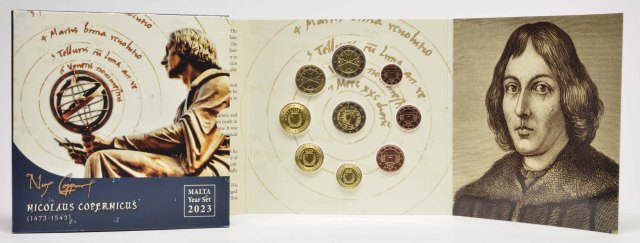
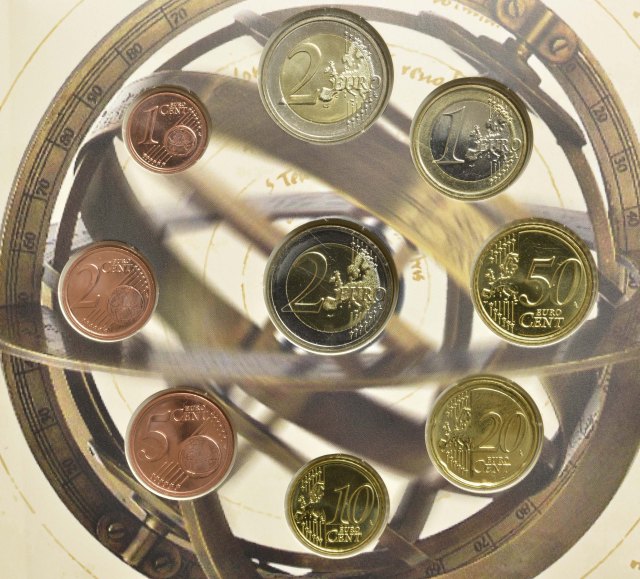
Coin set
10,000
More editions
2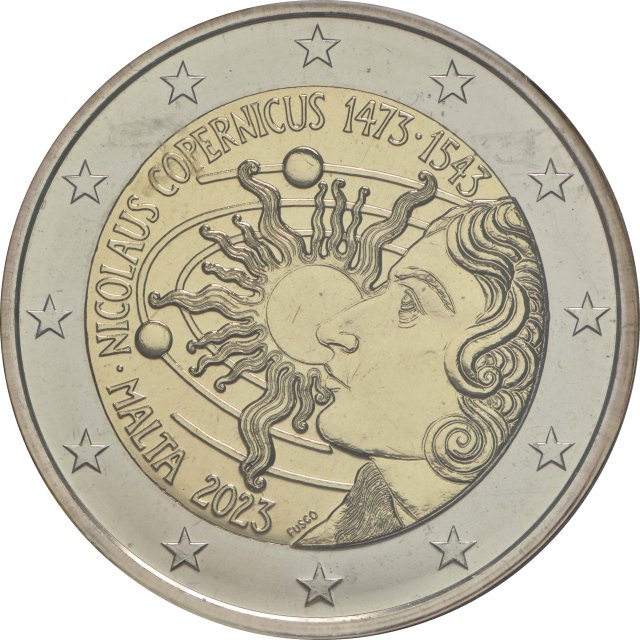
Issue date
214 Sept 2023 · Malta – 550. Geburtstag von Nikolaus Kopernikus
2 Euro Stgl./BU
14 Sept 2023 · Malta – 550. Geburtstag von Nikolaus Kopernikus
Coincard
Mintages
Malta
95,500Circulation: 5,000
Coincard: 80,500
BU Mint Set: 10,000
Official issue prices
2023 · Coincard: €16.00
2023 · BU Mint Set: €30.00