
 Deutsch
 English
 Français
 Español
 Italiano
 Nederlands
 Português
 Slovenčina
 Hrvatski
 Slovenščina
 Lietuvių
 Eesti
Eesti Български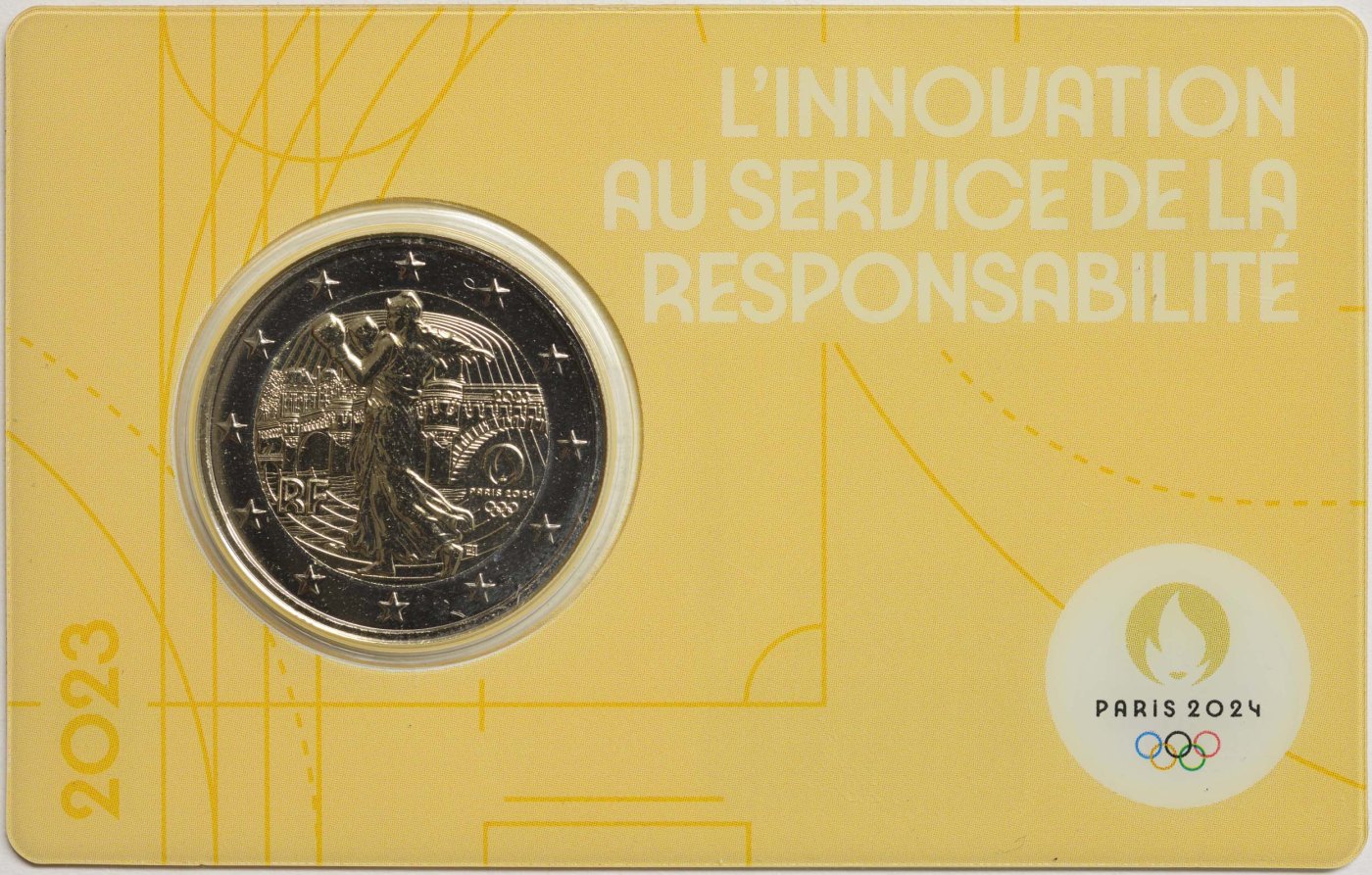


CC 476 2023
Coincard
BU
Coincard – Issue 2
France · The Sower and Boxing - Pont Neuf (Series: Summer Olympic Games, Paris 2024 - 3/4)
Mintage50,000
Issue date10 Jan 2023
PackagingCoincard
Edge lettering2 ★ ★ × 6, alternating upright/inverted
Market price€15.90
Mintage information from source: 5 x 50.000
Issue occasion
The coin commemorates the Paris 2024 Olympic Games, which are taking place in the French capital once again, one hundred years after the 1924 Summer Games. The design depicts the Sower, a national figure and icon of French numismatics, engaged in ancient boxing in front of the Pont-Neuf and the Île de la Cité. An athletics track and the logo of the Paris 2024 Olympic Games complete the design.
The design
One hundred years after the 1924 Olympic Games in Paris, the 2024 Summer Olympics are once again taking place in the French capital. Monnaie de Paris (Paris Mint) is using the countdown to the opening of the Olympics in one year as an opportunity to present the cultural heritage of the Games and the city of Paris. The Games are an event of international significance and are now increasingly coming into focus. In recent years, several 2-euro commemorative coins have already been issued featuring the Olympic Games.
This coin depicts the Sower, a national figure and icon of French numismatics. In reference to the Olympic Games of antiquity, the figure is shown engaged in fist fighting, a precursor to boxing. The silhouette is depicted in front of Pont-Neuf, with its surroundings typical of Ile-de-la-Cité in the center of Paris. In the background, an athletics track runs around the inner disc of the coin, with the logo of the 2024 Olympic Games in Paris inserted on the right. The year of issue, the letters “RF” and the mint marks appear below the arch, on the bridge railing and in the Seine.
The twelve stars of the European flag are depicted on the outer ring of the coin.
This coin depicts the Sower, a national figure and icon of French numismatics. In reference to the Olympic Games of antiquity, the figure is shown engaged in fist fighting, a precursor to boxing. The silhouette is depicted in front of Pont-Neuf, with its surroundings typical of Ile-de-la-Cité in the center of Paris. In the background, an athletics track runs around the inner disc of the coin, with the logo of the 2024 Olympic Games in Paris inserted on the right. The year of issue, the letters “RF” and the mint marks appear below the arch, on the bridge railing and in the Seine.
The twelve stars of the European flag are depicted on the outer ring of the coin.
Background on the topic
The 1924 Games were already the second time Paris hosted them, following 1900. They took place during the tenure of Pierre de Coubertin, the French co-founder of the modern Olympic movement. More than 3,000 athletes from 44 countries took part; women were admitted in only a few disciplines. What later became known as the Olympic Village was established for the first time, creating accommodation specifically for the participants. The ceremony of the closing ceremony, still customary today, involving the Olympic flag, the Greek flag and the flag of the next host country was also introduced in 1924.
The Olympic Games of Antiquity were held in Olympia in honour of Zeus. Boxing had been part of their programme since the 7th century BC. The fighters wore leather straps around their hands and forearms; there were no weight classes or set rounds. This reference to the discipline connects modern sport with its ancient predecessors.
The French sower, “La Semeuse”, is based on a design by the medallist Louis-Oscar Roty from the late 19th century. From 1897 onwards, she appeared on French silver coins, and later also on stamps as well as on other franc and euro issues. As a walking woman scattering seed, she represents the Republic and the transmission of its ideas. Her long use also makes her a reference to the history of French coinage.
The Pont-Neuf was built at the turn of the 16th and 17th centuries. Despite its name—“New Bridge”—it is today the oldest surviving bridge over the Seine in Paris. It crosses the western tip of the Île de la Cité and connects the two banks of the river. Unlike older Parisian bridges, it was not lined with rows of houses.
The issue in the year before the opening formed part of the French mint’s Olympic countdown. Historic national symbols, ancient sport and Parisian urban history were intended to bring together France’s role as host and the Games’ long prehistory.
The Olympic Games of Antiquity were held in Olympia in honour of Zeus. Boxing had been part of their programme since the 7th century BC. The fighters wore leather straps around their hands and forearms; there were no weight classes or set rounds. This reference to the discipline connects modern sport with its ancient predecessors.
The French sower, “La Semeuse”, is based on a design by the medallist Louis-Oscar Roty from the late 19th century. From 1897 onwards, she appeared on French silver coins, and later also on stamps as well as on other franc and euro issues. As a walking woman scattering seed, she represents the Republic and the transmission of its ideas. Her long use also makes her a reference to the history of French coinage.
The Pont-Neuf was built at the turn of the 16th and 17th centuries. Despite its name—“New Bridge”—it is today the oldest surviving bridge over the Seine in Paris. It crosses the western tip of the Île de la Cité and connects the two banks of the river. Unlike older Parisian bridges, it was not lined with rows of houses.
The issue in the year before the opening formed part of the French mint’s Olympic countdown. Historic national symbols, ancient sport and Parisian urban history were intended to bring together France’s role as host and the Games’ long prehistory.