
 Deutsch
 English
 Français
 Español
 Italiano
 Nederlands
 Português
 Slovenčina
 Hrvatski
 Slovenščina
 Lietuvių
 Eesti
Eesti Български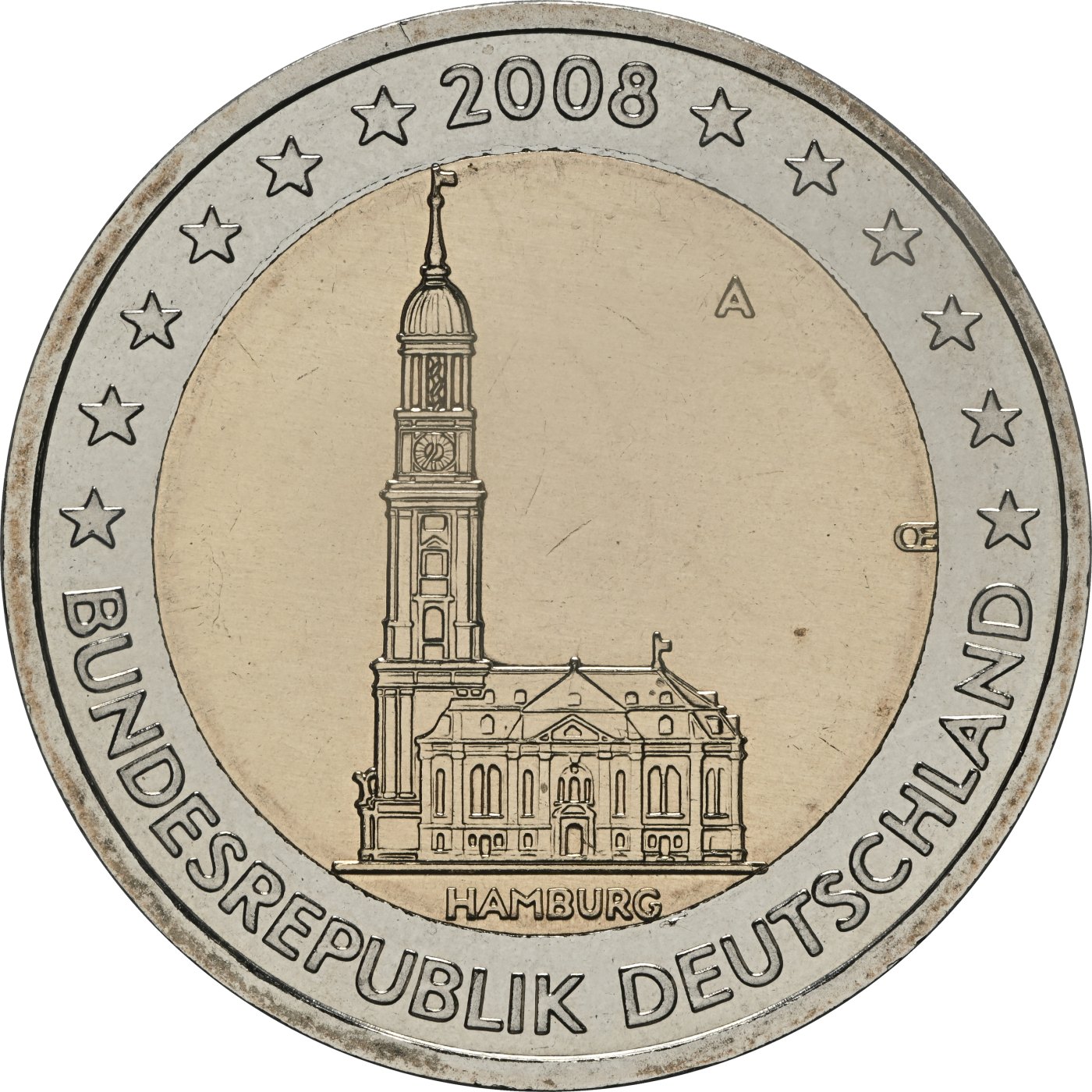

CC 42 2008
2 euro coin
BU Mint mark A/D/F/G/J Main coin Bank issue
2 Euro BU
Germany · Hamburg, St. Michael's Church
Mintage29,350,000
Issue date1 Feb 2008
Edge letteringEINIGKEIT UND RECHT UND FREIHEIT + Federal Eagle
Market price€3.40
Mintage information from source: 950000 | 8900000 | 9000000 | 4200000 | 6300000
Varieties
7Germany, A · A · Mint mark A · BU · Mintage 950,000
Germany, D · D · Mint mark D · BU · Mintage 8,900,000
Germany, F · F · Mint mark F · BU · Mintage 9,000,000
Germany, G · G · Mint mark G · BU · Mintage 4,200,000
Germany, J · J · Mint mark J · BU · Mintage 6,300,000
2.2 · Circulation · Rolls · Mintage –
alte Landkarte auf Wertseite
Federal States Series, 3rd Issue: Hamburg St. Michael's Church · Rolls · Mintage –
neue Landkarte auf Wertseite (Standard)
Issue occasion
The commemorative coin is dedicated to Hamburg. The design depicts the church Sankt Michaelis; below it is the name “HAMBURG”. The design is completed by the engraver’s initial “O”, the mintmark, the inscription “BUNDESREPUBLIK DEUTSCHLAND”, the year “2008” and twelve stars.
The design
The inner part of the coin depicts Sankt Michaelis in Hamburg. Beneath the monument is the name of the federal state “HAMBURG”. To the right of the monument, the engraver’s initial “O” and the mint mark, one of the letters “A”, “D”, “F”, “G” or “J”, are depicted from bottom to top. The outer ring bears the words “BUNDESREPUBLIK DEUTSCHLAND” in the lower section and the year “2008” and twelve stars in the upper section.
Background on the topic
The issue belongs to the first German 2-euro series “Bundesländer”, which began in 2006. Each year, it presented one of the Länder of the Federal Republic with a characteristic building. The order was generally based on the rotating presidency of the Bundesrat. Hamburg held the presidency of this constitutional body from November 2007 to October 2008. The Bundesrat represents the Länder in the legislation and administration of the Federation as well as in matters concerning the European Union. Hamburg’s selection for the 2008 issue was thus connected with federal political considerations.
Hamburg is both a city and a Land. Its development was shaped over centuries by the port, long-distance trade and membership in the Hanseatic League. The designation “Freie und Hansestadt Hamburg” recalls the city’s self-government and trading tradition. A widely recognizable landmark was therefore a suitable motif for depicting the city-state.
Sankt Michaelis, commonly called “Michel” in Hamburg, is a Protestant principal church dedicated to the Archangel Michael. Above the main portal, a group of figures depicts Michael fighting the Devil. The tower, approximately 132 metres high, defines the city skyline and long served arriving sailors as a visible landmark.
The present church building is the result of several construction and reconstruction phases. A predecessor was destroyed in the 18th century by a lightning strike and the subsequent fire. The Baroque replacement building was then constructed according to designs by Johann Leonhard Prey and Ernst Georg Sonnin. In 1906, the church was again gutted by fire during construction work. It was subsequently rebuilt, largely preserving its external appearance. Damage from the Second World War also had to be repaired later.
The building thus combines religious use, Hamburg’s urban history and the city’s perception shaped by shipping. This close local connection explains its selection within the Bundesländer series.
Hamburg is both a city and a Land. Its development was shaped over centuries by the port, long-distance trade and membership in the Hanseatic League. The designation “Freie und Hansestadt Hamburg” recalls the city’s self-government and trading tradition. A widely recognizable landmark was therefore a suitable motif for depicting the city-state.
Sankt Michaelis, commonly called “Michel” in Hamburg, is a Protestant principal church dedicated to the Archangel Michael. Above the main portal, a group of figures depicts Michael fighting the Devil. The tower, approximately 132 metres high, defines the city skyline and long served arriving sailors as a visible landmark.
The present church building is the result of several construction and reconstruction phases. A predecessor was destroyed in the 18th century by a lightning strike and the subsequent fire. The Baroque replacement building was then constructed according to designs by Johann Leonhard Prey and Ernst Georg Sonnin. In 1906, the church was again gutted by fire during construction work. It was subsequently rebuilt, largely preserving its external appearance. Damage from the Second World War also had to be repaired later.
The building thus combines religious use, Hamburg’s urban history and the city’s perception shaped by shipping. This close local connection explains its selection within the Bundesländer series.
eBay price analysis
For this issue, there is a price history based on actual eBay sales – with median, range and number of sales
View price analysis