
 Deutsch
 English
 Français
 Español
 Italiano
 Nederlands
 Português
 Slovenčina
 Hrvatski
 Slovenščina
 Lietuvių
 Eesti
Eesti Български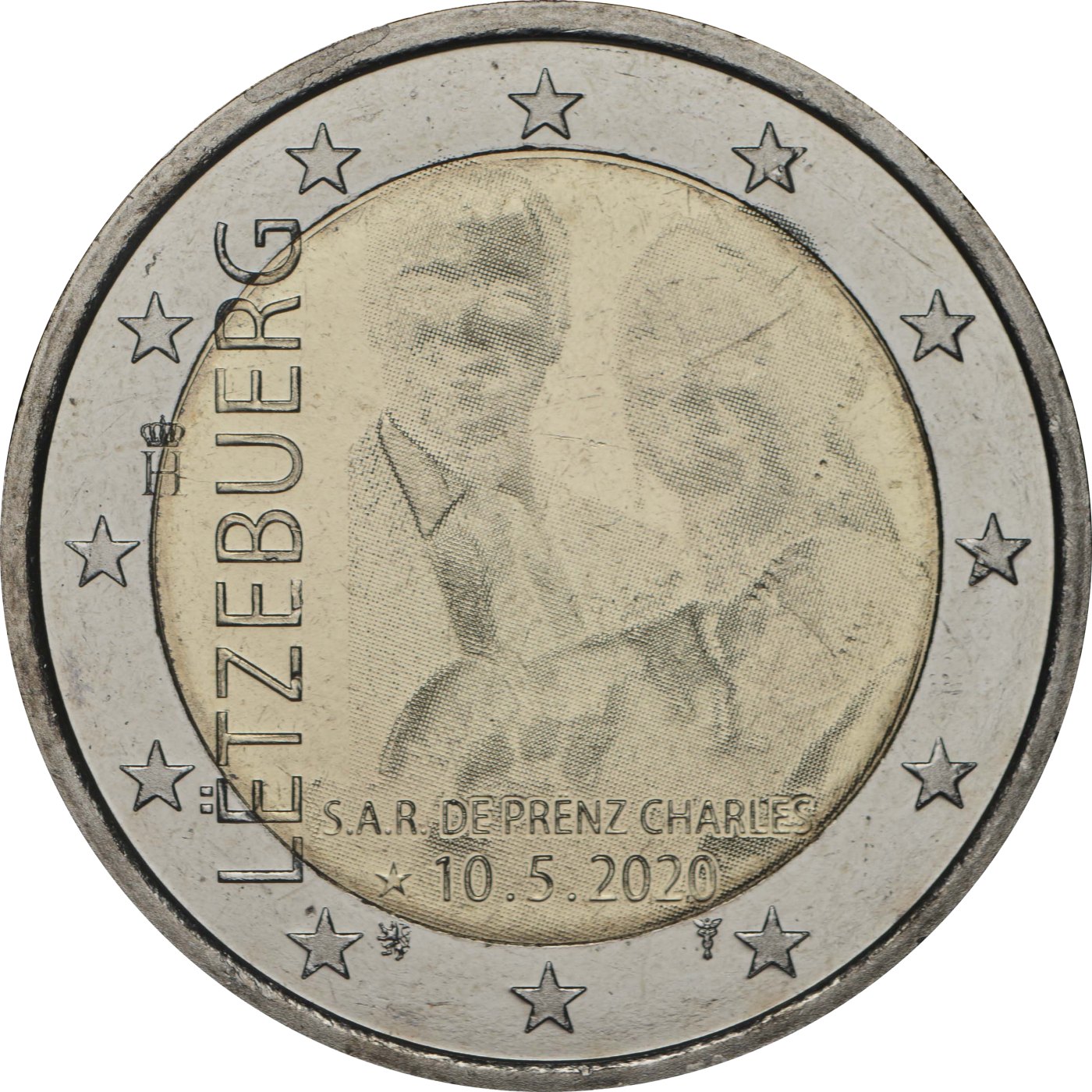

CC 397 2020
2 euro coin
BU
2 Euro BU – Issue 2
Luxembourg · Birth of Hereditary Grand Duke 'Prince Charles
Mintage160,000
Issue date23 Dec 2020
Edge lettering2 ★ ★ × 6, alternating upright/inverted
Market price€10.90
Issue occasion
The commemorative coin honours the birth of Prince Charles. The design shows him together with the portraits of his parents, Hereditary Grand Duke Guillaume and Hereditary Grand Duchess Stéphanie, as well as his title and the date of birth “10 May 2020”. The design is complemented by the inscription “LËTZEBUERG” and the crowned monogram of Grand Duke Henri.
The design
The coin design depicts Prince Charles in the centre, together with portraits of his parents, Their Royal Highnesses Hereditary Grand Duke Guillaume and Hereditary Grand Duchess Stéphanie. Beneath these portraits, the title “S.A.R. de Prënz Charles” (His Royal Highness Prince Charles) is followed by the date of birth “10 May 2020”. “LËTZEBUERG”, indicating the issuing country, is inscribed vertically on the left. The monogram (the letter “H” with a crown) represents Grand Duke Henri.
The outer ring of the coin features the twelve stars of the European flag.
The outer ring of the coin features the twelve stars of the European flag.
Background on the topic
Luxembourg is a parliamentary monarchy whose head of state is the Grand Duke. The succession to the throne within the House of Luxemburg-Nassau gives births in the direct line of succession a constitutional and dynastic dimension. At the time of his birth, Prince Charles was second in the Luxembourg line of succession after his father and thus a possible future Grand Duke.
His father Guillaume is the eldest son of Grand Duke Henri and Grand Duchess Maria Teresa. Since Henri’s accession to the throne in 2000, Guillaume had held the title Hereditary Grand Duke, which in Luxembourg designates the immediate heir to the throne. He performs representative duties and represents the head of state at official events. Stéphanie comes from the Belgian noble family de Lannoy. The couple married in 2012; Charles is their first child. He was later joined by a younger brother, Prince François.
The Luxembourg succession to the throne was originally characterized by the precedence of male descendants. In 2011, Grand Duke Henri introduced succession by primogeniture regardless of gender for his descendants. The decisive factor is therefore generally the order of birth. As Charles is the eldest child of the then Hereditary Grand Duke, he immediately took the place after his father.
Births, weddings and anniversaries of accession to the throne of the grand ducal family regularly appear on Luxembourg commemorative and collector coins. This is connected with the dynasty’s function as a visible symbol of the continuity of the state. The birth of a child in the direct line of succession therefore provided a national occasion for a commemorative coin. The monogram of the ruler frequently used on Luxembourg coins also establishes a connection with the head of state in office at the time and with the institutional framework of the monarchy. The issue thus documented not only a family event but also the continuation of the immediate line of succession.
His father Guillaume is the eldest son of Grand Duke Henri and Grand Duchess Maria Teresa. Since Henri’s accession to the throne in 2000, Guillaume had held the title Hereditary Grand Duke, which in Luxembourg designates the immediate heir to the throne. He performs representative duties and represents the head of state at official events. Stéphanie comes from the Belgian noble family de Lannoy. The couple married in 2012; Charles is their first child. He was later joined by a younger brother, Prince François.
The Luxembourg succession to the throne was originally characterized by the precedence of male descendants. In 2011, Grand Duke Henri introduced succession by primogeniture regardless of gender for his descendants. The decisive factor is therefore generally the order of birth. As Charles is the eldest child of the then Hereditary Grand Duke, he immediately took the place after his father.
Births, weddings and anniversaries of accession to the throne of the grand ducal family regularly appear on Luxembourg commemorative and collector coins. This is connected with the dynasty’s function as a visible symbol of the continuity of the state. The birth of a child in the direct line of succession therefore provided a national occasion for a commemorative coin. The monogram of the ruler frequently used on Luxembourg coins also establishes a connection with the head of state in office at the time and with the institutional framework of the monarchy. The issue thus documented not only a family event but also the continuation of the immediate line of succession.