
 Deutsch
 English
 Français
 Español
 Italiano
 Nederlands
 Português
 Slovenčina
 Hrvatski
 Slovenščina
 Lietuvių
 Eesti
Eesti Български
Reverse

Obverse

Portugal · Presidency of the Council of the European Union
Issue date2 Jul 2007
Total mintage1,272,559
EU maximum2,000,000
Editions3
Edge lettering5 Wappenschilde + 7 castles, evenly distributed
InscriptionPOR / TU / GAL / 2007 PRESIDÊNCIA DO CONSELHO DA UE / I Vilar / INCM
DesignerMaria Irene Vilar
mintImprensa Nacional Casa da Moeda S.A., Lisboa
Issue occasion
The commemorative coin honours the Portuguese Presidency of the Council of the European Union. The design features a cork oak (Quercus Suber), with the Portuguese coat of arms below it and the three-line inscription “POR TU GAL”. Along the lower edge, in a semicircle, is the inscription “2007 PRESIDÊNCIA DO CONSELHO DA UE”, complemented by the artist’s signature I Vilar and the mint mark INCM.
The design
The inner part of the coin depicts a cork oak (Quercus Suber). Beneath the branches, the Portuguese coat of arms is depicted on the left, while on the right, spread over three lines, the word “POR TU GAL” can be read. Along the lower edge of the coin motif, the inscription “2007 PRESIDÊNCIA DO CONSELHO DA UE” is arranged in a semicircle, with the artist’s signature (I Vilar) to the left and the mintmark (INCM) incorporated into the inscription below the coat of arms. The outer ring bears the twelve stars of the European flag.
Background on the topic
The presidency of the Council of the European Union rotates among the member states. Portugal assumed this task in the second half of 2007, following earlier Council presidencies in 1992 and 2000. The country thus chaired the meetings of the various configurations of the Council, prepared discussions and mediated negotiations between the member states. Together with Germany and Slovenia, Portugal worked in a so-called trio presidency on the basis of a longer-term programme.
The term of office fell during a period of institutional reorganisation. After the Treaty establishing a Constitution for Europe had failed in referendums in France and the Netherlands, the member states sought a new treaty-based solution. On the basis of a mandate previously agreed under the German Council Presidency, the Portuguese presidency brought the Intergovernmental Conference to a conclusion. In October 2007, the heads of state or government reached agreement in Lisbon on the Reform Treaty. The Treaty of Lisbon (Vertrag von Lissabon) was signed there on 13 December 2007 and entered into force in 2009 after ratification by the member states. Among other things, it changed the functioning and competences of the EU institutions.
Another focus was the relationship between the European Union and Africa. In December 2007, an EU-Africa Summit was held in Lisbon, at which a joint strategy for future cooperation was adopted. At the same time, the presidency had to coordinate the decision-making process in a Union that comprised 27 members following the accession of Bulgaria and Romania at the beginning of the year.
The cork oak refers to a characteristic aspect of the Portuguese landscape and economy. Portugal is closely associated with the harvesting and processing of cork; cork oak groves shape parts of the south in particular. The tree is therefore suitable as a state emblem without highlighting an individual political office or a specific person. The coin issue made the time-limited European presidency visible in everyday payment transactions and linked it with a Portuguese national symbol.
The term of office fell during a period of institutional reorganisation. After the Treaty establishing a Constitution for Europe had failed in referendums in France and the Netherlands, the member states sought a new treaty-based solution. On the basis of a mandate previously agreed under the German Council Presidency, the Portuguese presidency brought the Intergovernmental Conference to a conclusion. In October 2007, the heads of state or government reached agreement in Lisbon on the Reform Treaty. The Treaty of Lisbon (Vertrag von Lissabon) was signed there on 13 December 2007 and entered into force in 2009 after ratification by the member states. Among other things, it changed the functioning and competences of the EU institutions.
Another focus was the relationship between the European Union and Africa. In December 2007, an EU-Africa Summit was held in Lisbon, at which a joint strategy for future cooperation was adopted. At the same time, the presidency had to coordinate the decision-making process in a Union that comprised 27 members following the accession of Bulgaria and Romania at the beginning of the year.
The cork oak refers to a characteristic aspect of the Portuguese landscape and economy. Portugal is closely associated with the harvesting and processing of cork; cork oak groves shape parts of the south in particular. The tree is therefore suitable as a state emblem without highlighting an individual political office or a specific person. The coin issue made the time-limited European presidency visible in everyday payment transactions and linked it with a Portuguese national symbol.
eBay price analysis
For this issue, there is a price history based on actual eBay sales – with median, range and number of sales
View price analysis2 Euro BU – Single page
- Mintage
- 1,250,000
- Market price
- €3.60
- Edge lettering
- 5 Wappenschilde + 7 castles, evenly distributed
Mintage by issue type
BU
1,250,000
Blister pack
22,559
2 Editions
More editions
2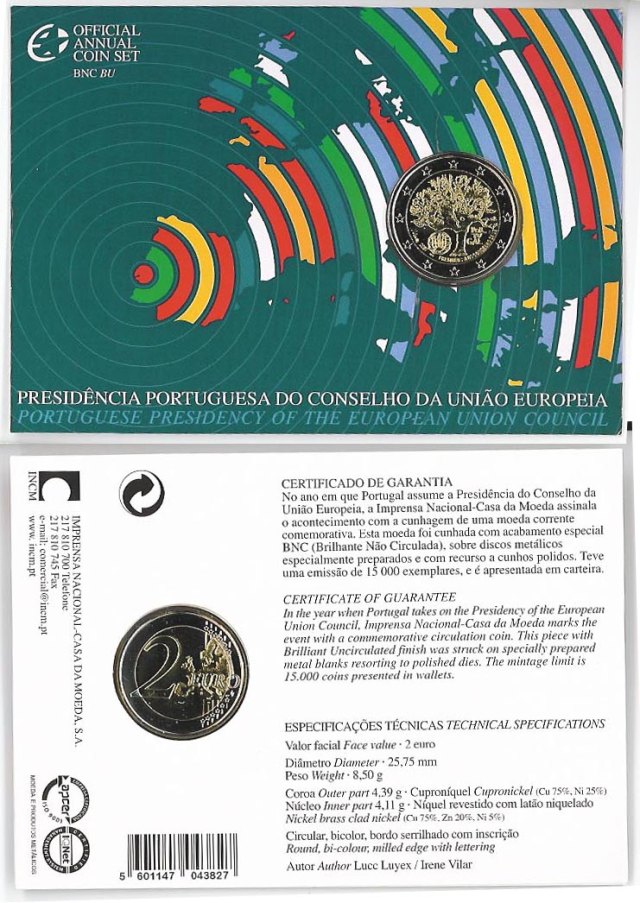

Mintages
Portugal
1,272,559Circulation: 1,250,000
Blister pack BU: 12,637
Proof blister: 9,922
Official issue prices
2007 · Coincard: €9.00
2007 · Proof blister: €16.00