
 Deutsch
 English
 Français
 Español
 Italiano
 Nederlands
 Português
 Slovenčina
 Hrvatski
 Slovenščina
 Lietuvių
 Eesti
Eesti Български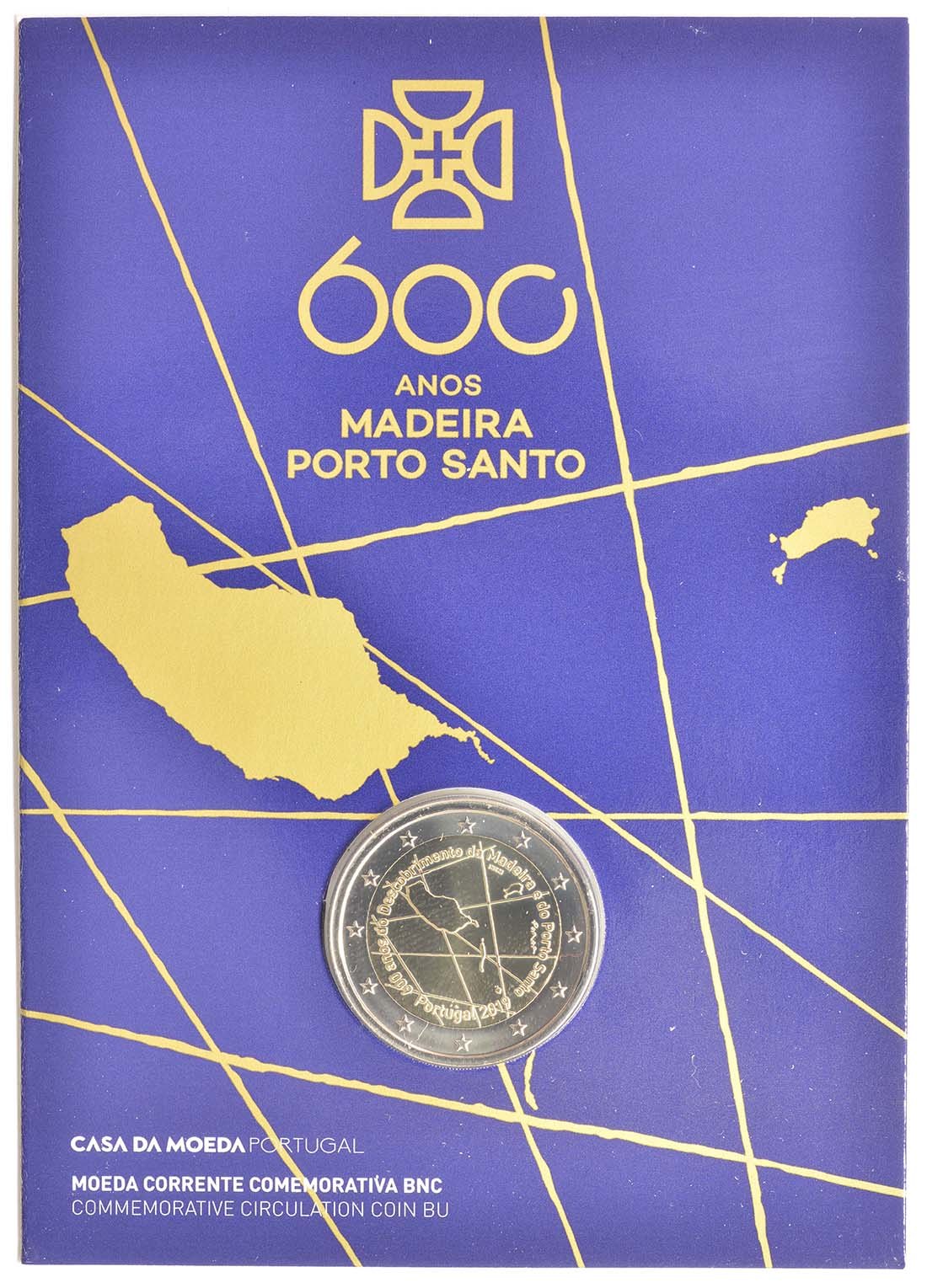

CC 346 2019
Blister pack
BU
Blister pack BU
Portugal · 600th anniversary of the discovery of Madeira and Porto Santo
Mintage3,996
Issue date6 Jun 2019
PackagingBlister pack
Edge lettering5 Wappenschilde + 7 castles, evenly distributed
Market price€11.90
Issue occasion
The coin commemorates the 600th anniversary of the discovery of the Madeira archipelago by the Portuguese navigators Bartolomeu Perestrelo and Tristão Vaz. This event is regarded as Portugal’s first territorial discovery, a milestone in its consolidation as a maritime power, and the beginning of the Portuguese Age of Discoveries (1418–1522). The design shows the Madeira archipelago and the island of Porto Santo, as well as the inscriptions “600 anos do Descobrimento da Madeira e de Porto Santo” and “PORTUGAL 2019”.
The design
The event known as Portugal’s first territorial discovery marked a historic milestone in the consolidation of Portugal as a maritime power and led to the Portuguese Age of Discoveries (1418-1522).
The coin design depicts the Madeira archipelago and the island of Porto Santo. The semicircle bears the inscriptions “600 anos do Descobrimento da Madeira e de Porto Santo” and “PORTUGAL 2019”.
The twelve stars of the European flag are depicted on the coin’s outer ring.
The coin design depicts the Madeira archipelago and the island of Porto Santo. The semicircle bears the inscriptions “600 anos do Descobrimento da Madeira e de Porto Santo” and “PORTUGAL 2019”.
The twelve stars of the European flag are depicted on the coin’s outer ring.
Background on the topic
The Portuguese exploration of Madeira was connected with the early expansion along the Atlantic. Under the patronage of Infante Heinrich, who later became known by the epithet “the Navigator”, Portuguese ships sought new routes, anchorages and trading opportunities. Alongside Tristão Vaz and Bartolomeu Perestrelo, João Gonçalves Zarco was also involved in the voyages and the subsequent development of the archipelago. Older European maps suggest that the islands may have been known previously. The Portuguese voyages, however, initiated their permanent settlement and political incorporation.
Madeira and Porto Santo were uninhabited when the Portuguese settled them. The Crown entrusted their development to so-called captains, who were responsible for land distribution, administration and colonisation. Zarco received the south-western part of the main island, Tristão Vaz the north-eastern part; Perestrelo was associated with Porto Santo. Settlers came primarily from mainland Portugal. For agricultural use, forests had to be cleared and irrigation systems established. This gave rise to the Levadas characteristic of Madeira, which carry water from areas with high precipitation to fields and settlements.
In the 15th and 16th centuries, Madeira became a centre of sugar-cane cultivation. Production and trade were integrated into Atlantic economic networks; the labour of enslaved people was also used. Later, viticulture gained importance. Madeira wine was distributed through international maritime trade routes. The location of the archipelago also made it a supply and stopover station for shipping in the Atlantic.
Today, the archipelago forms an autonomous region of Portugal with its own regional government and parliament. The memory of its Portuguese settlement therefore links the history of navigation, regional identity and the emergence of an overseas Portuguese sphere of rule and trade. The round anniversary provided the immediate occasion to commemorate this historical connection on a circulation coin.
Madeira and Porto Santo were uninhabited when the Portuguese settled them. The Crown entrusted their development to so-called captains, who were responsible for land distribution, administration and colonisation. Zarco received the south-western part of the main island, Tristão Vaz the north-eastern part; Perestrelo was associated with Porto Santo. Settlers came primarily from mainland Portugal. For agricultural use, forests had to be cleared and irrigation systems established. This gave rise to the Levadas characteristic of Madeira, which carry water from areas with high precipitation to fields and settlements.
In the 15th and 16th centuries, Madeira became a centre of sugar-cane cultivation. Production and trade were integrated into Atlantic economic networks; the labour of enslaved people was also used. Later, viticulture gained importance. Madeira wine was distributed through international maritime trade routes. The location of the archipelago also made it a supply and stopover station for shipping in the Atlantic.
Today, the archipelago forms an autonomous region of Portugal with its own regional government and parliament. The memory of its Portuguese settlement therefore links the history of navigation, regional identity and the emergence of an overseas Portuguese sphere of rule and trade. The round anniversary provided the immediate occasion to commemorate this historical connection on a circulation coin.