Edge lettering2 EURO ★★★ × 4, alternating upright/inverted
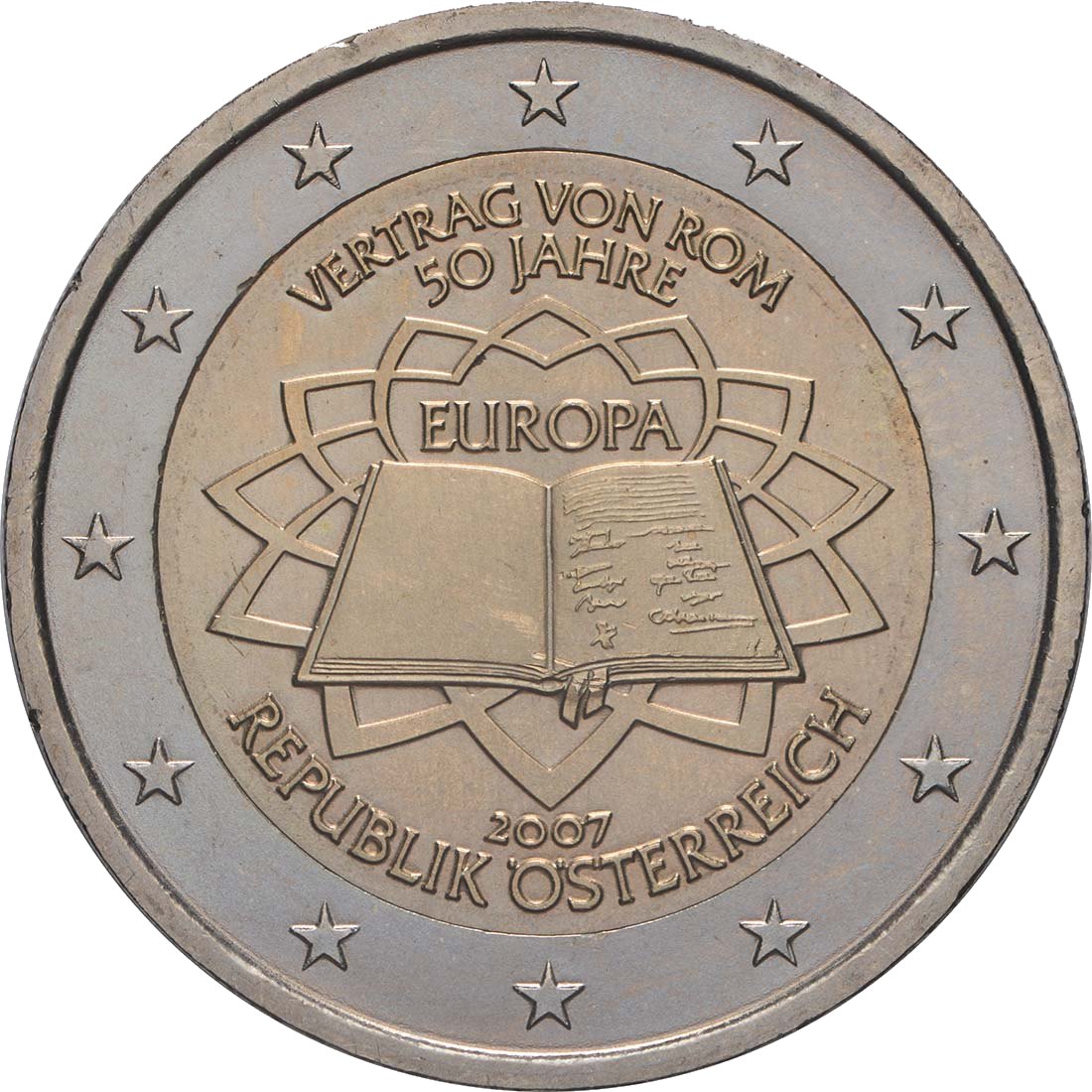
InscriptionVERTRAG VON ROM / 50 JAHRE / EUROPA / REPUBLIK ÖSTERREICH / 2007
DesignerHelmut Andexlinger
mintMünze Österreich AG, Wien
Issue occasion
The commemorative coin commemorates the 50th anniversary of the signing of the Treaty of Rome by the six founding members; on 25 March 1957, the treaties establishing the European Economic Community and the European Atomic Energy Community were signed in Rome. The design shows the treaties against the star-shaped paving of the Piazza del Campidoglio designed by Michelangelo, the place where they were signed, supplemented by the inscription “Europa”, the occasion for issue and the twelve stars of the European Union. In the Luxembourg issue, the portrait of Grand Duke Henri additionally overlays the left side of the design as a tilt effect.
The design
The coin’s centre depicts the treaty document signed by the six founding members against the background of the star-shaped paving of Piazza del Campidoglio in Rome, designed by Michelangelo, where the treaty was signed on 25 March 1957. Directly above the treaty document, the word “Europe” is inscribed in the respective language. The occasion for the issue appears above the overall design, while the issuing country in the respective language version(s) and the year 2007 appear below it. The outer ring of the coin bears the twelve stars of the European Union.
Background on the topic
The Treaties of Rome (Römische Verträge) represented a shift in post-war European history from individual forms of economic cooperation to more comprehensive integration. They were preceded in 1951 by the European Coal and Steel Community (Europäische Gemeinschaft für Kohle und Stahl), through which key industrial sectors were to be jointly controlled. After the failure of a European Defence Community (Europäische Verteidigungsgemeinschaft), the participating states focused more strongly on economic projects. The Foreign Ministers’ Conference of Messina in 1955 and the subsequently prepared Spaak Report paved the way for the new treaties.
The European Economic Community (Europäische Wirtschaftsgemeinschaft) pursued the gradual establishment of a common market. Customs duties between the member states were to be abolished, a common external tariff created, and the free movement of goods, persons, services and capital developed. Common policy areas were also introduced, particularly agriculture, trade and transport. Euratom was intended to coordinate research, safety standards and the peaceful use of nuclear energy. Both Communities began their work in 1958.
Through several treaty reforms, the Communities of that time developed into today’s European Union. The EEC was later renamed the European Community (Europäische Gemeinschaft); its responsibilities ultimately became part of the EU. The original EEC Treaty continues in amended form as the Treaty on the Functioning of the European Union. Euratom, by contrast, remained a separate treaty-based community.
Capitoline Square is located on Capitoline Hill, a political and religious centre of ancient Rome. Its present layout is based on plans by Michelangelo from the 16th century. The treaties were signed in the Palazzo dei Conservatori, one of the buildings framing the square and now part of the Capitoline Museums (Kapitolinische Museen).
Grand Duke Henri has been head of state of Luxembourg since 2000. His additional portrait on the Luxembourgish version reflects the country’s requirements for depicting the head of state on coins.
The anniversary was chosen for a joint issue because the treaties represent an institutional starting point of today’s EU. It was also the first jointly designed 2-euro commemorative coin issued by the states of the euro area; only the country names and language versions were adapted nationally.
eBay price analysis
For this issue, there is a price history based on actual eBay sales – with median, range and number of sales

 Deutsch
 English
 Français
 Español
 Italiano
 Nederlands
 Português
 Slovenčina
 Hrvatski
 Slovenščina
 Lietuvių
 Eesti
Eesti Български