
 Deutsch
 English
 Français
 Español
 Italiano
 Nederlands
 Português
 Slovenčina
 Hrvatski
 Slovenščina
 Lietuvių
 Eesti
Eesti Български
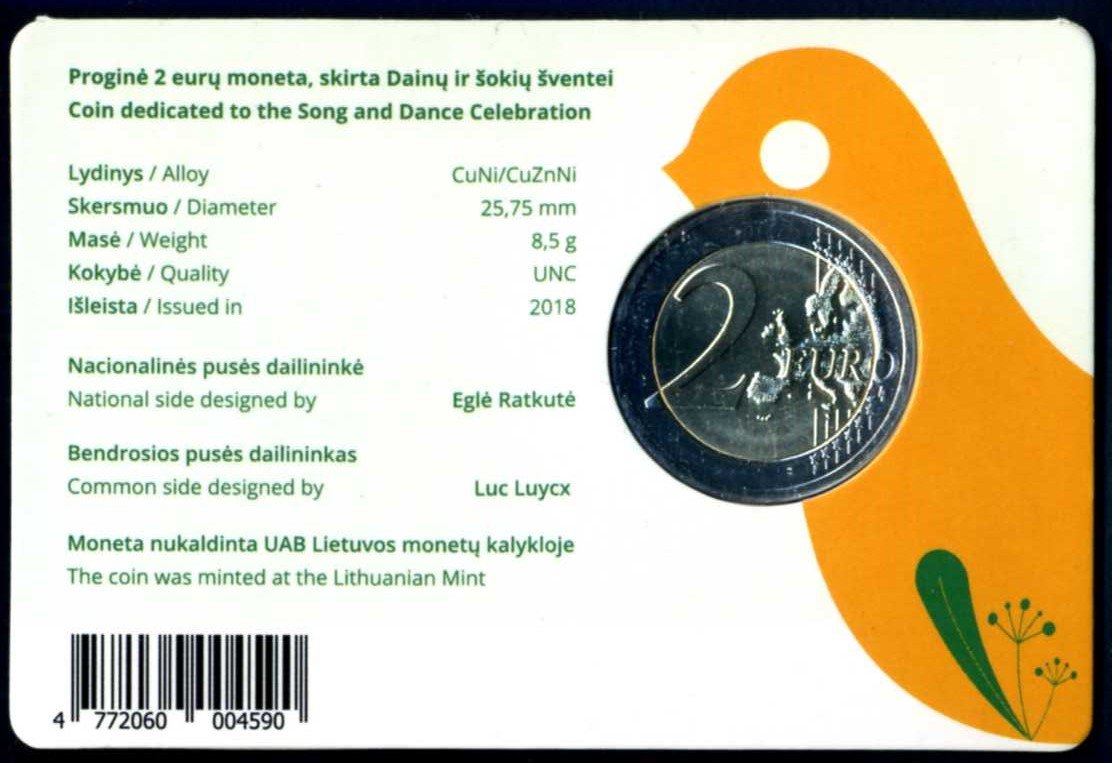
CC 320 2018
Coincard
BU
Coincard LMK
Lithuania · Song and Dance Festival 2018
Mintage7,000
Issue date26 Jun 2018
PackagingCoincard
Edge letteringLAISVĖ ★ VIENYBĖ ★ GEROVĖ ★
Issue occasion
The coin commemorates the Lithuanian Song and Dance Celebration (Litauische Chor- und Tanzfest), which was inscribed on UNESCO’s Representative List of the Intangible Cultural Heritage of Humanity. The design depicts stylized people and birds in the style of Lithuanian paper-cutting art, symbolizing folk dancing and singing. “LIETUVA” appears at the bottom.
The design
The inner part of the coin features stylised depictions of people and birds typical of paper-cut art, which is part of Lithuanian folk art, symbolising folk dances and singing.
The issuing state “LIETUVA” is engraved at the bottom in the centre, the year of issue “2018” on the left and the mintmark of the Lithuanian Mint on the right.
The outer ring of the coin bears the twelve stars of the European flag.
The issuing state “LIETUVA” is engraved at the bottom in the centre, the year of issue “2018” on the left and the mintmark of the Lithuanian Mint on the right.
The outer ring of the coin bears the twelve stars of the European flag.
Background on the topic
The Lithuanian tradition of large-scale song festivals emerged in the context of the national revival movements of the 19th and early 20th centuries. Singing together provided an opportunity to cultivate the Lithuanian language and folk culture publicly. This was particularly relevant because Lithuania then belonged to the Russian Empire and the use of Lithuanian was restricted at times. Choirs, folk songs and cultural associations thus became closely associated with the development of a modern Lithuanian national consciousness.
The first nationwide Lithuanian Song Festival took place in 1924 in Kaunas, the provisional capital at the time. Choral singing developed into an extensive festival programme, which later also included folk dances, instrumental music, theatre and other forms of traditional culture. The participation of numerous amateur ensembles from different regions is characteristic. The events are therefore not merely performances for an audience, but are based on long-term communal rehearsal and association work.
During Soviet rule, the festival tradition was continued, although it was organised by the state and ideologically influenced. Alongside prescribed political elements, Lithuanian songs, dances, traditional costumes and regional forms of expression remained present. In this way, cultural practices could be passed on, which many participants also understood as part of their national identity. After the restoration of state independence, this function acquired a new political and historical framework.
The Lithuanian celebrations belong to a shared Baltic song festival tradition that is also maintained in Estonia and Latvia. Characteristic features include large choral formations, mass choreographies and a repertoire that combines folk tradition with specially composed works.
The coin issue took place in 2018, when Lithuania commemorated the 100th anniversary of the restoration of its statehood in 1918. The Song and Dance Festival held at the time was also connected with this historical context. The choice of theme thus linked a regularly practised cultural tradition with the state’s anniversary year.
The first nationwide Lithuanian Song Festival took place in 1924 in Kaunas, the provisional capital at the time. Choral singing developed into an extensive festival programme, which later also included folk dances, instrumental music, theatre and other forms of traditional culture. The participation of numerous amateur ensembles from different regions is characteristic. The events are therefore not merely performances for an audience, but are based on long-term communal rehearsal and association work.
During Soviet rule, the festival tradition was continued, although it was organised by the state and ideologically influenced. Alongside prescribed political elements, Lithuanian songs, dances, traditional costumes and regional forms of expression remained present. In this way, cultural practices could be passed on, which many participants also understood as part of their national identity. After the restoration of state independence, this function acquired a new political and historical framework.
The Lithuanian celebrations belong to a shared Baltic song festival tradition that is also maintained in Estonia and Latvia. Characteristic features include large choral formations, mass choreographies and a repertoire that combines folk tradition with specially composed works.
The coin issue took place in 2018, when Lithuania commemorated the 100th anniversary of the restoration of its statehood in 1918. The Song and Dance Festival held at the time was also connected with this historical context. The choice of theme thus linked a regularly practised cultural tradition with the state’s anniversary year.