
 Deutsch
 English
 Français
 Español
 Italiano
 Nederlands
 Português
 Slovenčina
 Hrvatski
 Slovenščina
 Lietuvių
 Eesti
Eesti Български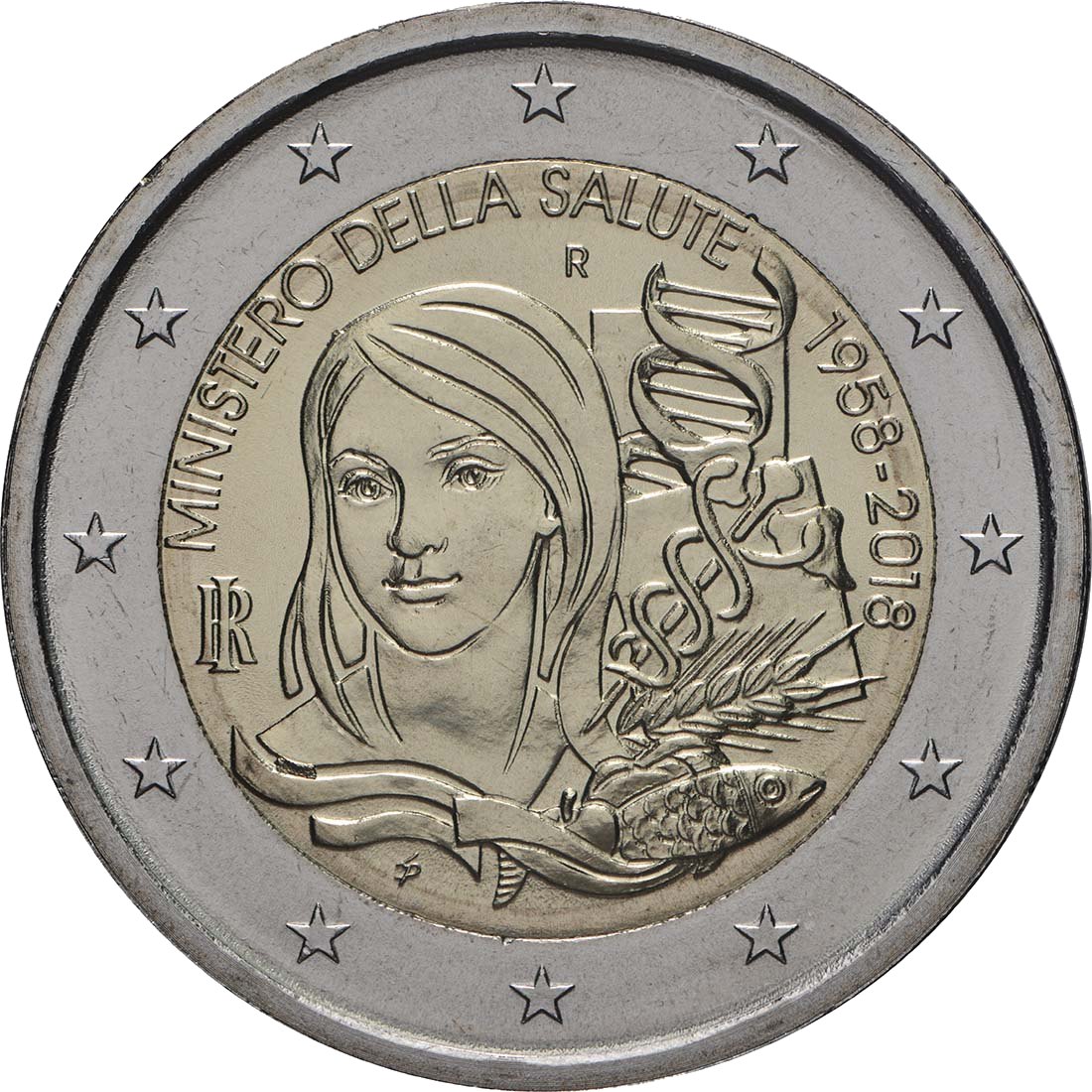
CC 309 2018
2 euro coin
BU Main coin Bank issue
2 Euro BU
Italy · 60th anniversary of the founding of the Gesundheitsministerium
Mintage2,985,000
Issue date5 Mar 2018
Edge lettering2 ★ × 6, alternately upright/inverted
Market price€4.50
Issue occasion
The coin commemorates the 60th anniversary of the establishment of the Italian Ministry of Health. The design features an allegorical representation of health as well as symbols representing the fields of activity of the environment, research, nutrition and medicine. It is complemented by the inscription “MINISTERO DELLA SALUTE” and the years “1958-2018”.
The design
The inner part of the coin depicts an allegorical representation of health, as well as several symbols representing the ministry’s activities: the environment, research, nutrition and medicine. On the left, the abbreviation of the Republic of Italy, “RI”, and above it, the mintmark of the Rome Mint, “R”, can be seen; at the base of the female figure are the initials of the artist Silvia Petrassi. From left to right, the inscription “MINISTERO DELLA SALUTE” (Ministry of Health) and the years “1958-2018” can be read in a semicircle.
The outer ring of the coin depicts the twelve stars of the European flag.
The outer ring of the coin depicts the twelve stars of the European flag.
Background on the topic
The establishment of an independent state health administration was connected with the rebuilding of Italy after the Second World War. Previously, central public health responsibilities had long been assigned to the Ministry of the Interior. From 1945, a High Commission for Hygiene and Public Health based at the Presidency of the Council of Ministers took over some of these responsibilities. With the subsequent creation of a separate ministry, health policy, disease control, hygiene and health supervision were given a permanent place within the government.
An important constitutional basis was provided by Article 32 of the Italian Constitution, which entered into force in 1948. It defines health as an individual fundamental right and, at the same time, as an interest of the community. It also obliges the state to guarantee free medical care to those in need. Health was thus understood not only as a private matter, but explicitly as a public responsibility.
The organisational development of the Italian healthcare system was not completed with the founding of the ministry. In 1978, the Servizio Sanitario Nazionale, the national health service, was established. It was intended to provide a generally accessible, tax-funded healthcare system and replaced the system previously characterised to a great extent by occupation-based health insurance funds. In subsequent developments, numerous responsibilities were transferred to regions and local health authorities. The central government remained responsible, among other things, for general health policy guidelines, prevention, the safety of medicines and food, and coordination in the event of health threats extending beyond regional boundaries. As part of several government reforms, the ministry was temporarily merged with other departments and subsequently again administered as an independent authority.
The female personification on the coin belongs to a long European artistic tradition. As early as Roman antiquity, “Salus” was depicted as a female figure. The term encompassed both physical well-being and protection and public welfare; Salus therefore also appeared on ancient coins. The modern depiction adopts this comprehensible allegorical form without portraying a specific historical person. The institutional anniversary gave Italy an opportunity to highlight, alongside the history of the ministry, the constitutional and state responsibility to protect health.
An important constitutional basis was provided by Article 32 of the Italian Constitution, which entered into force in 1948. It defines health as an individual fundamental right and, at the same time, as an interest of the community. It also obliges the state to guarantee free medical care to those in need. Health was thus understood not only as a private matter, but explicitly as a public responsibility.
The organisational development of the Italian healthcare system was not completed with the founding of the ministry. In 1978, the Servizio Sanitario Nazionale, the national health service, was established. It was intended to provide a generally accessible, tax-funded healthcare system and replaced the system previously characterised to a great extent by occupation-based health insurance funds. In subsequent developments, numerous responsibilities were transferred to regions and local health authorities. The central government remained responsible, among other things, for general health policy guidelines, prevention, the safety of medicines and food, and coordination in the event of health threats extending beyond regional boundaries. As part of several government reforms, the ministry was temporarily merged with other departments and subsequently again administered as an independent authority.
The female personification on the coin belongs to a long European artistic tradition. As early as Roman antiquity, “Salus” was depicted as a female figure. The term encompassed both physical well-being and protection and public welfare; Salus therefore also appeared on ancient coins. The modern depiction adopts this comprehensible allegorical form without portraying a specific historical person. The institutional anniversary gave Italy an opportunity to highlight, alongside the history of the ministry, the constitutional and state responsibility to protect health.
eBay price analysis
For this issue, there is a price history based on actual eBay sales – with median, range and number of sales
View price analysis