
 Deutsch
 English
 Français
 Español
 Italiano
 Nederlands
 Português
 Slovenčina
 Hrvatski
 Slovenščina
 Lietuvių
 Eesti
Eesti Български

CC 308 2018
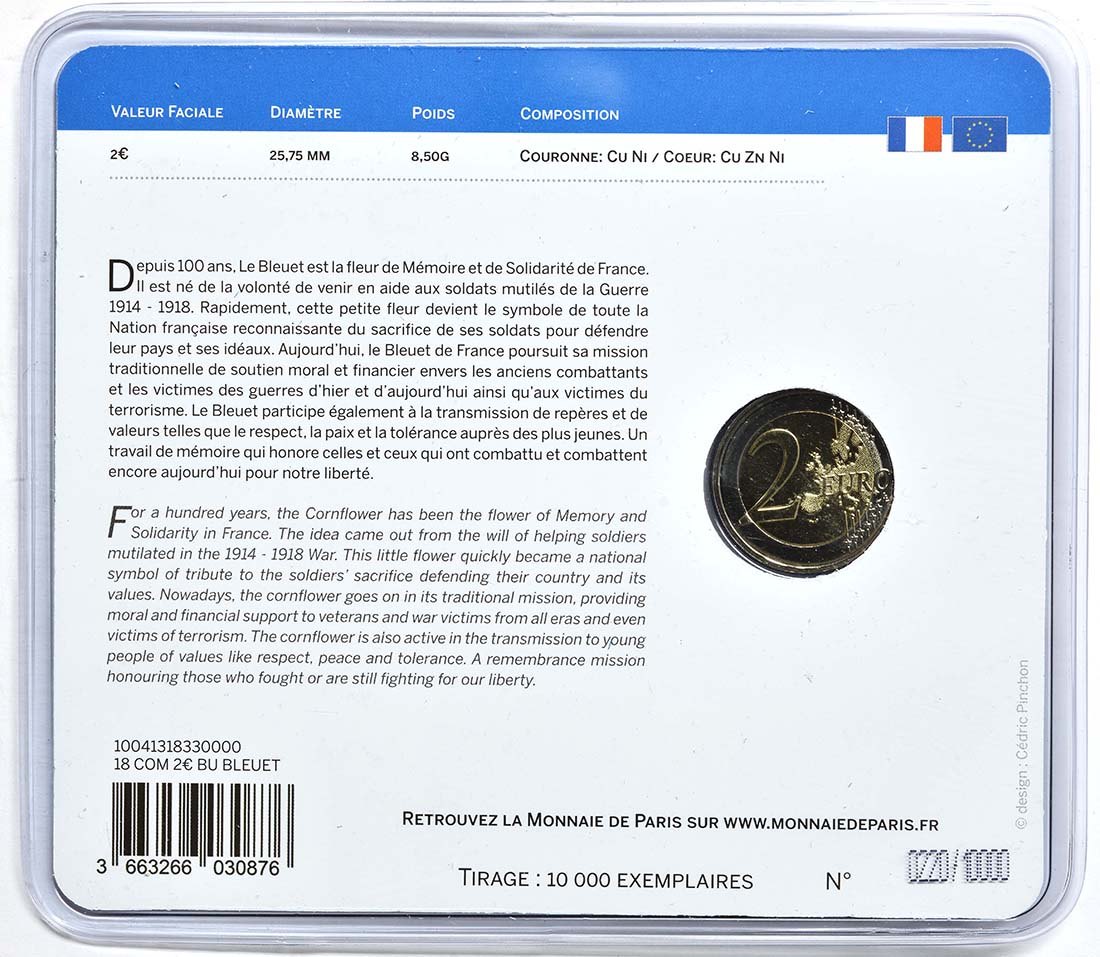
Blister pack
coloured BU
Blister pack BU
France · Le Bleuet - France's Cornflower
Mintage10,000
Issue price€10.00
Issue date21 Feb 2018
PackagingBlister pack
Edge lettering2 ★ ★ × 6, alternating upright/inverted
Market price€290.00
Mintage information from source: 10.000 col.
Issue occasion
The commemorative coin honours the 100th anniversary of “Bleuet de France”, which has stood for remembrance of the fallen and solidarity with veterans, war victims and victims of terrorism since the First World War. At the centre of the design is a cornflower surrounded by the inscription “Le Bleuet de France, fleur de mémoire et de solidarité”. The design is complemented by the years “1918-2018” and the abbreviation “RF” for “République Française”.
The design
For 100 years, the cornflower has represented France’s remembrance and solidarity. It originated as a sign of the will to provide support to veterans returning from the First World War 1914-1918. This small flower quickly became a symbol of the entire French nation, acknowledging the sacrifice of its soldiers in the fight for their country and ideals.
Today, the “Bleuet de France” continues its traditional role of providing moral and financial support to veterans and war victims of the past and present, as well as to victims of terrorism.
This small flower also helps convey values and points of view such as respect, peace and tolerance to young people. The remembrance is dedicated to all those who fought and continue to fight for our freedom.
The cornflower is positioned at the centre of the coin. It is surrounded by the inscription “Le Bleuet de France, fleur de mémoire et de solidarité”. The dates “1918-2018”, the designation “RF” (“République Française”) and the mintmark are also engraved.
The twelve stars of the European flag are depicted on the coin’s outer ring.
Today, the “Bleuet de France” continues its traditional role of providing moral and financial support to veterans and war victims of the past and present, as well as to victims of terrorism.
This small flower also helps convey values and points of view such as respect, peace and tolerance to young people. The remembrance is dedicated to all those who fought and continue to fight for our freedom.
The cornflower is positioned at the centre of the coin. It is surrounded by the inscription “Le Bleuet de France, fleur de mémoire et de solidarité”. The dates “1918-2018”, the designation “RF” (“République Française”) and the mintmark are also engraved.
The twelve stars of the European flag are depicted on the coin’s outer ring.
Background on the topic
The cornflower was already used as a French symbol of remembrance during the First World War. At the time, the term “bleuets” also referred to young recruits whose new, light-blue uniforms distinguished them from the older frontline soldiers in their former uniforms. In addition, cornflowers were among the plants that continued to be visible in fields churned up by fighting. The red poppy assumed a comparable role in British and other Commonwealth remembrance.
The creation of the “Bleuet de France” is associated with Suzanne Lenhardt and Charlotte Malleterre. Both worked in the vicinity of the Paris Invalides, where wounded soldiers were cared for. There, veterans made cornflowers out of fabric. The sales were intended to provide them with an occupation and their own income. This initially local initiative developed into a nationwide collection. Public fundraising campaigns are particularly associated with 8 May, the day commemorating the end of the Second World War in Europe, and 11 November, the anniversary of the 1918 armistice.
The initiative is now administered by the French Office for Veterans and War Victims. The pins worn during the collections thus fulfil a dual function: they are a personal symbol of remembrance and a visible sign of a donation. The French model combines state-organised days of remembrance with a relief initiative that originally emerged from the care of wounded soldiers.
The 2018 issue was associated with the centenary of the 11 November 1918 armistice. This ended the fighting between the German Empire and the Western Allies; the peace settlement followed only later. In France, the anniversary year was marked by numerous ceremonies and historical retrospectives. The choice of the “Bleuet” for a circulation coin linked this national commemoration of the war with a symbol worn in everyday life and made publicly visible through street collections.
The creation of the “Bleuet de France” is associated with Suzanne Lenhardt and Charlotte Malleterre. Both worked in the vicinity of the Paris Invalides, where wounded soldiers were cared for. There, veterans made cornflowers out of fabric. The sales were intended to provide them with an occupation and their own income. This initially local initiative developed into a nationwide collection. Public fundraising campaigns are particularly associated with 8 May, the day commemorating the end of the Second World War in Europe, and 11 November, the anniversary of the 1918 armistice.
The initiative is now administered by the French Office for Veterans and War Victims. The pins worn during the collections thus fulfil a dual function: they are a personal symbol of remembrance and a visible sign of a donation. The French model combines state-organised days of remembrance with a relief initiative that originally emerged from the care of wounded soldiers.
The 2018 issue was associated with the centenary of the 11 November 1918 armistice. This ended the fighting between the German Empire and the Western Allies; the peace settlement followed only later. In France, the anniversary year was marked by numerous ceremonies and historical retrospectives. The choice of the “Bleuet” for a circulation coin linked this national commemoration of the war with a symbol worn in everyday life and made publicly visible through street collections.