
 Deutsch
 English
 Français
 Español
 Italiano
 Nederlands
 Português
 Slovenčina
 Hrvatski
 Slovenščina
 Lietuvių
 Eesti
Eesti Български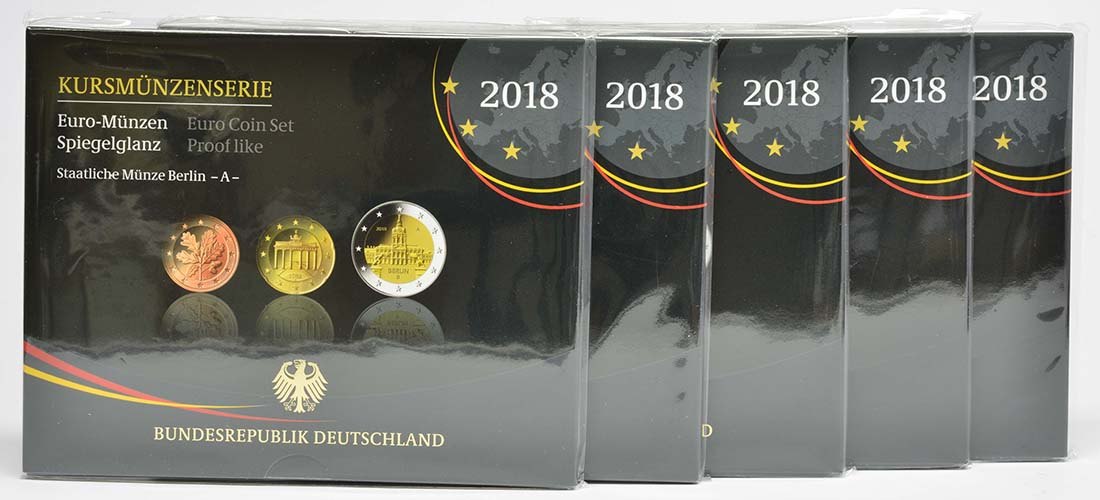
CC 300 2018
Coin set
Proof
Coin set proof
Germany · Berlin, Charlottenburg Palace
Mintage104,000
Issue price€24.50
Issue date30 Jan 2018
PackagingCoin set
Edge letteringEINIGKEIT UND RECHT UND FREIHEIT + Federal Eagle
Price of the set (2 coins)€139.00
Mintage information from source: 24000 | 20000
Varieties
5Germany, A · A · Mint mark A · Proof · Coin set · Mintage 24,000
Germany, D · D · Mint mark D · Proof · Coin set · Mintage 20,000
Germany, F · F · Mint mark F · Proof · Coin set · Mintage 20,000
Germany, G · G · Mint mark G · Proof · Coin set · Mintage 20,000
Germany, J · J · Mint mark J · Proof · Coin set · Mintage 20,000
Issue occasion
The commemorative coin honours Berlin as part of the “Federal States Series”. The design shows the main building of Schloss Charlottenburg with the Ehrenhof in front of it, as well as the inscription “BERLIN”.
The design
The coin motif is the main building of Schloss Charlottenburg with the ceremonial courtyard in front of it. In the inner part of the coin, the inscription “BERLIN” can be seen at the bottom, with the mint mark of the respective mint (“A”, “D”, “F”, “G” or “J”) below it. The country code “D” of the issuing country is shown at the top right, and the year of issue “2018” is inscribed at the top left. The engraver’s mark is located at the bottom left.
The twelve stars of the European flag are depicted on the outer ring of the coin.
The twelve stars of the European flag are depicted on the outer ring of the coin.
Background on the topic
Schloss Charlottenburg originated as a summer residence for Sophie Charlotte, the wife of the Brandenburg Elector Friedrich III. From 1695, he had the building erected in the then village of Lietzow west of Berlin. The complex was initially called Lietzenburg. After Friedrich became Friedrich I, King in Prussia, in 1701, the residence was expanded. Following Sophie Charlotte’s death, it was given the name Charlottenburg in 1705.
Under several Prussian rulers, further sections of the building and garden areas were added. In the 18th century, Friedrich II had the New Wing built. As a result, the original summer residence developed into an extensive palace complex whose architecture reflects various periods of Brandenburg-Prussian history. The settlement of Charlottenburg also grew in its surroundings; it later became an independent city and was incorporated into Groß-Berlin in 1920.
During the Second World War, the palace was severely damaged by air raids. After 1945, a decision was made against demolition and in favour of reconstruction, which continued over several decades. Today, parts of the complex are used as museums. They include historical room sequences, art collections and furnishings from the milieu of the Prussian monarchy. The palace thus commemorates both the residential culture of the Hohenzollern and the treatment of war-damaged architecture in the post-war period.
The first German Federal States series was based on the rotating presidency of the Bundesrat. In this constitutional body, the governments of the Länder participate in the legislation and administration of the Federation. For each Land, a building or landmark with a regional connection was selected. Berlin held the presidency of the Bundesrat from November 2017 to October 2018. In this context, Schloss Charlottenburg was selected as a building historically closely connected with the development of the city and its former role as a Prussian residence.
Under several Prussian rulers, further sections of the building and garden areas were added. In the 18th century, Friedrich II had the New Wing built. As a result, the original summer residence developed into an extensive palace complex whose architecture reflects various periods of Brandenburg-Prussian history. The settlement of Charlottenburg also grew in its surroundings; it later became an independent city and was incorporated into Groß-Berlin in 1920.
During the Second World War, the palace was severely damaged by air raids. After 1945, a decision was made against demolition and in favour of reconstruction, which continued over several decades. Today, parts of the complex are used as museums. They include historical room sequences, art collections and furnishings from the milieu of the Prussian monarchy. The palace thus commemorates both the residential culture of the Hohenzollern and the treatment of war-damaged architecture in the post-war period.
The first German Federal States series was based on the rotating presidency of the Bundesrat. In this constitutional body, the governments of the Länder participate in the legislation and administration of the Federation. For each Land, a building or landmark with a regional connection was selected. Berlin held the presidency of the Bundesrat from November 2017 to October 2018. In this context, Schloss Charlottenburg was selected as a building historically closely connected with the development of the city and its former role as a Prussian residence.