
 Deutsch
 English
 Français
 Español
 Italiano
 Nederlands
 Português
 Slovenčina
 Hrvatski
 Slovenščina
 Lietuvių
 Eesti
Eesti Български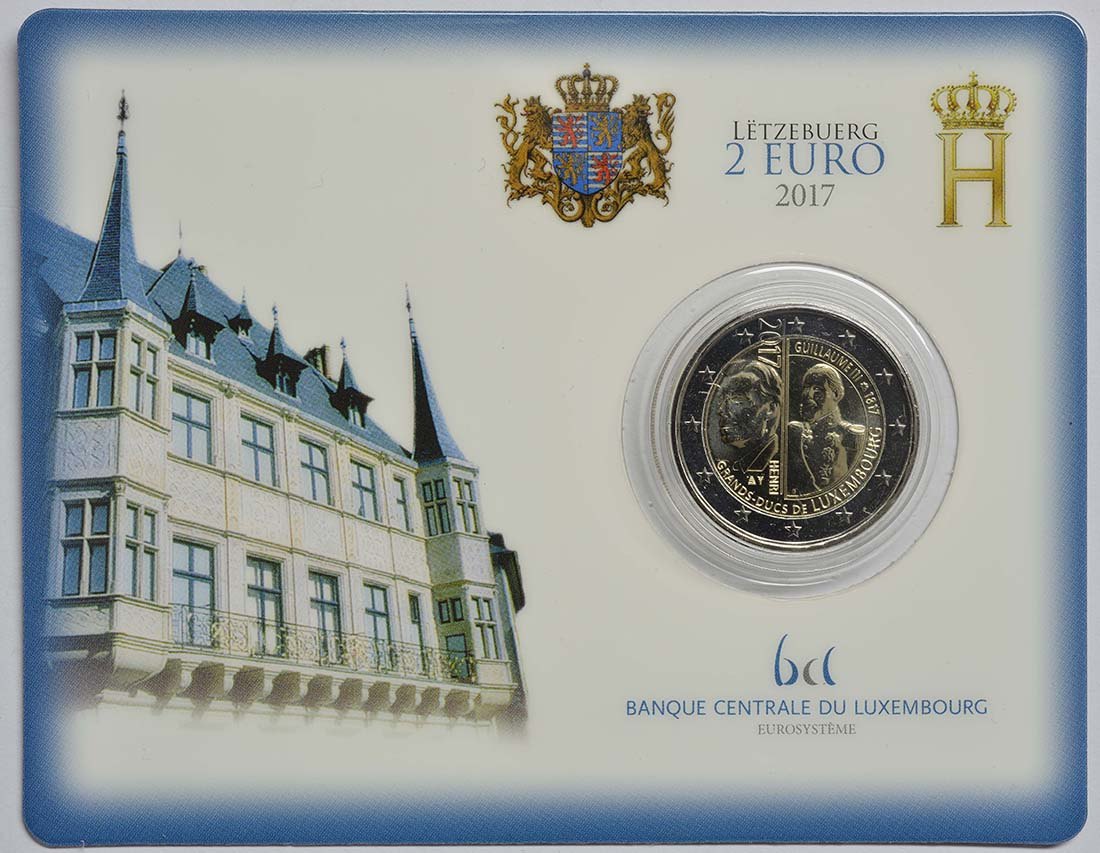

CC 287 2017
Coincard
BU
Coincard
Luxembourg · 200th anniversary of the birth of Grand Duke Wilhelm III
Mintage7,500
Issue price€10.00
Issue date26 Oct 2017
PackagingCoincard
Edge lettering2 ★ ★ × 6, alternating upright/inverted
Market price€19.90
Issue occasion
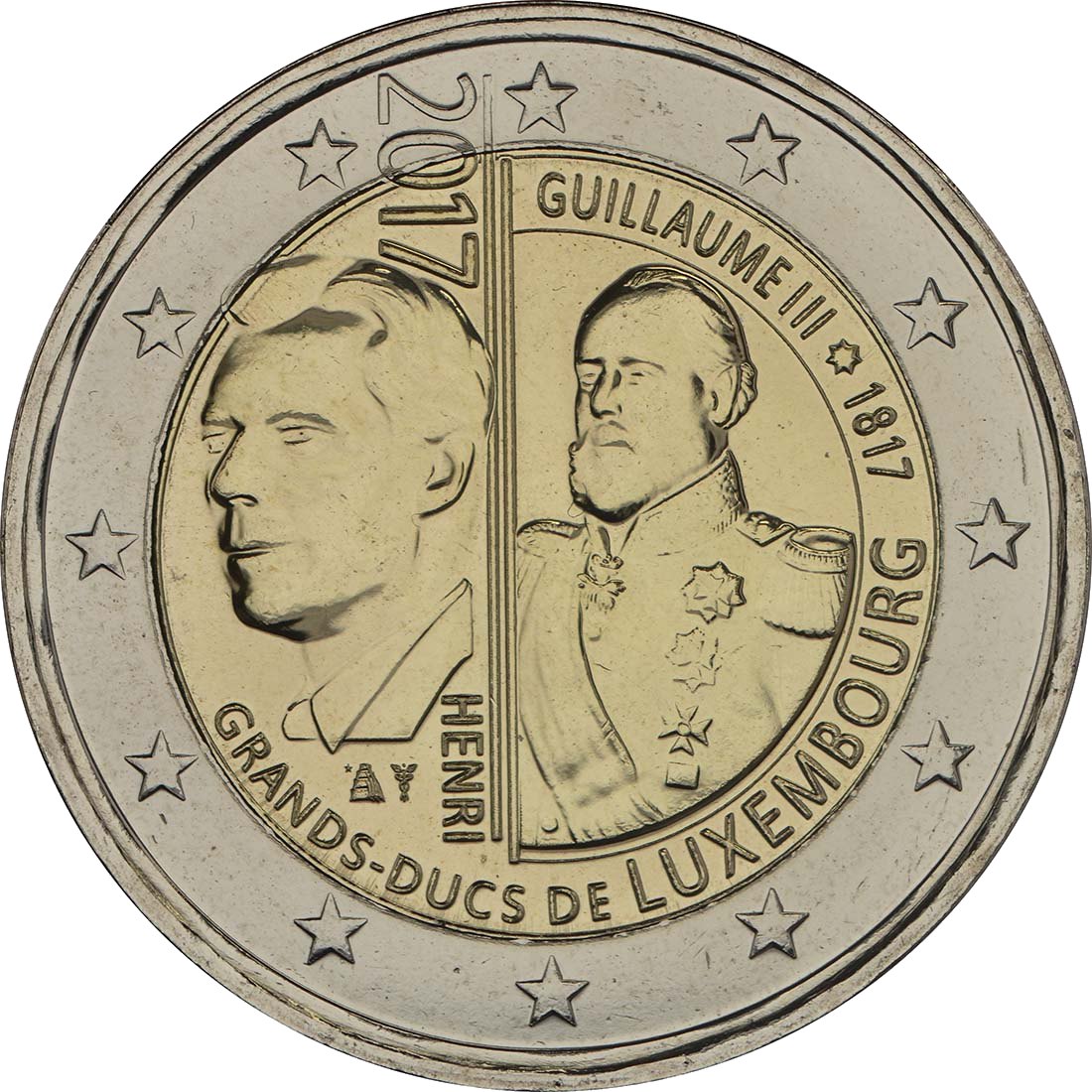
The commemorative coin marks the 200th birthday of Grand Duke Guillaume III. The design shows Grand Duke Henri in left profile on the left and Grand Duke Wilhelm III on the right; it also features the year “2017”, the inscription “GRANDS-DUCS DE LUXEMBOURG”, and the name “GUILLAUME III” with the year “*1817”.
The design
The coin design shows on the left the portrait of His Royal Highness Grand Duke Henri in left profile and on the right the portrait of His Royal Highness Grand Duke Guillaume III. The year “2017” appears at the top of the design. The text “GRANDS-DUCS DE LUXEMBOURG” (Grand Dukes of Luxembourg) can be read in the lower part. Above the right-hand portrait is the name “GUILLAUME III” (William III), supplemented by the year “*1817”.
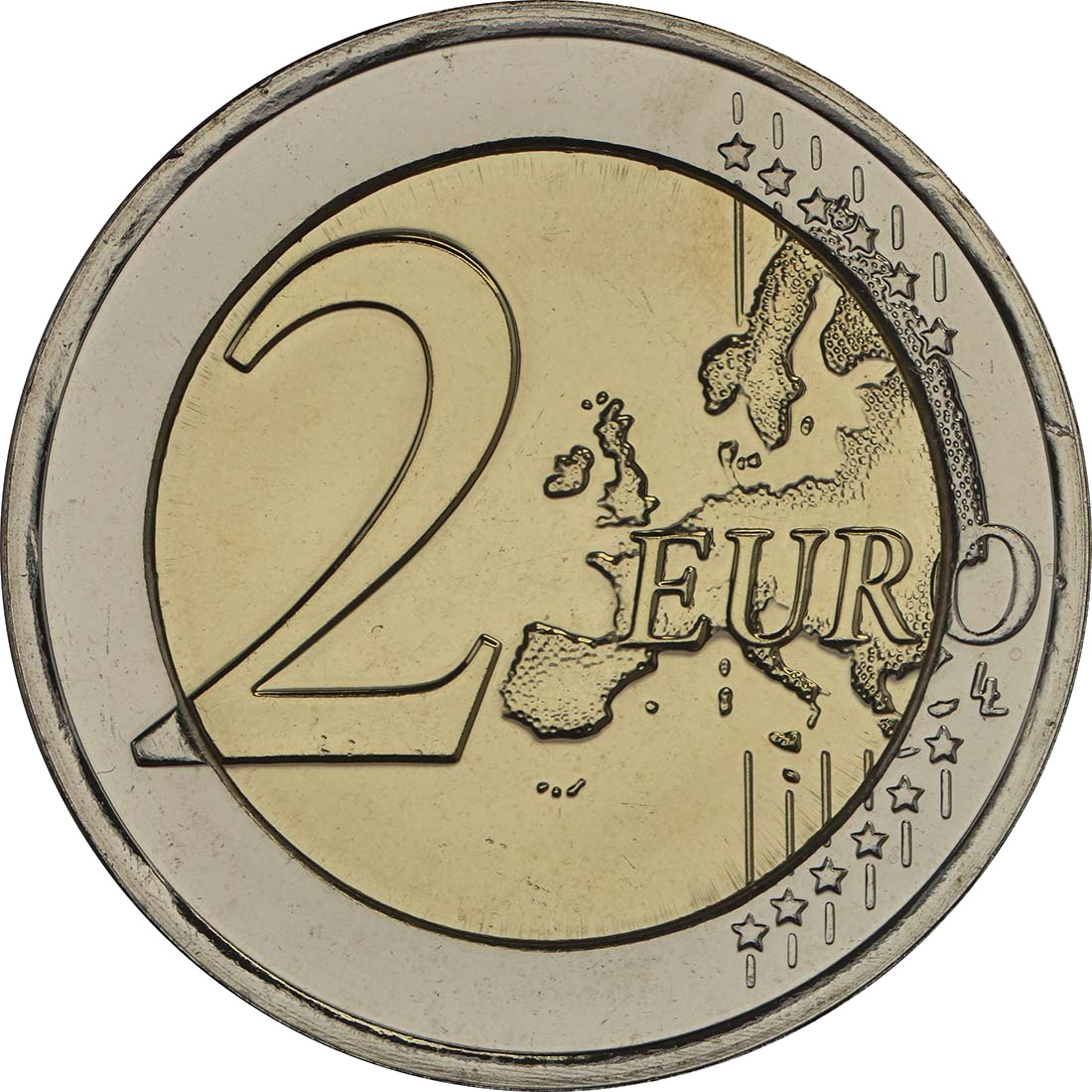
The twelve stars of the European flag are depicted on the outer ring of the coin.
The twelve stars of the European flag are depicted on the outer ring of the coin.
Background on the topic
Wilhelm III was born in 1817 as the son of the future Dutch King Wilhelm II and the Russian Grand Duchess Anna Pawlowna. From 1849 until his death in 1890, he was King of the Netherlands and, at the same time, Grand Duke of Luxembourg. At that time, the two countries were connected by a personal union: they had the same head of state but remained legally independent states. This union had been established in 1815 as a result of the reorganization of Europe after the Napoleonic Wars.
His reign coincided with a period in which Luxembourg’s position as a state was changing. A conflict between Wilhelm III and the country’s liberal forces led to a restriction of the 1848 constitution in 1856. At the same time, a Staatsrat was established. Later constitutional amendments reversed some of these interventions.
In 1867, Luxembourg was at the center of a European crisis. France wanted to acquire the Grand Duchy from Wilhelm III, while Prussia opposed this. One factor behind this was the Prussian garrison in the Festung Luxemburg. The Treaty of London of 1867 ultimately confirmed the country’s permanent neutrality. The fortifications were largely dismantled, and the Prussian troops withdrew. Under Wilhelm III, Luxembourg remained an independent grand duchy.
His death in 1890 brought the personal union to an end. In the Netherlands, he was succeeded by his daughter Wilhelmina. In Luxembourg, however, male succession applied under the Nassau house treaties, so Duke Adolf of Nassau became grand duke. The Luxembourgish crown thereby passed to the Nassau-Weilburg line, to which the present Grand Duke Henri also belongs.
The anniversary thus provided an opportunity to commemorate a former holder of the Luxembourgish crown and, at the same time, the era of the Dutch-Luxembourgish personal union. The juxtaposition with the present head of state points to the continued existence of the grand duchy despite the dynastic change of 1890.
His reign coincided with a period in which Luxembourg’s position as a state was changing. A conflict between Wilhelm III and the country’s liberal forces led to a restriction of the 1848 constitution in 1856. At the same time, a Staatsrat was established. Later constitutional amendments reversed some of these interventions.
In 1867, Luxembourg was at the center of a European crisis. France wanted to acquire the Grand Duchy from Wilhelm III, while Prussia opposed this. One factor behind this was the Prussian garrison in the Festung Luxemburg. The Treaty of London of 1867 ultimately confirmed the country’s permanent neutrality. The fortifications were largely dismantled, and the Prussian troops withdrew. Under Wilhelm III, Luxembourg remained an independent grand duchy.
His death in 1890 brought the personal union to an end. In the Netherlands, he was succeeded by his daughter Wilhelmina. In Luxembourg, however, male succession applied under the Nassau house treaties, so Duke Adolf of Nassau became grand duke. The Luxembourgish crown thereby passed to the Nassau-Weilburg line, to which the present Grand Duke Henri also belongs.
The anniversary thus provided an opportunity to commemorate a former holder of the Luxembourgish crown and, at the same time, the era of the Dutch-Luxembourgish personal union. The juxtaposition with the present head of state points to the continued existence of the grand duchy despite the dynastic change of 1890.