
 Deutsch
 English
 Français
 Español
 Italiano
 Nederlands
 Português
 Slovenčina
 Hrvatski
 Slovenščina
 Lietuvių
 Eesti
Eesti Български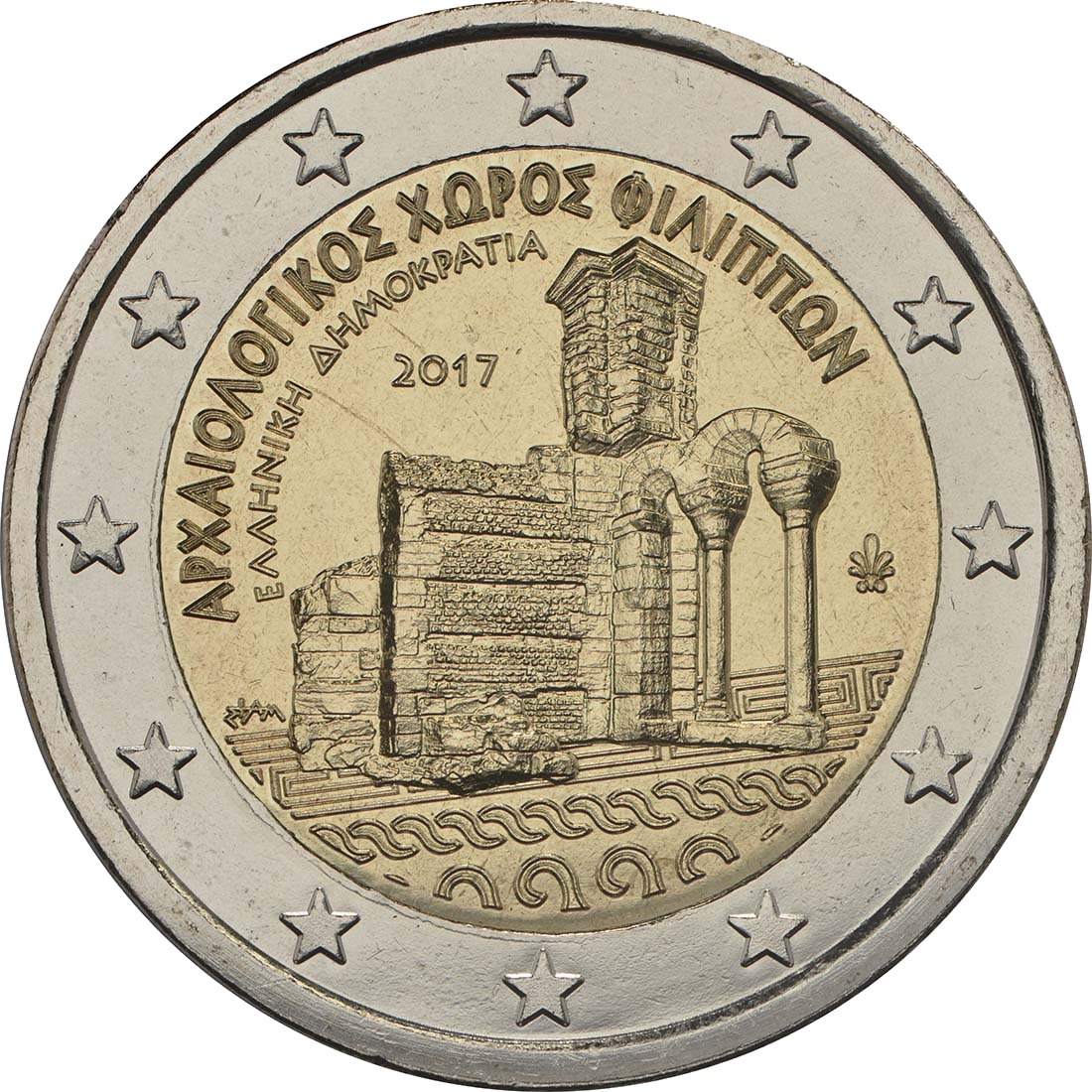

CC 285 2017
2 euro coin
BU Main coin Bank issue
2 Euro BU
Greece · Archaeological Sites of Philippi
Mintage744,000
Issue date12 Oct 2017
Edge letteringΕΛΛΗΝΙΚΗ ΔΗΜΟΚΡΑΤΙΑ + ★
Market price€5.90
Issue occasion
The commemorative coin is dedicated to the Archaeological Site of Philippi. The design depicts part of Basilica B as well as linear patterns modelled on the border pattern of an ancient Greek mosaic discovered there. Along the inner circle are the inscriptions “ARCHAEOLOGICAL SITE OF PHILIPPI” and “HELLENIC REPUBLIC” in Greek.
The design
The inner part of the coin depicts part of Basilica B, as well as linear patterns inspired by the border pattern of an ancient Greek mosaic discovered at the archaeological site. Along the inner circle, the inscriptions “ARCHAEOLOGICAL SITE OF PHILIPPI” and “HELLENIC REPUBLIC” (in Greek) can be read. The year of issue “2017” is also engraved in the background, together with a palmette to the right of the coin design, the mintmark of the Greek mint. The coin designer’s monogram (George Stamatopoulos) is located at the bottom left.
The outer ring of the coin depicts the twelve stars of the European flag.
The outer ring of the coin depicts the twelve stars of the European flag.
Background on the topic
Philippi lies in northeastern Greece near present-day Kavala. The settlement was founded in the 4th century BC, initially under the name Krenides, by colonists from Thasos. Shortly thereafter, the Macedonian king Philipp II brought the settlement under his control and named it after himself. The nearby gold deposits and the strategic location between Macedonia and Thrace were among the decisive factors.
In Roman times, Philippi lay on the Via Egnatia, an important transportation route connecting the Adriatic coast with the region around Byzantium. In 42 BC, the Battle of Philippi took place in the surrounding area. Marcus Antonius and Octavian defeated the troops of Brutus and Cassius, who had been involved in the assassination of Caesar. Philippi was subsequently developed as a Roman colony. Veterans were given land, while the city administration and architecture were modelled on Roman examples.
The site also plays a role in the history of early Christianity. The Apostle Paul came to Philippi in the 1st century AD and founded a Christian community there. It is traditionally regarded as one of the first Christian communities on European soil. The Epistle to the Philippians, preserved in the New Testament, is addressed to this community. Several church buildings were constructed in Late Antiquity, reflecting the transformation of the Roman city into a Christian centre.
Basilica B was built in the 6th century. It is a large early Christian church with several naves and a domed structure. Its architecture combines the basilica form with centralising architectural elements of the kind used in the Eastern Roman sacred architecture of the period.
The coin issue is connected in time with the inclusion of the archaeological site of Philippi on the UNESCO World Heritage List in 2016. The site documents several historical layers within a coherent spatial context: the Macedonian foundation of the city, the Roman colony and early Christian Philippi.
In Roman times, Philippi lay on the Via Egnatia, an important transportation route connecting the Adriatic coast with the region around Byzantium. In 42 BC, the Battle of Philippi took place in the surrounding area. Marcus Antonius and Octavian defeated the troops of Brutus and Cassius, who had been involved in the assassination of Caesar. Philippi was subsequently developed as a Roman colony. Veterans were given land, while the city administration and architecture were modelled on Roman examples.
The site also plays a role in the history of early Christianity. The Apostle Paul came to Philippi in the 1st century AD and founded a Christian community there. It is traditionally regarded as one of the first Christian communities on European soil. The Epistle to the Philippians, preserved in the New Testament, is addressed to this community. Several church buildings were constructed in Late Antiquity, reflecting the transformation of the Roman city into a Christian centre.
Basilica B was built in the 6th century. It is a large early Christian church with several naves and a domed structure. Its architecture combines the basilica form with centralising architectural elements of the kind used in the Eastern Roman sacred architecture of the period.
The coin issue is connected in time with the inclusion of the archaeological site of Philippi on the UNESCO World Heritage List in 2016. The site documents several historical layers within a coherent spatial context: the Macedonian foundation of the city, the Roman colony and early Christian Philippi.
eBay price analysis
For this issue, there is a price history based on actual eBay sales – with median, range and number of sales
View price analysis