
 Deutsch
 English
 Français
 Español
 Italiano
 Nederlands
 Português
 Slovenčina
 Hrvatski
 Slovenščina
 Lietuvių
 Eesti
Eesti Български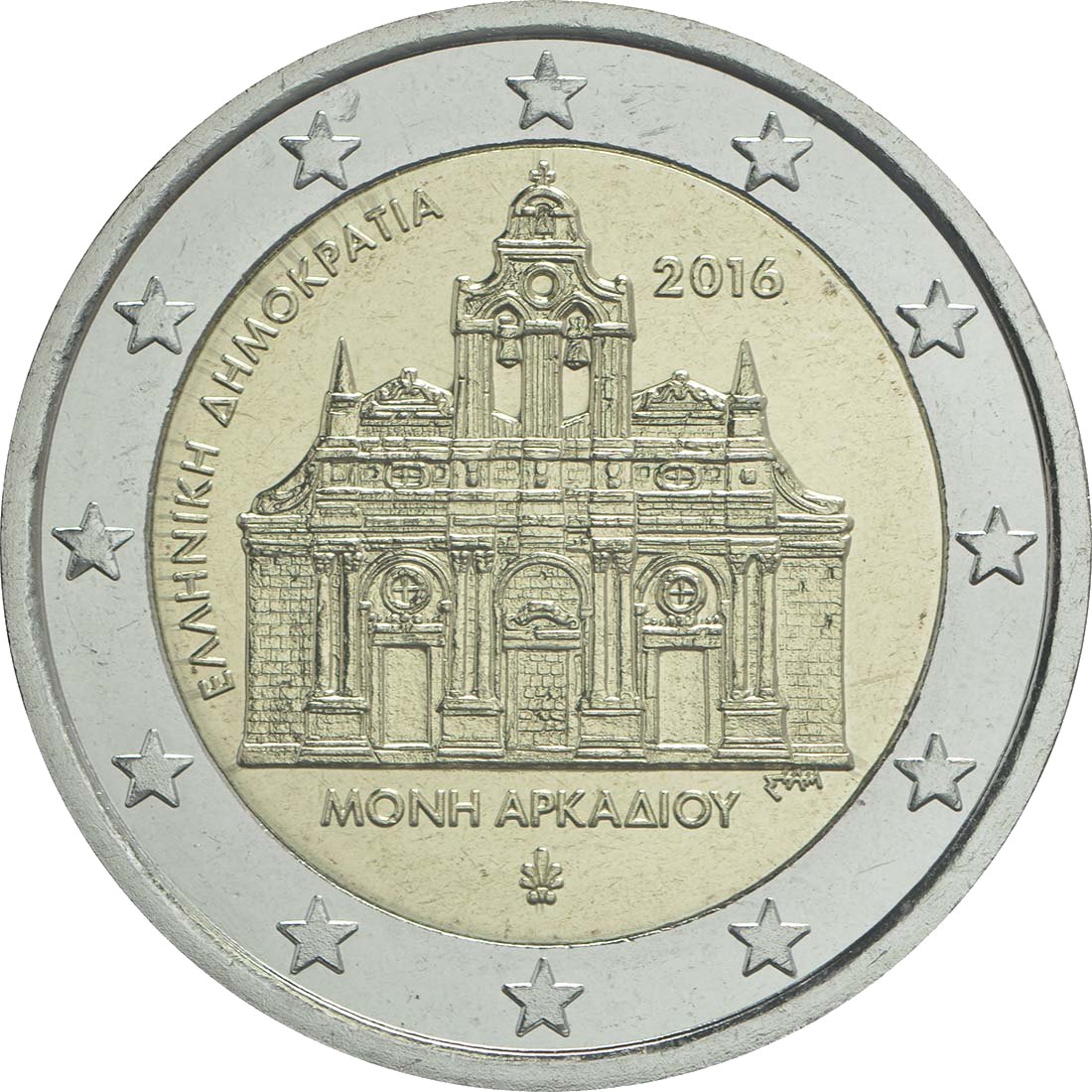
CC 260 2016
2 euro coin
BU Main coin Bank issue
2 Euro BU
Greece · 150th anniversary of the arson at Arkadi Monastery
Mintage742,000
Issue date16 Dec 2016
Edge letteringΕΛΛΗΝΙΚΗ ΔΗΜΟΚΡΑΤΙΑ + ★
Market price€6.90
Issue occasion
The coin commemorates the 150th anniversary of the arson at Arkadi Monastery. The design depicts the monastery with the Greek inscription “ARKADI MONASTERY” below it. The design is completed by the inscription “HELLENIC REPUBLIC”, a palmette as the mint mark, and the monogram of the coin designer George Stamatopoulos.
The design
The design shows the Arkadi Monastery and, below it, the inscription “ARKADI MONASTERY” in Greek. Along the left edge of the coin, also in Greek, “Hellenic Republic” can be read. The year of issue “2016” is located at the top right, and a palmette, the mintmark of the Greek mint, is centered along the lower edge of the coin. The monogram of the coin designer (George Stamatopoulos) can be seen at the bottom right.
The twelve stars of the European flag are depicted on the outer ring of the coin.
The twelve stars of the European flag are depicted on the outer ring of the coin.
Background on the topic
The Orthodox Arkadi Monastery lies southeast of Rethymno in Crete. The monastery complex acquired substantial parts of its present appearance during Venetian rule over the island. It is surrounded by a fortified perimeter wall and has a two-nave church building with a Renaissance façade. In addition to its religious function, the monastery at times served as a place of refuge and as a center of resistance against Ottoman rule.
Crete had belonged to the Ottoman Empire since the second half of the 17th century. In the 19th century, the predominantly Greek Orthodox population repeatedly rose up. Many insurgents demanded political self-determination or the island’s incorporation into the already independent Kingdom of Greece. During the Cretan uprising of 1866, armed fighters barricaded themselves in Arkadi Monastery. At the same time, numerous civilians, including women and children, sought refuge there.
In November 1866, the complex was besieged by Ottoman troops and eventually stormed. When the defense collapsed, the monastery’s powder magazine exploded. According to tradition, the gunpowder was deliberately ignited to prevent capture. Many of those trapped inside as well as attacking soldiers were killed. The precise sequence of events and the number of victims are given differently in various accounts. In Greece, the event is generally referred to as the “Holocaust of Arkadi”; here, the term refers to self-sacrifice by fire.
The destruction of the monastery did not end the uprising, but it attracted considerable attention outside Crete and strengthened support for the Cretan autonomy movement. Unification with Greece took place only decades later, in 1913. Arkadi thereby became a site of remembrance for Cretan resistance and the history of Greek independence. The choice of the coin’s subject is explained by this national culture of remembrance and the milestone anniversary of the event.
Crete had belonged to the Ottoman Empire since the second half of the 17th century. In the 19th century, the predominantly Greek Orthodox population repeatedly rose up. Many insurgents demanded political self-determination or the island’s incorporation into the already independent Kingdom of Greece. During the Cretan uprising of 1866, armed fighters barricaded themselves in Arkadi Monastery. At the same time, numerous civilians, including women and children, sought refuge there.
In November 1866, the complex was besieged by Ottoman troops and eventually stormed. When the defense collapsed, the monastery’s powder magazine exploded. According to tradition, the gunpowder was deliberately ignited to prevent capture. Many of those trapped inside as well as attacking soldiers were killed. The precise sequence of events and the number of victims are given differently in various accounts. In Greece, the event is generally referred to as the “Holocaust of Arkadi”; here, the term refers to self-sacrifice by fire.
The destruction of the monastery did not end the uprising, but it attracted considerable attention outside Crete and strengthened support for the Cretan autonomy movement. Unification with Greece took place only decades later, in 1913. Arkadi thereby became a site of remembrance for Cretan resistance and the history of Greek independence. The choice of the coin’s subject is explained by this national culture of remembrance and the milestone anniversary of the event.
eBay price analysis
For this issue, there is a price history based on actual eBay sales – with median, range and number of sales
View price analysis