
 Deutsch
 English
 Français
 Español
 Italiano
 Nederlands
 Português
 Slovenčina
 Hrvatski
 Slovenščina
 Lietuvių
 Eesti
Eesti Български
CC 25 2007
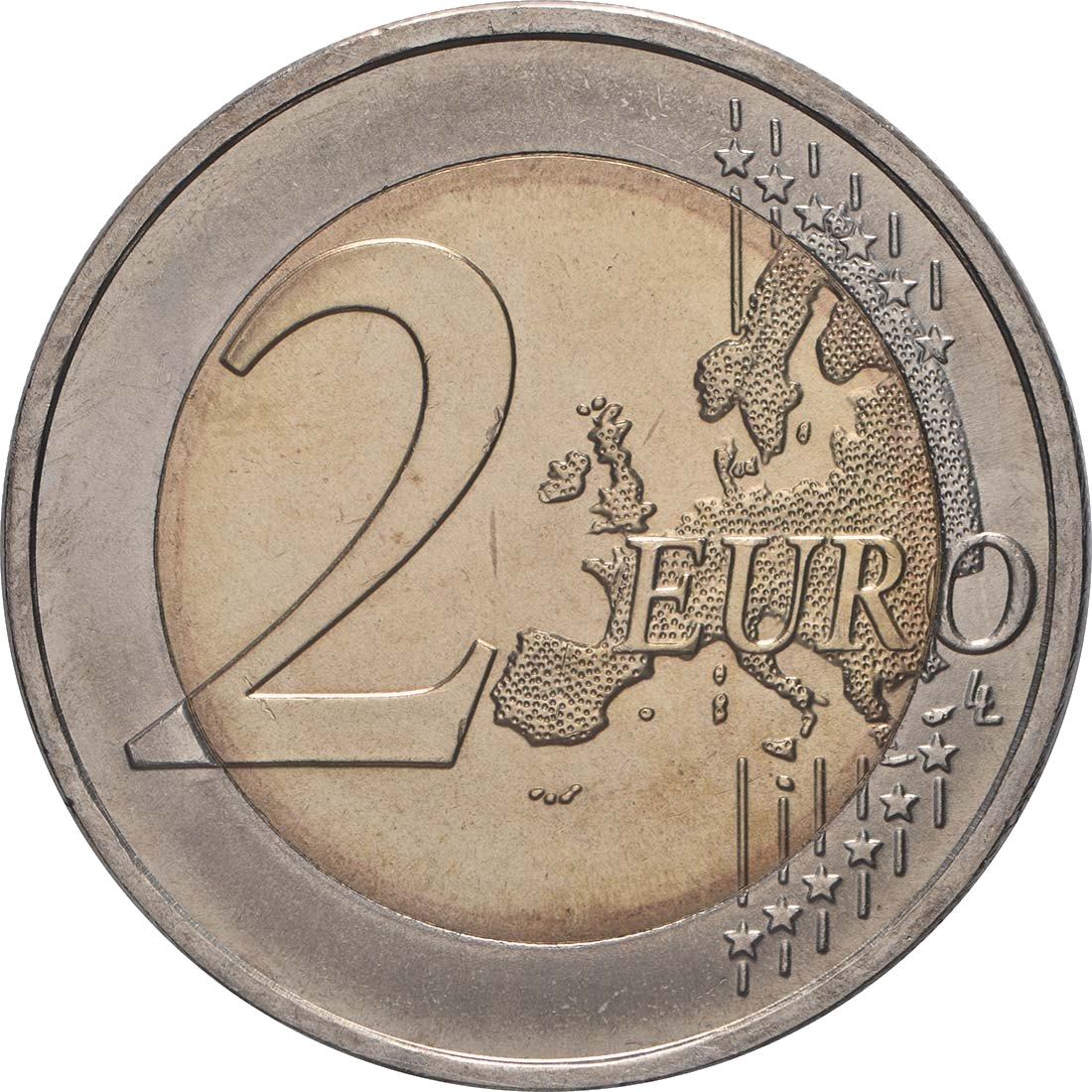
2 euro coin
BU Mint mark A/D/F/G/J Main coin Bank issue
2 Euro BU
Germany · 50 years of the Treaties of Rome
Mintage30,000,000
Issue date25 Mar 2007
Edge letteringEINIGKEIT UND RECHT UND FREIHEIT + Federal Eagle
Market price€5.00
Mintage information from source: 1000000 | 14500000 | 8000000 | 5000000 | 1500000
Varieties
5Germany, A · A · Mint mark A · BU · Mintage 1,000,000
Germany, D · D · Mint mark D · BU · Mintage 14,500,000
Germany, F · F · Mint mark F · BU · Mintage 8,000,000
Germany, G · G · Mint mark G · BU · Mintage 5,000,000
Germany, J · J · Mint mark J · BU · Mintage 1,500,000
Issue occasion
The commemorative coin marks the 50th anniversary of the signing of the Treaty of Rome, which the six founding members signed in Rome on 25 March 1957. The design shows the treaty document in front of the star-shaped paving of Piazza del Campidoglio designed by Michelangelo, as well as the inscription “Europa” and the twelve stars of the European Union. On the Luxembourg issue, the portrait of Grand Duke Henri additionally overlaps the left side of the design as a latent image effect.
The design
The coin’s centre depicts the treaty document signed by the six founding members, against the background of the star-shaped street paving of the Piazza del Campidoglio in Rome, designed by Michelangelo, where the treaty was signed on 25 March 1957. The word “Europe” is embossed directly above the treaty document in the respective language. The inscription above the overall design indicates the occasion for the issue, while the inscription below gives the issuing country in the respective language version(s), along with the year 2007. The coin’s outer ring bears the twelve stars of the European Union.
Background on the topic
The “Treaties of Rome (Römischen Verträge)” refer to two agreements: the Treaty establishing the European Economic Community (EEC) and the Treaty establishing the European Atomic Energy Community (Euratom). The contracting parties were Belgium, the Federal Republic of Germany (Bundesrepublik Deutschland), France, Italy, Luxembourg and the Netherlands. Both treaties entered into force in 1958.
The EEC was intended to create a common market. This included the gradual removal of customs duties between the member states, a common external tariff, and the free movement of persons, goods, services and capital. There were also common regulations, among other areas, for agriculture, transport and competition. Institutions such as the Commission, the Council of Ministers, the Parliamentary Assembly and the Court of Justice made it possible to adopt binding decisions not only through traditional cooperation between governments, but also through Community institutions.
Euratom was intended to coordinate the peaceful use of nuclear energy. Its provisions included joint research, safety controls for nuclear materials and rules governing the supply of nuclear raw materials. While the EEC later became the European Community and eventually formed part of the European Union, Euratom continues to exist on its own treaty basis.
The treaties built on the European Coal and Steel Community (Europäische Gemeinschaft für Kohle und Stahl), founded in 1951. After the Second World War, economic interdependence was intended in particular to ensure lasting cooperation between France and the Federal Republic of Germany. At the same time, in the context of the Cold War, the Western European states were seeking closer political and economic cooperation. The Treaties of Rome extended this approach from individual industries to large parts of the economy.
The venue on the Capitoline Hill was also historically significant: the signing took place at the Palazzo dei Conservatori, part of today’s Capitoline Museums (Kapitolinischen Museums). For the anniversary, the euro-area countries issued 2-euro commemorative coins jointly for the first time, bearing the same basic design. This linked the treaty-based origins of European economic integration with the common currency as a later result of this integration process.
The EEC was intended to create a common market. This included the gradual removal of customs duties between the member states, a common external tariff, and the free movement of persons, goods, services and capital. There were also common regulations, among other areas, for agriculture, transport and competition. Institutions such as the Commission, the Council of Ministers, the Parliamentary Assembly and the Court of Justice made it possible to adopt binding decisions not only through traditional cooperation between governments, but also through Community institutions.
Euratom was intended to coordinate the peaceful use of nuclear energy. Its provisions included joint research, safety controls for nuclear materials and rules governing the supply of nuclear raw materials. While the EEC later became the European Community and eventually formed part of the European Union, Euratom continues to exist on its own treaty basis.
The treaties built on the European Coal and Steel Community (Europäische Gemeinschaft für Kohle und Stahl), founded in 1951. After the Second World War, economic interdependence was intended in particular to ensure lasting cooperation between France and the Federal Republic of Germany. At the same time, in the context of the Cold War, the Western European states were seeking closer political and economic cooperation. The Treaties of Rome extended this approach from individual industries to large parts of the economy.
The venue on the Capitoline Hill was also historically significant: the signing took place at the Palazzo dei Conservatori, part of today’s Capitoline Museums (Kapitolinischen Museums). For the anniversary, the euro-area countries issued 2-euro commemorative coins jointly for the first time, bearing the same basic design. This linked the treaty-based origins of European economic integration with the common currency as a later result of this integration process.
eBay price analysis
For this issue, there is a price history based on actual eBay sales – with median, range and number of sales
View price analysis