
 Deutsch
 English
 Français
 Español
 Italiano
 Nederlands
 Português
 Slovenčina
 Hrvatski
 Slovenščina
 Lietuvių
 Eesti
Eesti Български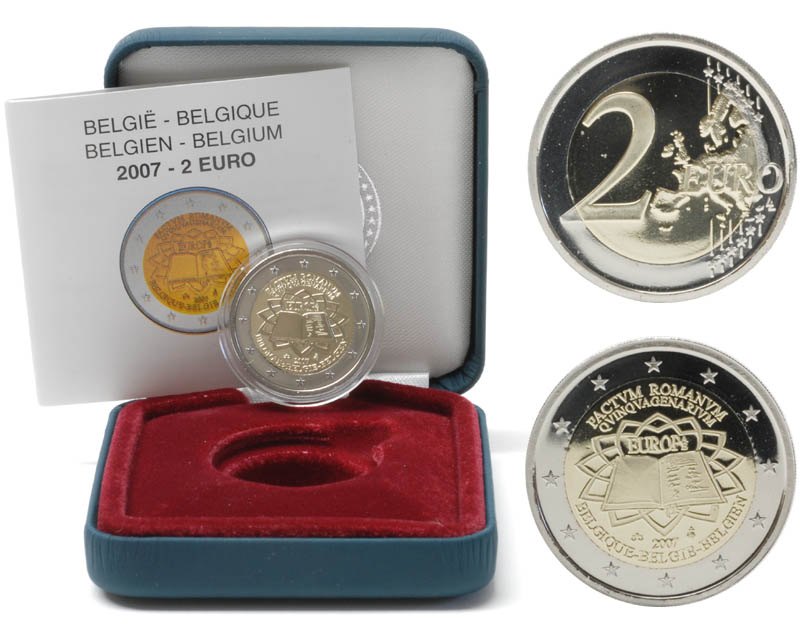
CC 24 2007
2 euro coin
Proof
2 Euro Proof
Belgium · 50 years of the Treaties of Rome
Mintage5,000
Issue price€18.50
Issue date25 Mar 2007
Packagingin case
Edge lettering2 ★ ★ × 6, alternating upright/inverted
Market price€59.00
Issue occasion
The commemorative coin marks the 50th anniversary of the signing of the Treaty of Rome, concluded by the six founding members in Rome on 25 March 1957. The design shows the signed treaty document against the star-shaped paving of the Piazza del Campidoglio, designed by Michelangelo, the place where it was signed. Above it is “Europe” in the respective national language; the occasion and country name complete the design.
The design
The coin features at its centre the treaty document signed by the six founding members, against the background of the star-shaped paving of the Piazza del Campidoglio in Rome, designed by Michelangelo, where the treaty was signed on 25 March 1957. Directly above the treaty document, the word “Europe” is inscribed in the respective language. The inscriptions above the overall design indicate the occasion for issue, and those below indicate the issuing country in the respective language(s), together with the year 2007. The outer ring of the coin bears the twelve stars of the European Union.
Background on the topic
The expression “Treaties of Rome (Römische Verträge)” refers to two agreements: the Treaty establishing the European Economic Community (EEC) and the Treaty establishing the European Atomic Energy Community (Euratom). The parties to the treaties were Belgium, the Federal Republic of Germany (Bundesrepublik Deutschland), France, Italy, Luxembourg and the Netherlands. Both treaties entered into force at the beginning of 1958.
European cooperation had already begun with the European Coal and Steel Community. It placed key raw materials of the armaments industry under joint control and was intended to make new military conflicts between the participating states more difficult. After more extensive plans for a European Defence Community had failed, integration shifted more towards economic and technical areas.
The EEC aimed to create a common market. Customs duties between the member states were to be gradually abolished, a common external tariff introduced, and obstacles to the cross-border movement of goods, persons, services and capital removed. At the same time, common rules and policy areas emerged, for example for agriculture, trade and competition. Euratom was intended to coordinate cooperation in the peaceful use of nuclear energy, promote research and monitor the supply of nuclear materials.
The EEC later developed into the European Community. Its institutions and legal order formed an essential component of the European Union. It was characterised by the fact that the member states permanently transferred certain competences to common institutions and that Community legal acts acquired binding force.
Capitoline Square (Kapitolsplatz) also refers to Rome as a historical and political point of reference. Capitoline Hill (Kapitolshügel) had been a centre of the city’s public life since antiquity. Its present-day square was redesigned by Michelangelo in the 16th century; parts of the design were not realised until considerably later.
For the anniversary, the states chose a common design for a 2-euro commemorative coin for the first time. This not only commemorated an anniversary of the treaties, but also represented the institutional cooperation that emerged from them through a coin circulating in several states.
European cooperation had already begun with the European Coal and Steel Community. It placed key raw materials of the armaments industry under joint control and was intended to make new military conflicts between the participating states more difficult. After more extensive plans for a European Defence Community had failed, integration shifted more towards economic and technical areas.
The EEC aimed to create a common market. Customs duties between the member states were to be gradually abolished, a common external tariff introduced, and obstacles to the cross-border movement of goods, persons, services and capital removed. At the same time, common rules and policy areas emerged, for example for agriculture, trade and competition. Euratom was intended to coordinate cooperation in the peaceful use of nuclear energy, promote research and monitor the supply of nuclear materials.
The EEC later developed into the European Community. Its institutions and legal order formed an essential component of the European Union. It was characterised by the fact that the member states permanently transferred certain competences to common institutions and that Community legal acts acquired binding force.
Capitoline Square (Kapitolsplatz) also refers to Rome as a historical and political point of reference. Capitoline Hill (Kapitolshügel) had been a centre of the city’s public life since antiquity. Its present-day square was redesigned by Michelangelo in the 16th century; parts of the design were not realised until considerably later.
For the anniversary, the states chose a common design for a 2-euro commemorative coin for the first time. This not only commemorated an anniversary of the treaties, but also represented the institutional cooperation that emerged from them through a coin circulating in several states.
eBay price analysis
For this issue, there is a price history based on actual eBay sales – with median, range and number of sales
View price analysis