
 Deutsch
 English
 Français
 Español
 Italiano
 Nederlands
 Português
 Slovenčina
 Hrvatski
 Slovenščina
 Lietuvių
 Eesti
Eesti Български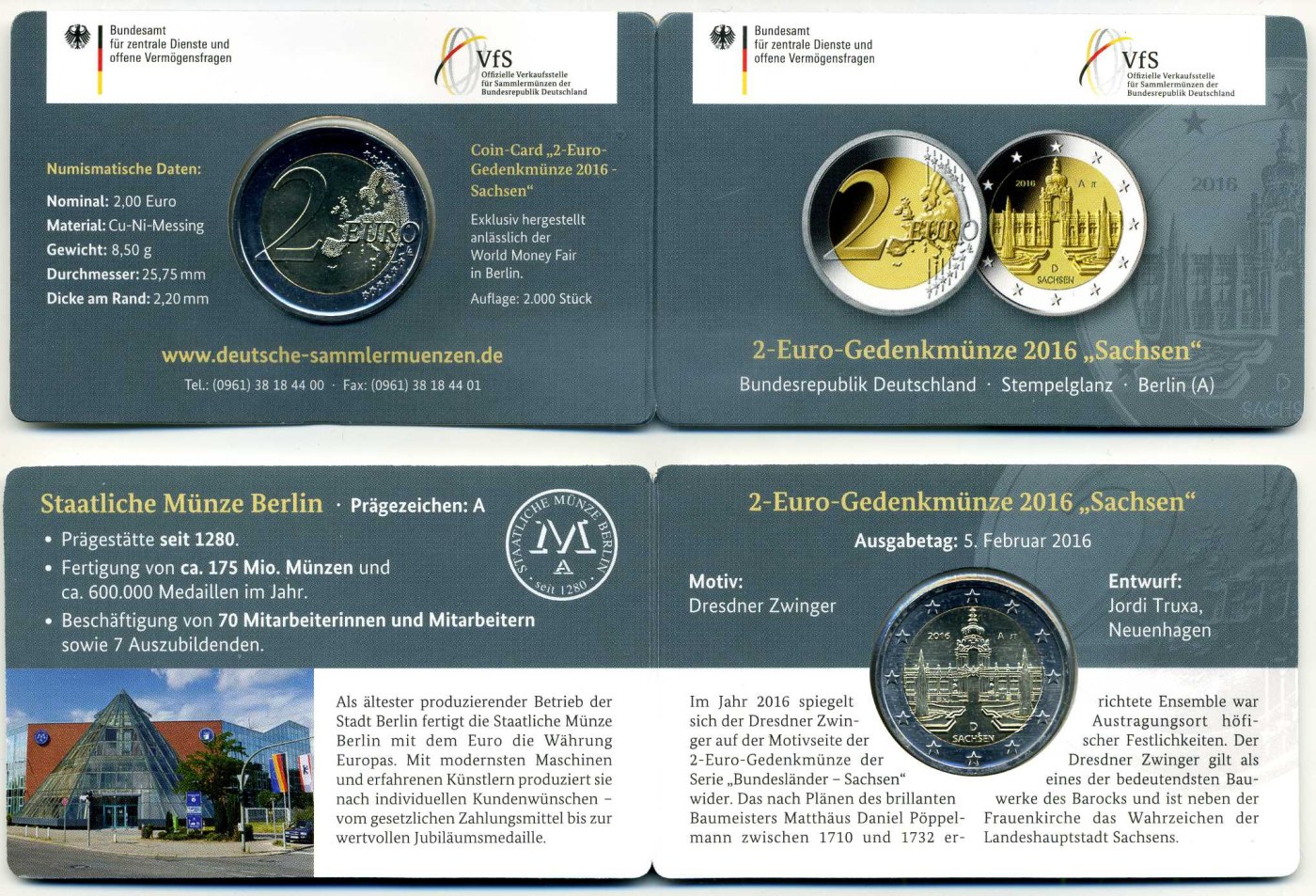

CC 235 2016
Coincard
BU
Coincard
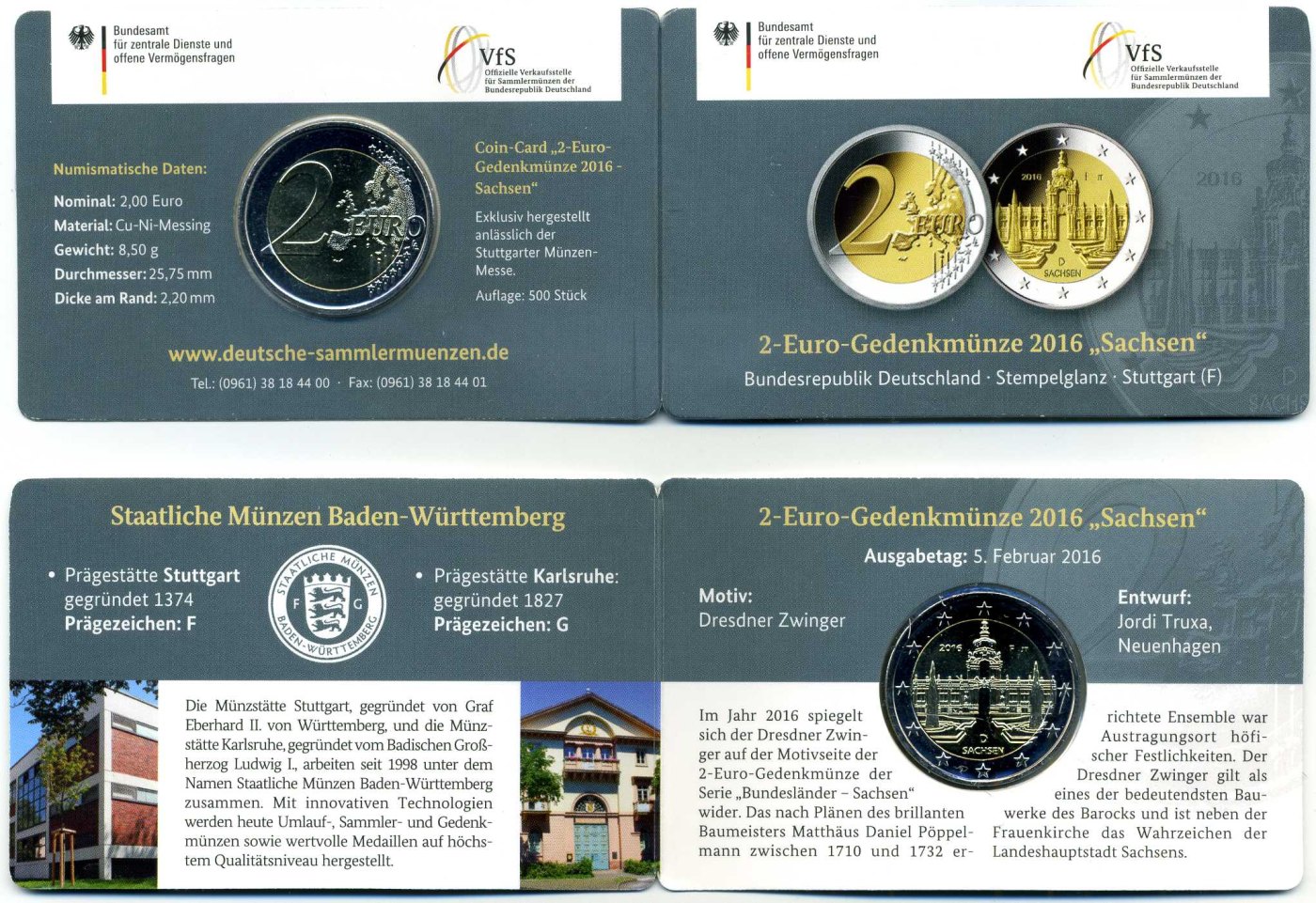
Germany · Saxony, Dresdner Zwinger
Mintage3,500
Issue price€4.90
Issue date5 Feb 2016
PackagingCoincard
Edge letteringEINIGKEIT UND RECHT UND FREIHEIT + Federal Eagle
Mintage information from source: 2000 | 1000 | 500
Varieties
3Germany, A · A · Mint mark A · Coincard · Mintage 2,000
Germany, D · D · Mint mark D · Coincard · Mintage 1,000
Germany, F · F · Mint mark F · Coincard · Mintage 500
Issue occasion
The commemorative coin is dedicated to Saxony as part of the “Federal States series”. The design shows a view from the inner courtyard of the Kronentor of the world-famous Dresdner Zwinger, as well as the inscription “SACHSEN”.
The design
The coin’s inner disc shows a view from the courtyard of the world-famous Dresdner Zwinger towards the Kronentor. It also shows the name “SACHSEN” and the country code of the issuing state, “D”, at the bottom; the mint mark of the respective mint (“A”, “D”, “F”, “G” or “J”) and the engraver’s mark (the initials “JT” — Jordi Truxa) at the upper right; and the year “2016” at the upper left.
The outer ring of the coin features the twelve stars of the European flag.
The outer ring of the coin features the twelve stars of the European flag.
Background on the topic
The Dresden Zwinger was built in the early 18th century during the reign of August the Strong, who was Elector of Saxony and also King of Poland. The complex was constructed according to plans by the architect Matthäus Daniel Pöppelmann; the sculptor Balthasar Permoser played a major role in creating its rich sculptural decoration. Originally, it served for court festivities, tournaments and housing delicate orange trees. The name “Zwinger” derives from fortress construction and refers to the space between two fortification walls.
The Kronentor belongs to the Baroque part of the complex. Its onion-shaped cupola is crowned by a replica of the Polish royal crown, thereby referring to the connection between the Saxon electorate and the Polish monarchy under August the Strong. The Zwinger was initially open towards the Elbe. It was not until the 19th century that the courtyard was enclosed by the Gemäldegalerie, built according to designs by Gottfried Semper.
Today, the building complex houses several collections of the Staatliche Kunstsammlungen Dresden. These include the Gemäldegalerie Alte Meister, the Porzellansammlung and the Mathematisch-Physikalischer Salon. The Zwinger was severely damaged in the air raids on Dresden in February 1945. Reconstruction began immediately after the end of the war; individual areas were gradually reopened for museums and visitors.
The German federal states series presented the states in the order of their presidencies in the Bundesrat. Saxony assumed the chairmanship for the 2015/2016 term of office according to the regular rotation. For each state, a building was generally selected that was closely associated with its history and public image. The Zwinger represents both the Baroque residential culture of the Saxon court and Dresden’s role as a city of museums and the arts. Its destruction and reconstruction also connect the building with the history of the city in the 20th century.
The Kronentor belongs to the Baroque part of the complex. Its onion-shaped cupola is crowned by a replica of the Polish royal crown, thereby referring to the connection between the Saxon electorate and the Polish monarchy under August the Strong. The Zwinger was initially open towards the Elbe. It was not until the 19th century that the courtyard was enclosed by the Gemäldegalerie, built according to designs by Gottfried Semper.
Today, the building complex houses several collections of the Staatliche Kunstsammlungen Dresden. These include the Gemäldegalerie Alte Meister, the Porzellansammlung and the Mathematisch-Physikalischer Salon. The Zwinger was severely damaged in the air raids on Dresden in February 1945. Reconstruction began immediately after the end of the war; individual areas were gradually reopened for museums and visitors.
The German federal states series presented the states in the order of their presidencies in the Bundesrat. Saxony assumed the chairmanship for the 2015/2016 term of office according to the regular rotation. For each state, a building was generally selected that was closely associated with its history and public image. The Zwinger represents both the Baroque residential culture of the Saxon court and Dresden’s role as a city of museums and the arts. Its destruction and reconstruction also connect the building with the history of the city in the 20th century.